Showing posts with label education. Show all posts

Tuesday, December 29

The 2010 municipal budget - good for the wealthy and who cares about the rest?

Yesterday evening the Tel Aviv - Yafo municipal council voted for the budget proposal for the year 2010: 
The coalition praised themselves for their great sensitivity and the wonderful budget proposal. That included Jaffa council member Ahmad Mashrawi (Meretz) who, like the total bunny he is,   voted in favour of a budget in which the south of the city, Jaffa included, continues to be discriminated against.
Mashrawi, who just loves publicity,  claims to vote in favour of  Jaffa but the facts show the opposite. Meretz are part of the coalition and their current track record is highly embarrassing.  


The outnumbered opposition (to Ron Hulday's wide coalition) asked to vote separately on a number of clauses, in order to try and make at least a few improvements and do some social justice:
Omar Siksik of the Jaffa list asked to vote separately for an added 200.000 NIS for the Jaffa based "Hirsh" early childhood development center. 
The Hirsch centre provides testing and treatment for development problems for children at a young age.   The centre is highly professional and the only service of its kind in the whole city able to provide these services in Arabic. The centre's very existence is threatened due to the continued budget cuts.  The implication of the centre's closure or limited ability to provide services is obvious: Parents will not be able to provide their young children with the most basic services. Not even privately (the majority would not have the money for that in any case) as their is no alternative in all of the city for Arabic speaking young children. 
Mashrawi (Meretz, that supposedly socially conscious party, now part of the coalition, what will people do for a little money) has been posing as the big fighter for the Hirsch centre, but reality is rather different as he did NOT vote in favour. He abstained, what a hero!


A city that spends 70 million NIS on a bicycle rental project does not have 1.100.000 for the Hirsch center, or 55.000 for the teenage health clinic, which will receive 0 money in 2010.


Or, another example: the Toulouse Club for the elderly, the only one serving Jaffa's elderly Palestinian population in Ajami, has an annual budget of 70.000 NIS. Its sister club in Neve Golan (Yafo Gimmel) which serves that area's Jewish population receives 220.000 NIS in the budget.  I am in favour of Neve Golan's budget. But Why does the Ajami Club for elderly Arabic speakers receive so little? 
And these are only a few examples. I could go on and on and on. The budget is highly biased.


Tel Aviv is positioning itself as a city for the wealthy only, disregarding its poorer inhabitants. In addition the 2010 budget is totally greenwashed. More and more car parks and highways. 
It was embarrassing to see Peer Wisner (the Green Party also in the coalition) vote in favour of the budget. What a little money does to these "freedom fighters".



Sunday, November 1

Separation wall inside Jaffa.

The Weizman and Zahara primary schools in the center of Jaffa share their playground. Weizman is a Hebrew language, predominantly Jewish, school with about 25% Palestinian students. Zahara is an Arabic language, Palestinian only school. As they are next door to each other and share the same playground, it was only natural the schools should try cooperative projects. After all, the parents and children are neighbours.
But Zahara is one of Jaffa's worst schools and Weizman's slowly doing much better. Many of the children at "Zahara" are sons and daughters of collaborators who came from the Gaza strip, children of impoverished parents. Children of families encountering major social difficulties and poverty.
The center of Jaffa is not a very strong area.

The (Palestinian) principal of the Zahara school has agreed to the construction of a separation fence between the two schools. A fence that will keep the kids from the two schools apart.
It's not entirely clear to me where the actual idea came from.

Some claim the idea came from the parents of the Weitzman children "who tired of the violence". I do not really know. But i do know one thing: education is NOT about walls and fences. Education is about working with children, dealing with prejudices and hate by means of discourse and talking. By means of playing together, by learning about each other's language, culture, habits etc. Not about constructing walls and obstructions.


Thursday, April 16

Identity / A Dress and a Prayer

Five women from Jaffa whose children attend the Weitzman primary school met for a period of 6 months to talk and make art under the guidance of a professional artist, Ziv Peleg- Ben Ze'ev.
Today they opened their exhibition in Ziv's Tel Aviv studio, showing a series of "dresses" representing themselves, their dreams and their prayers.

During the opening a short documentary movie made in the framework of the project, was shown. Each woman, except for Palestinian Astar Saba, told about her experience in the movie.
Astar read out a short statement instead.
All of the participating women went through a significant personal process during the six months of weekly group art work. Except for one woman, Orna Marton, an architect, none were professional artists. They all come from very different backgrounds. But, being women living in Jaffa, parents from kids going to Weitzman, they had a lot to share and to talk about.

People from the art community, the school and from Jaffa in general attended the opening event.

The Weitzman School , a public primary school located in the center of Jaffa, is trying to implement a bi-national and multi-cultural curriculum, is in danger of being closed. I hope the municipality will have the brains to keep it going.

They work with the children AND with their parents. Each class has 2 teachers: a Palestinian and a Jewish teacher. Although the school belongs to the "Jewish public school track", many of its students are Palestinian kids from Jaffa.


The art project is supported by "Mémoire de l'avenir" and "One to One" as well as, ofcourse, the school.


Wednesday, April 1

Is the april joke on us?

Today officially the "Tel Aviv 100 years" party starts.

I like parties, in fact, i like parties a lot, but the one hundred years anniversary of Tel Aviv must be some sort of joke.
The first neighbourhoods of what was to become Tel Aviv, were founded as a part of Jaffa during the late 19th century. They were established by Jaffa's Jews, mostly by Mizrachi Jews who were tired of living in Jaffa's cramped old city.
"Ahouzat Bayit" (according to some historians established in 1909 by a shell lottery in the sands) was NOT the first Jewish neighbourhood established outside of Jaffa. But the founders of Ahouzat Bayit were mostly Ashkenazi Jews and perhaps that has something to do with the particular view Tel Aviv' likes to have and to present on its own history, the myth of "the White City, born in the sands".

And if Tel Aviv is the "White City", then it needs to be asked: where is the black city? Jaffa? "Arous ElBahar", the bride of the sea, "Arous Falestin", the "Bride of Palestine" as Jaffa is historically known in Arabic?
The municipality is filling Jaffa with flags of the "hundred year anniversary of Tel Aviv - Jaffa.
Well, our Black City goes back several thousands of years. We don't need your festivals and parties. Even the life guard stattions on our beach have been decorated with the "100 Tel Aviv" flag. It wqould not at all surprise me if someone form Jaffa will carry out certain "corrections" to these flags. After all, this is Jaffa, and we exist a little longer than Tel Aviv's one hundred years.

The municipality is spending some 41 million NIS on the party. That same municipality doesn't have 8 million for the education of Jaffa's children.
Save me your April jokes, Ron Huldai!

Saturday, March 21

Looking for a new "governor" for Jaffa

The "Mishlama leYafo, or the Jaffa Governance as it is called by the Jaffa Tel Aviv municipality, was supposed to be a kind of mini municipality for Jaffa. According to the original plans the governance was to have authority and full control over its own budget in the various municipal fields. But that was the original plan and reality is rather far away.
The mishlama tuned out to be a sort of Jaffa based executing branch of the municipality (where the real decisions were being made and the money was and is controlled), in essence creating a further barrier between Jaffa's people and the municipality instead of bringing them closer. Moreover, the mishlama has no responsibility in the fields of formal education and welfare and very little (close to nothing) in the field of informal education and culture.
The mishlama is run by bureaucrats and none of its top-people are from Jaffa, except ofcourse the "muhtar", aka Ahmad Balahe, (in)famous mostly for making sure no real change will be made, unless it is wanted and required by and serving the municipality, never mind Jaffa's people.
Gilad Peled, the resigning mishlama director, attempted to make a real change.
Initially Peled was conceived by the public as yet another ex-pilot, another one of mayor Huldai's ex-airforce buddies, serving the system, rather than the polulation who the system is supposed to serve.
Yet over time, it appears Peled started to see the other side of things. Not that he became a member of the various action gourps in Jaffa, but i think he srtaed to see the other side of the coin and wanted to do something real about it. He recognized the failure of Jaffa's educational system and dared to place the blame (and responsibility) where it should go: the municipality.

So he convened a multi-disciplinary team (from within the municipality) to work on a holistic program aimed at solving some of Jaffa's most awful problems: the way a large group from among Jaffa's young Palestinian population looses out, drops out of school, has no employment and gets dragged into the violent world of drugs and crime.

The program put the problem and the responsibility for solving it straight in the municipal center.
I have read the program's white paper (although i was not shown the budget) and i do have quite a lot of criticism, but that's looking at the "half empty bottle" rather than at the half full part: the Jaffa governance recognizes the problem (Jaffa's educational system starts failing at a very early stage, and dropping out of schools is caused by the system's failures), puts it straight at the center and points an accusing finger, putting the blame at the municipality and demanding it takes responsibility for solving the problems.
The white paper goes further and suggests holistic, dynamic and ongoing multi facetted solution based on cooperation between the various departments, age groups etc. The rpgram starts its intervantion at a very young age and aims at involving the parents. However, the program does not look at the various NGO's in Jaffa, which provide successful models and have the public's trust. The ngo's were not involved in wiriting the papar and their various extra curriocular activities and educational programs are not mentioned. I believe they could play a crucial role, ad they been involved in the planning. This is where lots of my criticism goes, but that is not the point of this article.
The program was rejected by the municipality as they see the mishlama as an executing body for the physical restoration of Jaffa (road repair, lighting, planting trees, garbage disposal and repairing the failing sewage system etc.) rather than undertaking work in the human sphere: education, culture, welfare etc.
The program is not mentioned at all in the municipal budget for 2009 that was authorised by the municial council this week.
Gilad Peled dicided to resign two weeks ago, frustrated by the municipality's rejection of his program.
Yesterday's papers carried ads looking for candidates to replace Gilad Peled. The local rags also carried articles stating the ex-labor knesset member Nadia Hilu intends to submit her candidacy.
Ouch...
Yes, it is important the Mishlama should be managed by a local professional who has a deep understanding of the local community and its problems (as well as strenghts), who is able to speak Arabic fluently, who knows his or her way around inside Jaffa, inside the municipality as well as the various relevant ministries and yes, it would be great if that professional would be a Palestinian as well as a woman...., someone we can actually trust, who sees Jaffa first and is not blinded by the ultra wealthy newcomers whose needs are very different from the needs of the local population, especially from the needs of the more weakened people.

What we need, is, first of all, a creative professional as well as a deeply caring human being, able to think "beyond the box" and understand long term aims rather than short term fancy sidewalks. Someone who can see through the nice-looking plans of the various enterpreneurs and understand how the local population will be affected. Someone whjo can actually take the mishlama into the direction it was supposed to take: become a mini municipality serving Jaffa's population. ALL of its population


Monday, October 13

Rightwing extremists endangering the peace in Jaffa as well

Some weeks ago a "hesder" yeshiva (Jewish religious academy) was opened in Ajami. An old synagogue that had been standing standing unused and boarded up for many years, at the end of Toulouse Street, is its center and flats in the area have been bought or rented, financed (so the rumour goes) by Moskowitz, for its students.
I have absolutely nothing against yeshivot, and very much respect religion, of any kind. As long as it is not abused for political and nationalist purposes, of any kind.
I also believe that people should be able to live where they want, as long as it is not at the cost of their neighbours, who, in this case, happened to be there way before them.

Ajami was constructed by "tribal" Muslim families at the onset of the 20th century, when Jaffa's old city was becoming too cramped. It's city walls had been taken down. And the wealthier people of al communities moved out to start new "garden" neighbourhoods in the surrounding areas.
They tended to do so on lands previously owned by their families and used for growing grapes, grain or oranges etc. , on which they constructed homes for the family, its sons and their families. As the new neighborhoods were family oriented (in the tribal sense of that word). thus neighborhoods were formed alongside tribal and religious lines, including Jewish garden neighborhoods: What is now Neve Zedek, was initially a Jaffa "garden neighborhood" for Jaffa's Jewish population. The wealthy Chelouche family, who had been living in Jaffa since the early 19th century, moved there amongst others.

In 1948 the very large majority of Jaffa's Palestinian population had been forced out (or killed) and the former cultural center of Palestine. the "Bride of the Sea, as Jaffa was known, had become a mere shadow of its former self.
Only about 3000 Palestinans had been left. Ajami was encircled by a barbed wire fence and became a prison camp for these 3000.
Many of Ajami's majestic homes stood empty and crmubling down, when large waves of immigrants started to arrive. They moved into Ajami and shared the homes with the 3000 already living there.
Often in a home which had previously housed one wealthy family, now each room housed a family and all shared the kitchen and the bathroom.
Many people remember this period not with bad feelings. Everyone was dirt poor, both the Arab families and the Jewish ones. But when women have to share the kitchen and the kids play together, relationships are formed. Friendly ones.
Many of Jaffa's women, who were girls at the time, told me about these relations. How they felt comfortable falling asleep in the room of the neighbouring mummy when back from school, how all kids ate at each others' homes, how the boys held long going football matches or went fishing and swimming together. The mothers shared whatever, because that was the natural thing to do.
Yes , i am aware of the naqbe, the Palestinian catastrophe and do not try to make "light" of it. I realize this was a situation forced upon the Palestinian families and they had no choice in having to share their homes with the newcomers. Not a simple or pleasant situation. But reality and Jaffa's women were stronger than that.

Ajami had become a slum, for poor people. The houses were in a terrible condition and were not repaired by the "Israel land administration" who had overtaken ownership and forced people to sign rental contracts, often for their homes they had previously owned. They knew how to take the rent, but not how to do maintenance.
The idea was to let Ajami deteriorate and then break down everything and replace it with apartment buildings of the well-known "shikun" (a typical Israeli public housing style) type.
Thus, it was impossible for the inhabitats to maintain the homes, because there was no "municipal building plan" for Ajami and therefore it was impossible to get any kind of legal building permit, as these are related to the official building plan, which, as previously stated, did not exist. A logic worth of Kafka, if you consider it "non intentional". Or of Mephisto, because, i think, it was VERY much intended.
Over three thousand homes were destroyed, their rubble thrown onto Ajami's beach to form what we call "the "Garbage Hill", the grave of Ajami's naqbe.

Many of the Jewish families had been offered housing in newly contructed public housing in Yafo Gimmel and Daled, or in nearby Bat Yam and further away Rishon leZion.
Thus, Ajami became a predominantly (about 80%) Muslim neighbourhood once more. Poor and neglected. A slum no one cared about.
A few Jewish families stayed there, some artists and young people moved in as they were either too poor to live elsewhere in Tel Aviv or saw the beauty and charm underneath the thick layer of grime and fell in love with Ajami. Ajami's synagogues fell into disuse and were boarded up. There was no minyan and no need for them any longer. Most of the Jewish families living in today's Ajami are not religious. Some are traditional.

Today's Ajami has a small Jewish community, about 20% of the population. Some are the ultra-rich newcomers, living in their big villas. Every morning they get into their gaz slurping 4 wheel monsters for the arduous trip to their work in Tel Aviv. They do not really live in Ajami, only their fortified home exist in Jaffa's geographical space. They are not part of our community, except for, perhaps, buying their wines and meat at one of the Hinawi stores of great quality.

Jaffa's school system is not good (understatement of the century), unless you can afford to go private (very expensive) or are accepted into one of the two selective Jewish schools, "the open democratic school" or the "nature school". And to get into those schools, the parents need to talk the talk and walk the walk. In addition they cost a lot of money, although they are officially "public" schools, therefore should be free. They are not. They are good schools with lots of special programs and great teachers. And the parents pay for it, a lot.
Thus these schools are colored; very "white 'n wealthy". If you do not belng, it's not easy to get your kids in. The other kids are forced into the "other schools", which are indeed "other".
The educational system serves the formation of problematic social strata and reinforces the distribution of wealth. That's for Jaffa's Jewish children.

For the Arab children there exist excellent private (Freres [French Jesuits], Tabitha [Church of Scotland], Terra Santa [Italian nuns] or Greek Orothodox) schools. As they are private they cost a lot of money, so are open only to few.

The rest of the kids have to go to the horrid, third rate public schools. Only some make it to the better, but selective, Ajial school or to the newly created Arab Democratic School, which has not yet been authorised and experiencing serious problems.

The implications of the built-in discrmination are obvious, hard and unfair.

For Jewish parents if your children are not accepted into the two good schools (or if you cannot afford it) you can move elsewhere. And some do. Jewish Friends of mine left Jaffa because they could not afford the good schools and preferred not to send their kids to the lousy public ones. They were able to.
For Arab Parents there is no alternative, as they cannot move int0 Tel Aviv etc.. Thus, the education system also "served" (and still does so) as a strong devider and definer of who lives where.

So why am i not happy these "Hesder Yeshiva"people moved in? After all it's "good" when educational establishments move into the neighborhood, no?
NO, because they are not a naive well-meaning "educational establishment" serving the local population, who have absolutely no need for their "services". If their intentions had been those of the local Jewish community, they would have moved not into Ajami, but into nearby Jaffa Gimmel or Daled neighbourhoods, where there are large traditional and religious Jewish communities, mostly from Boukharian background. Many of them recent migrants with religious or traditional background and who can do with assistance and help getting succesfully absobed nto Israeli soceity. there, the Hesder guys would have been truly answering a need.

The hesder guys came here as colonialists would. They have no wish to be part of the local community, but rather to replace it. The synagogues in the area had stayed boarded up for many years, because those who needed their services had left and the Jews who stayed behind are not religious. At most they would open up the synagogue for the "High Holidays" and close it afterwards, for a lack of need.
They come here to provoke, to cause unrest. And it is easy to do that. Very little is needed to create that an Accre of situation in Jaffa. They do not wish for peaceful coexistence and cooperation, but to replace the local Muslim population.
It is also possible to prevent violence just around the corner. Having a zionist colonialist extremist type establishment (that serves no exisiting religious Jewish community, as they claim) in the middle of a predominantly Muslim neighborhood is a cause for trouble, rather than furthering coexistence.


Sunday, August 24

Food safety measures and the violence of poverty

Aida fainted last week. From Hunger. She hadn't eaten in two days and that wasn't the first time it happened. She and Ramzi, her husband are both ill, but there is no money for the many medicines they need to take.
Aida doesn't see much, her glasses broke and she fixed them, with tape as there is no money to replace them.
Ramzi used to work transporting and lifting heavy objects such as fridges, washing machines etc. from the age of 18. Now in his late forties, his back and heart give him trouble. Social security recognised him as 30% disabled, not enough to warrant him disability pay. But he can no longer lift heavy things, and has no other job skills.
They have only child allowance as income. 400 NIS a month for them and their 5 young children aged 3-10. (They are supposed to receive 800 NIS, but as Ramzi has not paid national insurance while being ill and not working, he has a debt, which is being deducted) .
Yes, he is trying to correct the situation with the social security, but not being able to read and write makes it complicated.
And in the mean time, they were not able to pay the rent, so the house owner wants them to leave their flat in another two weeks.
They used to receive rent subsidy, but when Ramzi's social security payments were cancelled, the family's rent subsidy was automatically cancelled as well. One only receives rent subsidy is one is dependent on social security. They same goes for the discount in municipal taxes, which was cancelled. Ramzi and Aida don't see a way out.

It's not only Aida and Ramzi and their five kids who live in the small 1 bedroom flat, but also Aida's sister and her 4 children, who were kicked out of their flat two months ago by the bank after they couldn't meet the mortgage payments. That makes three adults and eleven children in a one bedroom flat. Her husband works but as the market is slow, his employer reduced his work to 3.5 days a week, "for the time being". His salary (minimum pay) doesn't always arrive on time. After they were kicked out of their flat, the bank sold it, for a low price. They still owe the bank money, although they paid the mortgage for more than 10 years.

It's almost Ramadan, time for reflection and and meeting the family. Festive dinners after a day of fasting. Well fasting is a regular one at Aida's home, There is no food. The festivities are far away.
School will also be starting for the children. But they do not have the books, pens and notebooks they need.
One of the children, a 10 year old boy, has been found to be extremely gifted and is supposed to enrol in a special educational program for gifted children. But he doesn't sleep well, he's scared of being out in the streets, having no home, nowhere to go. The school promised psychological counselling.
The boy's parents suffer from serious health problems and there is little chance of them finding good employment. Social security has been denied (yes it will probably be returned, but these procedures take time) and in the mean time there is no food. Soon there will be no home. Psychological counselling will not do much good. The young child will probably loose the chance of a lifetime, as the gifted children's program is demanding and the kid doesn't have the energy. Of course the family doesn't have the transport fees (it's in Tel Aviv) so he won't go.

Lately there have been political talks about food safety programs. There are also talks about additional cuts in social security payments in the coming budget.
Cuts cuts and more cuts. If social security payments would be higher and the bureaucracy dealing with them simpler and quicker there would be no need for food safety programs. The same goes of course for raising the minimum wage. After all, 60% of Israel's poor are WORKING poor.

Poverty and keeping people poor is a form of violence. Aida, Ramzi and their children and Aida's sister's family and so many others are victims of that violence.
Israel's ever widening social gap between the "haves" and the "have nots" is ethnically marked.

Almost Ramadan and almost the beginning of the school year, Ajami, Jaffa 2008


Saturday, April 12

murder & violence, the sequel, as expected

"Bicuray Zion" is one of the silliest street names ever encountered in Jaffa. It's also the location of today's murder.
About a year ago i assisted a movie production team in finding a good location to shoot a certain scene supposed to be taking place in a refugee camp in the Gaza Strip. "Bicuray Zion" fitted the purpose just perfectly.

Even post delivery people have trouble locating this crooked, graffiti-covered alley somewhere off the Gaza (yeah :) , seriously, that's what it is called ) and Ehrlich Street crossing.
It's where very poor people live, those who have been treated roughly by life, a small alley with rules of its own.
I have friends there, a poor family, with 10 children, robbed of their only source of income; social security child allowance. When the food is finished before the next hand out, the kids go hungry except for their regular school dinner. Holidays and weekends are the worst, as school is closed.
This is poverty as many people think exists only in the third world.
But it's here, right on our doorstep, in Bikuray Zion alley.

And it is also the background of the murder that took place early this morning.
Muhamad Mashrawi, a 23 year old man from Jaffa was killed and two others wounded by shots.
As usual, the media will try to link it to the ongoing family feuds in Jaffa.

But what is really behind the violence on our streets, is poverty, a lack of chance, a lousy public school system, no employment options for the Jaffa's young Palestinian population, no housing options and the alienation and anger triggered by all of those.

Sure, there is tension between the families. But the anger and frustration, the undignified way society relates to Jaffa's young are important factors.
By stating it has to do with the family feuds, society can absolve itself of its responsibility; there probably will be increased border police presence in the streets over the next few weeks. the usual and inefficient reaction.

More money spent on education, creating job-opportunities, cancelling the ethnic transfer and building homes for Jaffa's Palestinians instead of villas for wealthy yuppies make more sense. Is anybody in the municipality listening?

The truly guilty are those making the policies that keep Jaffa's Palestinian population uneducated, poor. Who make people live in inhumane conditions under a constant threat of being evicted.

Friday, March 21

Back to the ma'aberot, one more Nimby in Jaffa

The Tel Aviv municipality has started to construct a tent camp in Jaffa, a refugee camp basically, for the many homeless refugees from Darfur and Eritrea currently staying in the over-crowded and dangerous shelters and the park in the area of Tel Aviv's central bus station.
Yes, it is about time the establishment takes responsibility for care for the many refugees who have come into the country from Egypt.
There is not only a moral obligation to do so, but a legal one as well: the state of Israel signed the various relevant international agreements relating to the rights of refugees and it is about time those rights were fully recognized: visa, health, welfare, adequate housing, employment , education for the children as well as language studies for the adults and perhaps vocational training for those in need of it etc. etc. and of course financial assistance until the refugees find employment and will be able to fend for themselves.

There is no doubt NGO's can no longer take that responsibility: the sheer numbers and depth of distress of the people coming in from the hell that Darfour and Eritrea have become, demand state intervention and responsibility in the form of a well-integrated absorption and assistance plan. The refugees are not a "short term problem" that will go away if you do not think about it. Such a plan should relate to the short, mid and long-term problems and solutions.

The state, instead of what was mentioned in some publications about providing every refugee with 2000 NIS to help him or her with housing and first expenses, is not actually doing anything.
The Tel Aviv municipality, faced with a major humanitarian and health crisis (last week a shelter caught fire and by sheer luck there were no major incidents nor wounded), decided to do something, which is great. To take some responsibility, excellent.
But why build a ma'abera (transit camp)? And if that is the only solution, why in the already weakened south of the city, in Jaffa?
Moreover, those responsible for it, will be the Jaffa welfare department (according to Ha'aretz), who already are over burdened and under staffed. Already their level of functioning is way below what i would call merely adequate.

One more NIMBY in Jaffa. It's unfair both to the refugees and the Jaffa population.

Why not construct the tent camp in north Tel Aviv? I can think of some excellent, large, green locations which already have the necessary basic infrastructure. More over, there are good bus-lines, excellent schools and health clinics in those areas, so why not?
But it is municipal election year and it's the guys in the north who vote for Huldai no? I guess that's why.

When thousands of new migrants from the USSR arrived some 15 years ago, caravan camps were established as a first line of housing solution. Rightfully, this solution was criticised and funny enough the majority of the people sent to those caravan camps were Ethiopian migrants. Now it's a tent camp
, they are constructing. Back to the fifties.
Would
skin colour have anything to do with it?


Sunday, August 12

Soccer Kids from Jaffa on their way to Europe

"I'm almost 11 years old!" " Me Afraid? Never!" "I didn't sleep last night, I couldn't, I'm so excited!" "Miss my mum? No, mmm yes, I've never been away from home for such a long time, I'm a bit scared but also very happy."
They are 10 - 15 years old and over the last year or so they've trained and played soccer at least 3 times a week at Rifat Turk's Soccer School.
We met this morning in front of the Muslim Scouts Club on Jaffa's Yefet Street, next to the big bus that's taking them all to the airport. The large majority come from Jaffa. They are Arab and Jewish boys on their way to Europe, to a training camp and soccer matches with their European peers in Austria, Hungary and Italy. For most it's the first time they go abroad and for all the first time they are leaving home without their parents for such a long time.
"Where's my passport?" "Make sure to call me to let me know you're OK, come on, say our phone number out loud so I know you remember it by heart". Granny wants to give you a kiss, come on!. And granny gets on the bus and embraces her grandsons.
Then the bus doors close
The excitement was catching. After the bus had left, the parents, some of them tearful, embraced each other. Proud of their kids and also a little worried.


Saturday, February 17

Seven kids, two cameras, a small stray dog and me

Seven boys from Jaffa, aged 10 - 13, 2 brandnew digital cameras, donated by a Jaffa NGO & me (and a small stray dog we met on our way to Gabaliyah beach (aka) Givat Aliyah Beach) had a lot of fun friday afternoon.
The kids are all from Ajami. Together they play football in a youth team (on condition they have finished homework first) and over the weekend they meet with Maisa, their youth leader and Rifat, who is also their football trainer (as well as my neighbor). They are inquisitive, love gathering shells, daring each other to walk-jump on the sea-surrounded rocks (NOT with the cameras, one of the rules we established) and play with the dog we found.
Over the coming weeks, we'll be putting up the group's photoblog. Right now, the kids are still getting the basics going (and having a lot of fun).

Friday, January 19

Cutting poverty by paying even less money...

Zaqi , Aysha & Mahmoud (respectively 8, 6 and 3 years old) share one winter blanket with their mother, Fatma. The older sisters, Zeinab, Sharifa and Amina (aged 13, 16 and 18) share the other winter blanket owned by the family. They sleep on matresses on the floor, huddled together in one room, because of the cold. Social services have promised beds, the family has been waiting for 2 years now, after the previous beds fell apart during the move to yet another flat.
The children are often ill during the winter, so they miss out on a lot of school.
The mother is almost blind (waiting for an operation, which hopefully will save or even improve the little eyesight she has) and suffers from arthritis in her hands and back in spite of her young age.
She has always worked as a cleaner but can no longer do so. She has applied for "nehut klalit" (invalid's pay) but her case has not gone through the system yet. Right now the family survives on 502 NIS (about $ 120) a month "havtahat hahnasa" (social security) and child allowances, another 1500 NIS (another 300 $) a month. Imagine a family with 6 kids living of $520 a month.
The family lives in social housing, but as the mother has not paid the 200 NIS rent for several months nnow, the housing company is threatening to evict them.
That's poverty. True, a few NGO's occasionally donate food, clothing and schoolbooks. But these children do not get medicine when they are ill, the mother cannot afford the not so small fee for 5 days moxypen or whatever else is needed when a child is ill.
These kids NEVER go on schooltrips, as the mother owes money to the schools. She knows it's illegal, to single out her kids, but what can she do?

The government is discussing the means needed for fighting poverty. One of the ideas suggested is reducing child allowances, and providing dinners at school. In a country where one out of every three children lives below the poverty line that's close to criminal:
Many children do not go to school, because of their young age (in Jaffa there is a waiting list for the kindergardens), because they are ill, or because they drop out (the school drop-out rate in Jaffa for Arab students is 49% according to the municipality, 53% according to the Jaffa community).
Dropping out is worst among the poorest. Moreover, until a student is registered as a "real" drop out, usually there is a period of about 2 years of "hidden" dropping out, during which the kid sometimes goes to school, so he or she is still registered. Thus the actual drop-out rates are even higher, MUCH higher. The schools receive money per child, so even when a child hardly ever comes to school (like 14 year old H, who went to school for 2 days this year, or 12 year old O, who has visisted school for 5 days, since September). If indeed, the government will carry out this plan (cutting child allowances and transferring the money to school dinners), the weakest children will be hurt the most.
And ofcourse during the holidays, all children will be hurt, as none actually go to school, but perhaps our brilliant politcians forgot that little detail, alienated as they are from reality.

But the children mentioned above are not the only ones to be hurt by this evil scheme. As a professor ar Ben Gurion University (forgot her name) recently pointed out in a radio interview: When talking about the poor, people often think "big families in the Orthodox Jewish sector and Arab children", but in reality many first children from many families are poor: the young families of young first children are just starting on their way, having many expenses and as yet not a good income. Child allowances for the first child have been cut worse than the rest. This measure will not just hurt very low income families but also many lower middle class families just starting out.

Another, much better, plan is removing the VAT payments from food. Now that WOULD truly help poor families, whose income mostly goes to food. It will really assist them, i hope the plan will be carried through.

Poverty in Israel and elsewhere is foremost a matter of human rights, of social justice. It has been caused first of all by politicians, making decisions that serve the needs of their wealthy friends. It is not "natural", nor does it "just happen". It is the worst form of disicrimination against children.


The children's names have been changed.
Today the family will receive a heater and 2 big winter blankets from an NGO, whom I alerted.

Wednesday, December 27

More than 30% of Israel's children live below the poverty line, but there might be a new welfare minister some time soon

Y. aged 10, needs medicine for his heart problem, but his mother doesn't always have the money to buy it, so often towards the end of the month, when there are still a few days to go before the social security payment comes in, she halves his pills, to make them "last longer". She is aware of the danger, but not eating is problematic as well.
The water has been cut off.
So has the electricity.
But these are mere technical problems, overcome with a little help of the neighbors. Not legal, ofcourse, but at least the family can warm the house and take a hot shower.

The family is in danger of eviction from their home. It's rented on the private market and Y's mother receives some help with her rent. but it simply is not enough. So the rent has not been paid for some months now and the landlord is loosing his patience and becoming quite unpleasant.
The children visited Jerusalem, once, on a school trip, but many years now, they have been refused participation, as their mother cannot afford to pay for the trip. She by herself has never been to Jerusalem, she's hardly ever left Jaffa, in fact. Her children are good students, but it's difficult to pay attention when you are hungry. And hungry they are, quite often. They have been given tickets to go to a free soupkitchen (well almost free, that is, the food costs a small symbolic fee), but it takes 2 buses to go there, so it's simply too expensive.

That's what poverty means.
You get it? More than 30 % of Israel's children live below the poverty line. That's one out of every three.
In Jaffa these numbers are higher, especially amongst the weaker populations: one parent families headed by women, many of them new immigrants, large Arab families, families suffering from long term unemployment.
It's the children who pay the highest price for poverty.

There has not been a welfare minister for about 2 years now. They say the current minister, Herzog, of tourism may be appointed. No one seems to care very much.
The welfare budget is cut again and again and even then not all is used so towards the end of the year the unused funds go back to the treasurer. Who cares, it's just the kids who suffer, and the weakenend people, and THEY don't vote, they don't really count, they are not really seen, the see-through people of Jaffa


Friday, December 15

Akhbar Al-Madina - Jaffa's Newest Weekly

Before 1948, most of the country's Arabic language newspapers, magazines and books were printed in Jaffa, which had several tens of printing houses and many bookstores. On sunday mornings Jaffa's well educated elite would gather at the literary club to listen to poets and writers reading their latest work.
At times there would be over 500 people listening, and chairs and a loudspeaker were placed outside as there was barely space to breathe inside the overcrowded club building.
Jaffa was "Arus AlBahar", the Bride of the Sea, the cultural center for the Palestinian population.
All that had been finished by 1948 (in fact Jaffa's elite had started leaving in 1946 when conditions in Jaffa were becoming unbearable, often extendeding their summer stay abroad "until the situation would improve", not expecting the Naqbe, not understanding they would never be able to return to their beloved city.
The printing presses had been silenced.
In fact, there were no bookstores in Jaffa for many years. Then the small Steimatzky store was opened, which carried mostly Hebrew books and a tiny selection of books in Arabic, mostly for young children. A few years ago, "Jaffa, Coffee & Books" was opened but that's mostly a coffeeshop with a small selection of books, some in Arabic. They claim "human rights", but their employment practice proves soemthing rather different. As a result, I make it a point not to go there, although it is quite popular with some of the left.

Office supply stores sell schoolbooks in Arabic at the beginning of the school year. But if you want serious literature or academic materials in Arabic, you have to go to the Triangle, Haifa or Jerusalem.
Some people prefer going to Jordan or once a year, the the great Arabic Book Fair in Egypt, often bringing back many books for themselves and for bookloving friends.
The cultural price of the Naqbe paid by the Jaffa residents has not been researched much, to the best of my knowledge. Researchers and authors Danny Monteresqu, Mark Levine, Sami Abu Shade, Adam LeBor and Dan Yahav all relate to aspects of this loss in their works.

So imagine how wonderful to finally see a Jaffa made weekly magazine on the newsstands today!

I want to say "Mabruk!" to Akhbar Al-Madina.


Tuesday, December 12

Festival of Festivals

The "Amal" Highschool in Jaffa is located in what used to be the "Manshiye" neighborhood. Close to the sea, in an area somewhat run down these days.
It's a small not adequately funded public school, trying to assist students, most of whom have dropped out of all other schools. Kids who do not believe in the system, and worse, who do no longer believe in themselves.
Different from the majority of Jaffa's public schools, the school caters to both Jewish and Palestinian students.
The teaching language is Hebrew.
Many of the children come from "broken" homes or very poor families. At the end of the schoolday, many of the kids run off to work. In a few cases, the children's income is the only one the family has.
For almost all students, it is the last chance they have to study.
Many of the staff are very idealistic, care about the children. Some are tired, it's not easy doing a diffecult job with inadequate resources.

As the school has children from many religions (a rarity in Israel's single track system) they today had the "Festival of Festivals: a joint celebration for Hanuka, Christmas and Id El Adha.
The Reut Sedaka (a joint Palestinian Jewish youth movement) band gave a rap performance of Jaffa related political songs in Hebrew and Arabic, called "System Ali".

As i myself facilitated an art workshop, i cannot tell you about all of the day, just about the atmosphere.
It was wonderful, great, special. I guess it was the way festivals should be, happy, fun, together.
Respecting each group's traditions, willing to try out , to listen and to appreciate.

Saturday, August 26

On the meaning of social statistics and discrimination

With your head in a freezer and your feet in an oven at the same time, you may feel quite well, on average, that is, were we to believe the numerical implications of social statistics.

I just read 15 million (fifteen million, no, not a numerical mistake) people in China are currently homeless as a result of typhoons. A catastrophe of a size we cannot even begin to imagine. I truly hope the Chinese have better logistics, welfare, contruction, health etc. etc. professionals than we have here in our northern district.

And on a much more local scale:

I also read in the weekend papers (our local "HaIr", to be exact), the Tel Aviv municipality has canceled 226 (two hundred twenty six) welfare and social work jobs over the last 5 years, a trend they intend to continue also during the coming year. It is impossible (for me with my limited means) to figure out how many of these jobs were canceled in Jaffa as the municipal statistics presented to the public, are constructed in such a way, it is impossible to analyze them by sub-district and the concept "south Tel Aviv" also includes the Shapira, Florentine, Kiryat Shalom and other neighborhoods, which are not part of Jaffa.
However, from my experience and talks to people here, i know a thing or two about what is happening in the Jaffa welfare scene.

Jaffa has e.g. two separate "advancement of youth" ("kidum noar) municipal systems, one for Arab speakers , the other one for Hebrew speakers. Both groups work with street youths, school drop-outs, kids in danger of becoming marginalised. They work only with kids until the age of 18. After that, the municipality provides nothing, zil, zero, efes (0 in Hebrew), sifer (0 in Arabic), who cares.... (sure there are a few NGO's doing a great job, but they are not part of the municipality). Apparently when these kids reach the age of eighteen, their problems are all of a sudden, as if by magic, solved. In this context, it is fair to state i do some work for one of the NGO's with girls and young women in the ages 18 - 25.
More over, the employees of the Jewish system do all have "steady jobs" as municipality employees, whereas the employees of the Arab system have temporary contracts for part time jobs, which can be deminished easily. And many have been made redundant, or have their jobs cut to part-time jobs over the last few years.
No doubt, there is distress and danger of marginalization for most of Jaffa's youth, both Jewish AND Palestinian (or Arab Israelis, as the media and the municipality like to call them).
Yet services for both groups are not the same.

Ideally, in a society which holds equal chances and social justice as important values, where the needs are biggest, is where you should spend the most. Thus, in south Tel Aviv in general and in Jaffa in specific, relatively more should be spent on welfare and (in) formal education than in, let's say Ramat Aviv Gimmel or Bavli or any of the other wealthy and rich neighborhoods in Tel Aviv's north.
Moreover, more should be spent in order to assist Jaffa's Palestinian population, as even the municipality admits, this is by far the weakest population in the Tel Aviv-Yafo municipality (source: the municipal "Jaffa Conference for Wlefare and Education, held in December 2005).

However, the opposite appears to be the case. The poor get poorer and the services provided to them get worse, thereby deepening the problem. Especialy for children, this is detriment. Their chances are minimalized and a 3rd and 4th generation to poverty is in the making.

The cancellation of 266 welfare jobs does very little to solve that.

The welfare system in Jaffa is little more than a sad joke, no longer believed in by anyone, the population nor many of its demoralized employees.
The decisions to cut welfare jobs and where to cut them are part of a policy, someone makes those decisions and another group of people authorize them.
Is it social justice that guides them, or perhaps something else, such as the wish for continued support from their buddies in the northern neighborhoods where many of the policy makers live.


Monday, July 24

Nasrallah the folk hero?

I've been thinking for more than 24 hours now whether to write the following text or not.
It's easy to misinterpret or otherwise abuse the information.

I do some community work in Ajami, the neighborhood where i live. I work with girls and young women, some of them from extremely impoverished homes, where they are faced with various forms of violence, drug abuse etc.

The majority of them are Palestinian girls, although they will not define themselves as such, they have very little political awareness, or... do they?

Yesterday, in spite of the very hot weather, we sat in the garden, in the shadow of a huge "toot" tree, drinking cold water and eating" majadara". Talking about this and that.
Thirteen year old Aisha* said; " You know Yudit, in the X store in "Gantamar" (a part of Ajami) they sell posters of Nasrallah, they have different sizes, i want to buy one to hang in my room. Nasrallah is the only one who cares about the Palestinians".
Sixteen year old pious Mervat* agreed with her, and spat on the photographs of fallen soldiers, on the "Yediot" front page she was holding while saying they were "maniakim". I knew she was waiting for my reaction. Would act in anger? Would i be distressed?

We started talking. Mervat told me she'd spoken yesterday to her sister, who lives in the Gaza strip with her children. Although the sister has a blue, Israeli id card, the sisters have not met for years, as her Gaza-born children cannot travel with her, and they cannot get an entry permit to Israel.
Mervat, who herself was born in the Gaza strip to an Israeli mother, carries an Israeli ID, so she cannot go to visit Gaza, to meet her family.
The only way the sisters can meet, is abroad. As people in the Gaza strip have little money, that road is open to few.
Mervat 's sister's home has been destroyed. They can talk only occasionally, when there is enough electricity to charge the batteries of the sister's cellphone. The sister and her children live with her husband's family now. All stay in one room. The children, traumatized by the noises, the loss of their home, the lack of hope, the poverty, the stress, find it difficult to cope.

Mervat is angry. she knows very little about politics and only occasionally watches the news. But she is certain of one thing : Nasrallah is the only one who cares about the Palestinians, he has given her hope. She sees him as an honest man with honor, a hero, not scared of the "zionists who kill our children".
Aisha agrees with her.

Then they say "don't worry Yudit, you are not like them, we know you are ok".

Two little girls from Ajami saying it more clearly, if we'd only listen "the Israeli emperor's new clothes are non-existent".

But we don't listen, or perhaps we don't want to listen. No, Aisha and Mervat are not dangerous extremists. what they see in the news upsets them, deeply. Hundreds of Lebanese civilians get killed, murdered. While all eyes are trained on Lebanon, no one pays attention to what is happening in the WestBank and the Gaza Strip where people are killed as well and infrastructure and houses destroyed.

Aisha and Mervat don't know much about the politics, the dynamics and the "expert opinions" of this or that (ex) general. In fact, they never watch the Israeli Hebrew language channels. They watch AlJezeera etc, where they see the violence, the horror, they talk to their relatives and they perceive one thing: Nasrallah makes promises which he keeps.
Whether that is true or not, doesn't play much of a role. they perceive it as true, honest and honorable.

Their lives in Jaffa are poor and they have few chances.

Aisha and Mervat are the future. They can change a lot, in any direction. We better listen to them and take them very seriously.
They are two very innocent well meaning and sensitive young girls.
They don't believe the Israeli version, they know they have very little to expect from life and if someone gives them hope, they'll take it up, with all the vigour of the very young.

*Not their real names

Wednesday, July 19

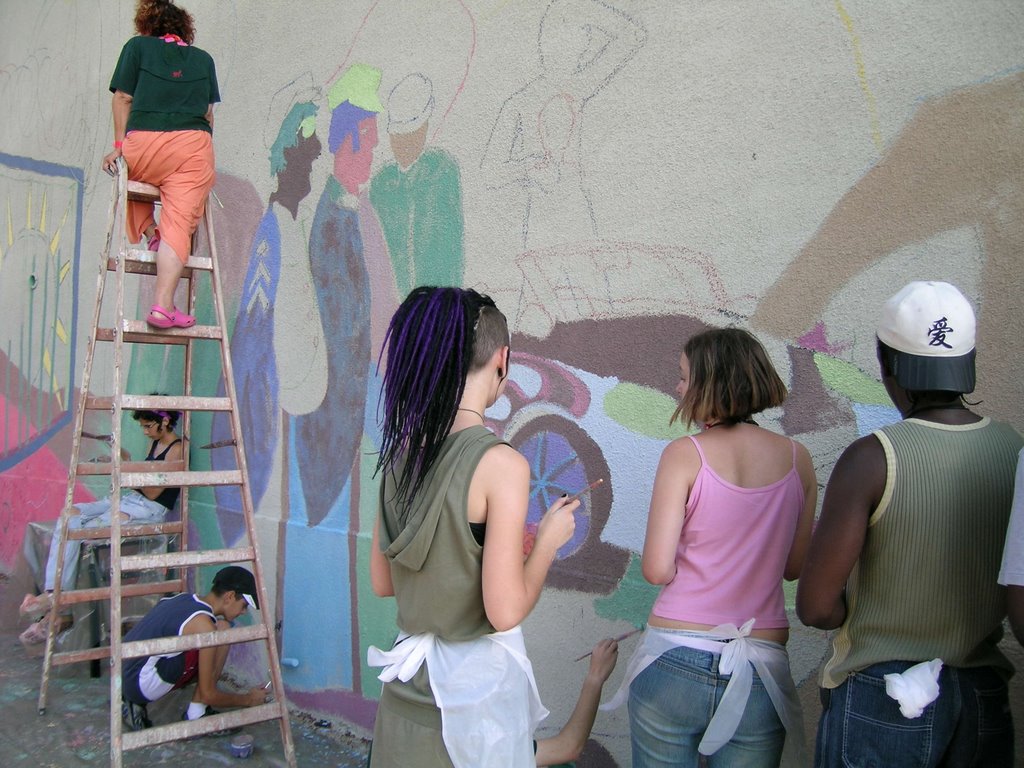
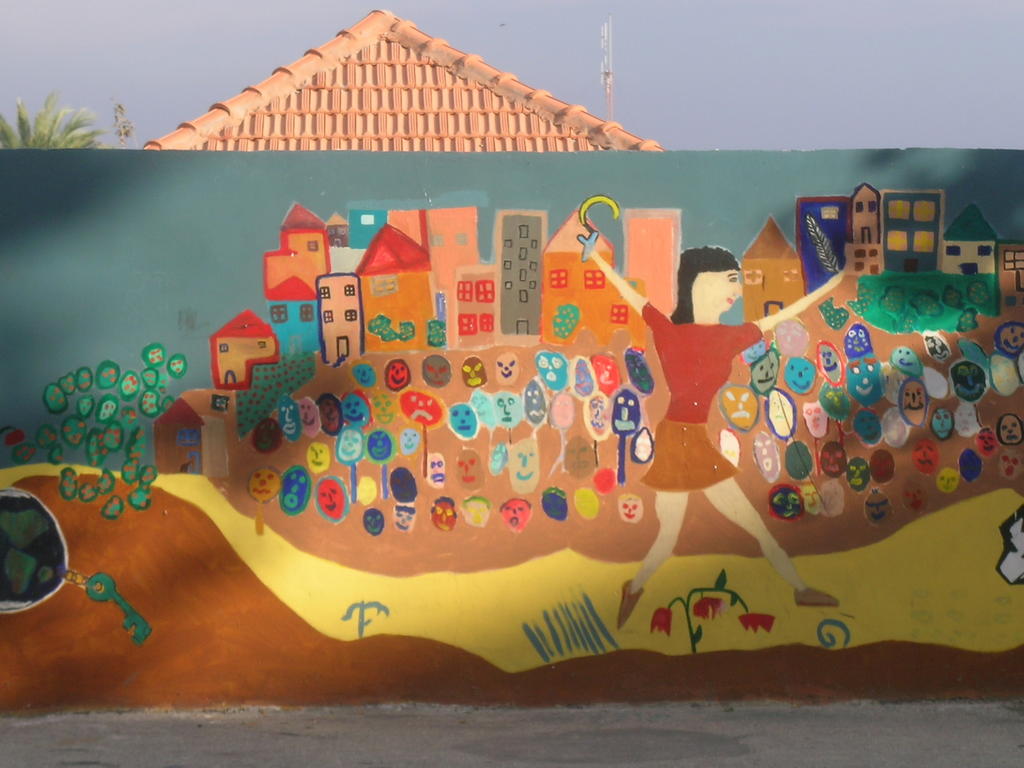
Palestinian and Jewish kids from Jaffa make a huge wall drawing

Some things are still somewhat normal in Israel, in Jaffa: On the corner of Yehuda HaYamit / Yefet street (the "Yefet bridge") in the direction towards the harbor, kids from all over Jaffa are cooperating in painting a huge wall drawing.


They started this morning and will continue to work on the project all week through, until next monday. Each day, between 9-12 and 15-19 o'clock, Jaffa's children are invited to join the kids from "Reut-Sedaka" (the Palestinian - Jewish youth movement), the scouts, girls from the Women's Court, boys from the Jasmin hostel, children of migrant workers and many others in making a huge wall drawing.

The design was made cooperatively by all groups, by means of a long process of meetings in which all children voiced their opinions, selected imagery, symbols and colors they like. The final design based on the results of the process and put together by professional artists, was ok-ed by the kids' representatives and the Tel Aviv Jaffa municipality.

Later today images will be available on "picasa".

You can do something and join us!

Saturday, June 17

Poverty in Israel, the highest ever, an image beyond the statistics

Every half year the Social Security Institute publishes its report on poverty. Each time more people are found to live below the poverty line, yet what does that statistic really mean?
The so called "Caesarea Conference" will discuss poverty. But do the participants have an inkling of what poverty really means?
I would suggest they (the Caesarea participants) live for one week, on social security money only, in one of Jaffa's public housing estates, travel by bus, go to Jaffa's health clinics and send their children to Jaffa's schools. Oh and, they might find them selves cut of from the electricity or the water,as the bills have not been paid for a while. Also, they might have to walk a little longer to a further grocery store, as their debt from the previous month has not yet been paid and the close by grocery refuses to sell them anything unless they pay their outstanding debts. Let's see how they will manage.
Perhaps they should also work as cleaners or guards through an employment company, just for one week. Oh sweet dreams. And now, over to reality:

Ety*, 19 years old, studies to finish her matriculation exams and works part-time as an kinder garden teacher aid. She dropped out of school when she was 16, after her father had been sent to jail for abusing her. She's exempt from army service due to her partial reading skills.
Ety is very intelligent, but she visited over 12 different schools in 10 years. Each time her mother had to run away from her violent husband to a shelter for battered women, Ety had to leave her school. Each time her father located the two of them, so they moved from shelter to shelter and Ety from school to school.
Ety urgently needs dental treatment but cannot afford to get it, even at the free dental clinic where payment is close to symbolic. She walks around in continuous pain and is about to loose 2 teeth, which are too far gone.
During winter she stopped coming to a weekly class i teach. She explained me, she has her own summer sandals, but during the winter she shares shoes with her mother who thankfully has the same shoe size. Her mother, who is ill, had to go to see her doctor, so Ety had no shoes to come to class. As it was raining she couldn't wear her sandals.

Last week the hotza'a lepoel came to the family's 2-bedroom rented flat to carry away the TV and stereo. Much of the furniture had been taken away on a previous visit.
The family's debts?
1. A mortgage they could not pay after the father had been sent to jail. The house was reposessed and sold, but they still owe money on it.
2. Social security fees they did not pay because the mother was waiting to be recognised for an invalid's social security payment.
3. House rent

Ety's mother receives about 1200 NIS monthly, Ety makes between 400 - 800 NIS monthly. The rent for the 2 bedroom apartment they have is 1900 NIS a month.

Ety's mother can barely work, Ety grabs every chance she has to work as a kinder garden aide. As she is on the WIZO replacement list, she gets called every now and then to work for a day or two when the regular aide is ill.

There isn't always enough food in the house. there is no money for the medicine the mother needs, and Ety walks around in pain, with a continuous tooth ache.
Every few days the owner of the house comes by to demand this months rent, which they have not yet paid. They may be evicted soon

That's what's behind the poverty statistics.
As to the statistics: by the recent reports, we are the worst of the western world. Definitely somthing to be "proud" of.
But then, perhaps we are not so much part of the western world. Our "western" gloss is just that, a thin layer not really covering the levant.
Or is it perhaps the deadly combination of globalization, occupation and greed that has led to this situation.
A great many of the poor are actually working people, some of them working in more than one job to make ends meet.
Yet the minimum salary is so low, there is no way a family can live on it.
Many of those with lower wages are employed by so called "employment offices". Although the law is supposed to be some sort of protection, in reality this protection does not work. There are all sorts of loop holes and ways to get around the law.
To understand more about this, it is worthwhile watching Asaf Soudri's and Amir Tausinger's movie "Strike".

More and more subsidies have been cut, as well as ongoing cuts in social security payments. Controlled prices (and subsidies) for basic foodstuffs have been cancelled and public transport has become more expensive.
"They" try to tell us it will make people "work harder" (thus putting the blame for poverty on the poor), but truly, is the aim of cutting the old age pension of an eighty year old immigrant going to make him run to find a job?
Should a woman with mild retardation working full time for 400 NIS in a rehabilitative protected workshop now look for a second job to be able to pay for the rent?
Or perhaps my friend Souha, mother of 4 young children and a husband in prison who works 5 days a week as a cleaner from early morning to late afternoon and is looking for a summer camp for her kids, because the social services said she's not eligible. Should she leave her job (minimum wage) to take care of her kids during the long summer holiday?
Or perhaps pay all of her wage to a child carer and then beg for food at one of the food banks?

And they are not alone.

Statistics don't tell the real image....

*not her real name, the facts are true however.


Friday, September 9

Education, Jaffa-style

Someone send me this link, to show there ARE reasons for optimism in Jaffa, and ofcourse there is some truth in that statement.


Yet most kids cannot attend the expensive private schools such as Tabeetha, Terra Santa, Freres and the very new and wonderful "Jaffa" school run by the Arabita organization. The other children have no choice but to attend the public schools.

Israel has a separate school system for Arabs and Jews. Guess where most of the funding goes. The illnesses of the Arab public school system are difficult to cure for many reasons. Some efforts are made by some people (e.g. at the "Kaf Bet" high school) but most schools are the pits. There is a lot of violence (also by staff towards students) and learning is not high on the priority list.

Many children drop out at a very young age. The official Arab school drop-out rate (in Jaffa) is 53%! But reality is even worse. Many children are registered, but never visit school. As the schools receive per-capita funding, they have no interest in reporting those children, some of them as young as 12 years old. These children are not counted in the drop out rate, although effectively they should be.

The department for the advancement of youth ("kidum noar") reaches out to these drop-outs and can assist them with schooling, but they also receive their funding only if they have a certain number of children in their informal frameworks. And, magic, as long as a child is registered at a school, he or she cannot be registered for the informal program for dropouts.
And ofcourse these kids keep being registered formally, as the schools do not wish to loose their funding. Thus, the children loose on both accounts.

Last year a small group of 6 drop-out girls (some of them as young as 13) was to start a special, high quality, pilot program geared to their personal needs. Everybody agreed it was a great idea, as these girls are in grave danger, living on the streets etc.. they would receive individual schooling in a very supportive setting which would also cater to their emotional needs. The specially designed framework w9ould let them experience success by using innovative educational methods carried out by specially trained teachers and other staff.

The program never took off, as the girls are formally registered (although they had been kicked out from all the schools they ever visited including, surprise surprise, the school in which they are still registered).

Yesterday i spent a few hours talking to a 12 year old Muslim girl who wants to leave school. Last year she came back home form school crying every single day. The school year started last sunday and with it the hel she has to go through: she's beaten up and bullied by her classmates again and again.
Last year some intervention was carried out, but it did not really help.
She wants to quit and sees no alternative.

She is 12 years old and already feels powerless, hopeless, defeated.

I could tell you about another little girl i know, also 12 years old. She is registered at the same school, but did not attend school at all, last year.
She has a "supervision order" from the juvenile court, but nobody actually carried out the supervision. She hangs around in the streets, day and night. She carries out all kinds of mischief (if that word is still applicable to the things she does, but at 12 there is no criminal responsibility in Israel) and is reall in danger. She is a victim of violence in the family, which was reported to social services, but nothing was done.
She is highly intelligent, but is not able to read nore write. Probably dyslexia, but i don't think anybody ever bothered to diagnose. Insetad they place children like her in special slow classes. Which is ofcourse the worst you can do. She is VERY intelligent and gets bored quickly, so she starts to act out. This ofcourse starts a chain reaction ending in her never ever visiting school.

And not much can be done, as there are no real educational frameworks for Arab girls who can no longer stay at home nor at school. So, yes her family is dangerous, she does not function. she probably should be in a special framework which can answer her needs, protect her and also allow her to develop her very good abilities.

Instead she is out on the streets.

Adalah are leading a legal battle for opening special educational frameworks for Arab girls who need protection and extra help. Until then, these girls are left to fend for themselves. And they are loosing.

But maybe that's what someone high up there wants. Or am i being paranoid?