Showing posts with label waste. Show all posts

Tuesday, February 17

The sea, the lovely sea

Huge waves crash onto the beach, strong winds and grey storm clouds above, drama.
Yet reality is slightly less pleasant. Since yesterday the Tel Aviv Jaffa municipal sewage company allows raw sewage to flow directly into the sea. Signs have been put up along the beaches to warn potential swimmers against it, "for the sake of their health".

The fish are reportedly very happy too.


Saturday, June 28

Shem HaGdolim 2

It is unbearably hot inside Salwa's* clean and cosy home; A living room and a bedroom shared by her, 2 of her adult children and a number of grand children.
A very young boy sits on the floor making a drawing and school books and copybooks are scattered on the small table, the holiday is about to begin, but there is still homework to be made. "Being good students, that's the only way for them to get out of here", says Salwa, while smiling at the earnest face of her little granddaughter. The girl doesn't notice it, she's concentrated on writing an exercise.
It is stifling and humid inside.
However, opening the window is a very bad idea. The over flowing sewage is right underneath her ground-level flat's window and entrance door. The smell is unbearable.
Getting out of here (meaning, the Shem Hagdolim housing estate owned by Halamish) is not an option for Fatma herself. Disease and long hospitalizations made it impossible for her to work. She has to get by on her social security payments. She cannot afford to live elsewhere. But she hopes her grandchildren will be able to escape. "Escape" is the word Salwa uses. Escape from the jungle.
We called the municipality "106" and after about half an hour of waiting a guy called Shmuel promised us they would send someone. "Yes today, or tomorrow". They will contact Salwa so she can show them the problem. This was Thursday.
On Friday morning we call again. This time, after "only" 25 minutes a guy called Rafi anwers. He checks on his computer and states someone had been over there (no one contacted Salwa), but it is NOT the municipality's problem, the house-owners should take care of it. I explain to Rafi the
buildings are Halamish public housing and they don't work on friday. Moreover, we contacted them on Thursday and they said it's not their problem.
Rafi insists it IS the owners' problem "and we will send them a letter". "When will this letter be sent?" we ask. Well, in sunday a report will be filed by the men who checked the problem. After the report has been filed, we will check who the owner is and we will send him a letter."
Patiently i explain to Rafi that we are talking Halamish here, not private owners. And that Halamish has already been contacted but they claim it is the municipality's responsibility.
I also explain to Rafi that we are dealing with a river of shit, flooding the entrance to a large apartment block where many children live. Maybe they can come and carry out the necessary repairs and fight over the paying the bills afterwards? After all Halamish is a municipal housing company, so it doesn't matter very much in the end if the work is paid by the municipality or by Halamish.
Rafi is not convinced.

The stench is horrid.

In the afternoon, Salwa's son calls a friend who works for a company providing sewage services to the municipality. The friend loans equipment from his boss. We do not ask questions. After several hours of work, assisted by several men from the housing estate the problem is solved. For the time being.
The friend informs us the sewage system is in bad condition and this type of things can happen again and again. More serious repair works are urgently necessary.

We will send letters to Halamish and the municipality and i guess they will pass on the responsibility to each other.

Shem HaGdolim, they call this housing estate. The "jungle" is what the inhabitants call it.

Later, over dinner at my friend Aisha's*, i tell her about today's developments (earlier she overheard my phone conversation with the municipality). She informs me that when she was working as a nurse, they used to get a special "danger" addition to their salary, when they made house-calls in "the jungle". They were not allowed to go in there alone, only 2 nurses were allowed to make house calls in the jungle together. "If something happens to one, the other one can call for help".

Shem HaGdolim indeed


*names have been changed for the sake of confidentiality


Saturday, November 10

Jaffa's Garbage Mountain revisited

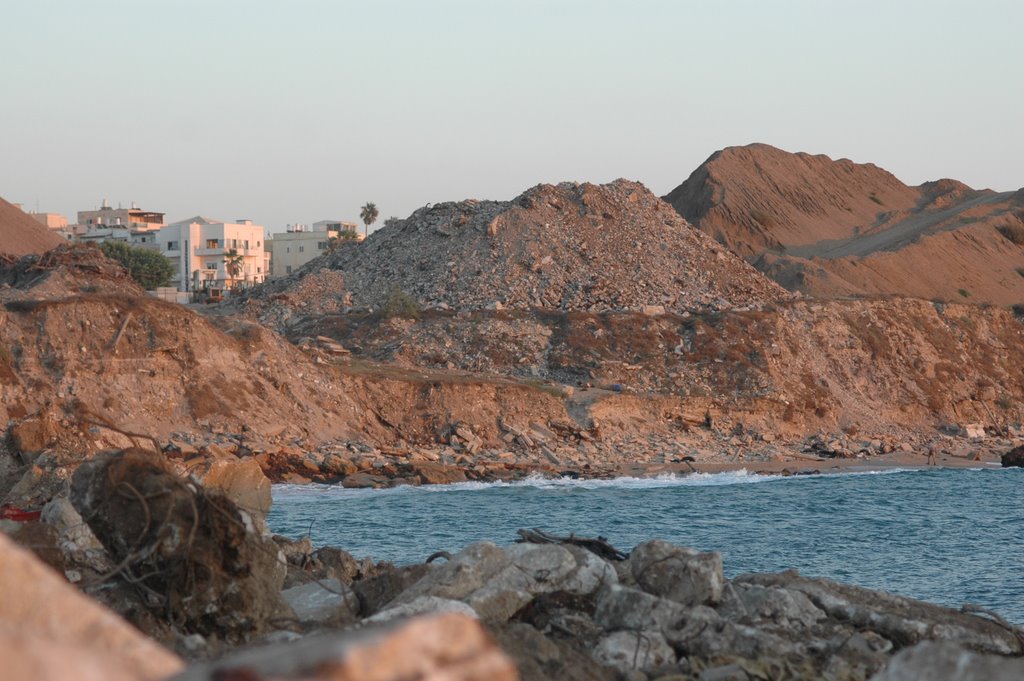
Jaffa's garbage mountain is continually changing. About to be turned into a park, "Midron Yafo", huge quantities of dumped building rubble are ground into smaller stones and then into sand, to be used in the construction of the Tel Aviv local train rail road.Tens of thousands of truck loads are being carried off. The mountain's surface keeps changing literally from day to day.

The garbage mountain covers much of what used to be Jaffa's beach. Jaffa's thousands of destroyed buildings were simply dumped into to sea to create and artificial piece of land on which villa's for the wealthy were to be constructed. That plan didn't work out as the Jaffa population took the municipality to court and won.
The mountain consists of rubble, garbage and a plethora of nasty stuff, such as asbestos. The grinding process releases particles into the air and the nice sea breeze carries it into our homes and lungs. Even dusting twice a day is useless. A thin layer of the nasty stuff covers the furniture before you're done dusting.

Yet the mountain also has a strange and dramatic beauty to it. An ever changing wasteland high baove what used to be our beach.
They are turning back part of the mountain into a beach once more. The waves and the sea sand grind the bits and pieces, creating a dazzling colourful mosaic of what once were the the floor tiles of Jaffa's houses.

The Garbage Mountain Today:


The Garbage Mountain about a year ago:


Monday, July 2

Shafdan Found Guilty

Last week, the "Shafdan" company was found guilty by the peace court of having seriously damaged Israel's marine environment some years ago.
They were fined 800.000 NIS, which is quite a pathetic joke, considering the extent of the damage done.
The Shafdan company is responsible for the waste water management in the Tel Aviv metropolitan area. For many years, they did not bother to maintain Jaffa's rather ancient sewage pipe system, until, one hot summer day, the main pipe basically exploded. A 10 meter high pressure shit fountain was the result. Houses were flooded, cars swept away and the smell...
No words can describe it.
As repair was going to be a time-consuming business, they decided to simply chuck the metropolitan raw sewage directly into the the sea for a period of approximately 2 months. No swimming, no fishing, no beach and yes, the smell, that too.
Fishermen went broke, kids were frustrated and nobody asked the fish and other marine creatures what they felt about their environment.
The lovely azure water close to the beach looked sort of brownish for months.

The shafdan constructed an huge monster of an elevated sewage pipe in Jaffa, adorning our main boulevard for about a year, while laying a new permanent pipe system.

Sewage pipes don't simply crash one day, they crash when they are not properly maintained in an ongoing regular manner. But that was beyond the Shafdan management 's considerations, who, by the way, make huge salaries.
Irresponsible? Unprofessional? Insensitive? All of those, but, as the court decided, foremost criminal.

Zalul

Thursday, March 29

Rainbow Warrior vs Shafdan

The Greenpeace flagship the "Rainbow Warrior" anchored just outside of the Jaffa harbor, opposite the "Shafdan" sewage plant, quite close to the spot where the sewage flows from the shafdan pipes into sea on an almost daily basis.
Decorated with yellow signs saying "Let the Sun Shine", the Rainbow Warrior is visiting the Israeli shoreline with a message of peace and a nuclear-free zone.

Wednesday, March 14

In Jaffa the beach is filthier

Jaffa's beach used to be lovely, soft golden colored sand, clear blue green water, a few ancient rock beds and indeed, also today the view is breathtaking: huge waves, a dramatic sky with windswept rain-clouds. Yet coming a ilttle closer, the disaster becomes quite clear.
The beach is simply full of filth of all kinds.
In nearby Bat Yam as well as on the more northern beaches of Tel Aviv the respective municipalities clean the beach daily. They are well aware of its value and know the city's people will complain if the soft sand looks less than pristine.

As to Jaffa's beach? Who cares?
Well, we do, but the municipality doesn't. Mishlama guys are you listening?
Jabaliya beach! It's filthy!

The storm of the last days has washed up enormous amounts of filth, ranging from black gobs (crude oil?) dead fish, dead cats, huge amounts of plastic bottles and all manner of yucky things better not mentioned during dinner. In other parts of the city, the beaches are kept meticulously clean, in Jaffa not so. Walking the beach has become hazardous. Anybody out there?

Jaffa winter 2007


Sunday, February 18

Fish anyone?

Fishing and Jaffa go hand in hand. Jaffa has been a fishermen's town for some 4000 years.
One wonders about the next 4000, or perhaps about the next 100 years or so.
My fishermen friends tell me there are less and less fish in the Mediterranean Sea.
Some fish types have almost completely disappeared.
Overfishing may have something to do with it, but so the fishermen say, there are other, more serious reasons for it.
One is the Suez Canal, whose waters and passing ships have brought all kinds of non-Medditerranean fish with it over the years. Another reason is the release of different poisons, the Shafdan's sludge among them. The food chain is easily disturbed. Delicate ecologically balanced systems have been torn apart and chainreactions bring about unexpected modifications in marine life, or perhaps, one should say, marine death.
It's not only the professional fishermen, going out of Jaffa harbor with their nets night after night, but also the guys sitting, patiently waiting for the fish to bite, saturday after saturday.
They catch less and what fish they catch, are small.
Normally after a storm there are many fish. After last weeks storm, there was much less than they expected.
Just bad luck, or don't we even have another 100 years of fish? Industrial waste, sewage from the big cities, tankers and yes, perhaps also over fishing. Anybody listening out there?
It's a pity the fish cannot scream. If they could, perhaps we would hear them.

This is not only about Jaffa, it's about our sea, our neighbor's sea. Everybody's sea.

Wednesday, February 7

Sea of Sludge

Our lovely sea and wonderful beaches, look better, much better, from a distance. Upon getting a little close, you might want to put a clip on your nose at some hours of the day and as to bathing.... or eating fresh sea fish, better think twice.

I often feel powerless, in face of the slow poisoning of the sea. Although there are different laws against it, these are rarely and only partially applied. Fines are ridiculously low, so it's cheaper to pay a fine now and then, than to actually solve the problem.
In Tel Aviv and Jaffa the problem is accute. My fishermen friends tell me many fish have completely disappeared and this has nothing to do with over-fishing.
If it's bad for the fish it's bad for us. The strange thing is, that there actually are solutions available. It is absolutely unnecessary to poison the sea. Sewage can be dealt with in many ways. Some might look expensive on the short run, however, on the long run, killing off the sea is far more expensive.
On the short run there obvioulsy appear to be certain conflicts of interest, but do we really want to tell our future grandchildren that once upon i time you could go swimming in the sea and there were real fish in it?

So, some of you people, my readers, have contacted me over time saying they want to do something about it. This is your chance:

The coming meeting of Tel Aviv's "Green Forum" will take place on February 13th at 19.00 at the offices of the Society for the Protection of Nature at 85 Nahalat Benyamin Street in Tel Aviv. the meeting will be dedicated to our beaches and what we want (and do not want).
The ideas and wishes expressed during the meeting will form the basis for an alternative plan.

It really depends on us.


And for a little more information about what's happening to our beaches and water quality:
article by Karin Kloosterman


Saturday, October 28

The beach? Well, it's gone, sort of

Over night a large stretch of Jaffa beach has simply disappeared. Gone, an ex-beach.

May i introduce to you: About 15 M wide and at places more than 75 cm deep, Jaffa's latest sewer.

A few year ago a strange little building was contructed at the southern end of the Al Ajami beach, just below the ancient Muslim cemetary. During the sumer it looks somewhat strange, out of place.
During the winter its function became clear:
It's nothing but a huge sewer, supposedly providing drainage to the always flooded area (after the torrential winter rains) of "Pardes Dakeh" and other low laying areas in Jaffa and south Tel Aviv.
But this is not surplus rrain water, we are talking about, by smell and look, it's raw sewage, coming from "somewhere".
Last year, it produced a small stream, deep, a little disgusting, but something you could simply jump over on your beach walks.
This year the situation is completely different. The strong current has taken away a huge stretch of beach: instead we have a river of smelly black debris-flooded water.
The waves carry the debris back to the beach, so all of our beach is littered with an assorted amount of what, in order not to completely gross out my four steady readers, i will call "garbage" (the understatement of the century, if you like).
I suspect someone in the municipality or at the "Shafdan" sewage plant decided to pull a few switches in order to releave the presssure here or there elsewhere, up north, thinking ofcourse that "well, the shit flows to Jaffa, so who cares, nobody will notice it anyway".

It took away a big stretch of beach and the southern part of our beach can only be reached by climbing over slippery rocks, as crossing the 75cm deep, 15 mr wide shitcreek is not something one likes ot consider.

Even in rainy weather like this, there always are some swimmers, surfers and beach walkers, who come day in day out, unable to do without the sea.
We just stood there, in shock.
No one even thought about going into the water.


Tuesday, October 24

No shit,... well, actually, a lot of it

The brilliant minds of the ministry of transportation have done it again.

The Ayalon river (that's the stinking little stream in the middle of the Ayalon Highway in Tel Aviv) is to be turned into a railway, to cater to the increased train traffic coming in from Lod.

Wonderful, public transport is green and i am all in favor of good public transport, but...

Guess what they want to do with the stinking waters of the Ayalon river (that is, the stinking filthy, horrid sewer aka "Nahal Ayalaon")?

You guessed it, it will be diverted to Jaffa, to our wonderful Ajami beach, where it will quietly flow into the meditarranean where its odorous waters will kill off the bathers and the fish.

NO NO NO, not in my backyard and not on my beach either! We have enough nimby's in Jaffa and south Tel Aviv.

Ecology is a matter of social justice.
They want to improve traffic from Lod? Fine. They want to divert the Ayalon river? What will it do to the ecological system of its natural course?
Or maybe clean it up?
Why to Jaffa?
Why not, let's say , to Rishon leZion? To Bat Yam? Ah, because the Rishon & Bat Yam people don't like it? It will do damage to their beach? It will affect the value of their housing? Surprise surprise, we in Jaffa don't like it either.

We have a small, but lovely, beach. We like to swim, to surf, to bath, to fish, to walk & to jog, to picknick, to dance and do capoeira on our beach. We do NOT like bad smells, poisonous water, filth, mud and sewage. And dead fish stink.

Don't even think of it, we will fight you, this means WAR


Sunday, October 8

Back to work at the garbage hill


Finally, after a fairly long break, they went back to work at Jaffa's "Garbage Hill", one more stage in turning the worst eyesore in Jaffa into a beach park, serving all its citizens.

The work on the park, which by some Israeli architects has been defined as the most important architectural project for the year 2007, was stopped some time ago, due to, so they say, misunderstandings between the municipality and the contractor.

Once the hill, the mountain really, was sea. Then they started throwing building rubbish into the sea, until it grew into a monster mountain, devouring both the beach and the sea, with its natural ancient riff.
The idea was to build villas for the wealthy on top of it, however a lawsuit stopped them from doing so. Besides, the rubble had been thrown in so quickly, the mountain was unstable and not fit for construction.
Following the lawsuit, it is supposed to become a park. Jaffa has less than 50% of all the greenspaces in Tel Aviv (in comparison with other neighborhods, according to a research carried out by the society for the protection of nature and the "greens").


A huge truck was spraying water over the dust paths. For weeks now houses in the area have been covered with a fine layer of dust that gets into everything. Dust blown in from the meters high dustmountains left behind by the huge stone grinding machines.

While walking on the mountain i noticed many small pieces of asbestos. Hell knows what the dust blowing into hour homes contains. Perhaps it is better not to know.
At least when it is wet and muddy, the wind cannot disperse it so easily.


GivatHaZevel, the Rubbish Mountain
Jan 9, 2005 - 37 Photos


Friday, September 1

Rubbish and more rubbish (including asbestos), instead of a park

Jaffa has a lovely beach, but it is a relatvely small one.

Jaffa also has a huge mountain, covering what used to be Jaffa's gorgeous ancient Al Ajami beach. A mountain made up entirely out of rubbish, a true monster.

Most of Jaffa, as can be seen from aereal photographs from as late as the 1960-ies, used to have a very long beach, running from south of Jaffa harbor to today's beach, all along Street nr. 60 (or Kedem street as it is called nowadays). A wonderful beach, used by fishermen and all locals for swimming and recreation.
By the 1960-ies many of Jaffa's once magnificent "Arab" houses had started to delapidate as a result of the complex social processes as well as the continued influence of of the salty sea air on buildings which are not properly maintained. Over 7000 houses were subsequently destroyed, their rubble simply dumped into the sea. The Jaffa beach had become the place to dump building rubble and as well as other rubbish completely for free. Contractors from all over the country came with their truckloads which soon turned into a huge mountain, where there once was a beach and water, where fish swam and children played. The mountain runs along the coast for about 2 km's, is about 500 m. wide and is today more than 20 m. high at some places. A mountain made entirely out of rubbish. Some of it Jaffa's beautiful old houses, a true grave for Jaffa's Naqbe.

The idea behind the mountain was to create a piece of artificial seafront land on which villas for the very wealthy would be constructed. The arrival of those very wealthy people would "raise the level of the locals" (yeah right, we really need that).

But, the mountain was dumped in such a way that it proved unstable. So large construction on top of it would be very problematic and unsafe.

The mountain also cut of Al Ajami from the sea. Streets which once had a gentle slope towards the sea now end in a huge mountain, suddenly rising out of nowhere. The fresh seawind in summer and beautiful view has been blocked. On top of the mountain wild plants started to grow and in winter, at some hours of the day, it is almost beautiful.

When the first and the second gulf wars came around, the US army placed a battery of Patriot anti-missile missiles on top of it, surrounded by barbed wires and guards. We in Al Ajami were woken up by American marching music competing with the muezzin, a weird sound, but all that is now memory (and it better stay memory).

This time the Jaffa people (by means of Al Rabita and Yafo Yefat Yamim, two NGO's, one a Palestinian NGO, the other a mostly Jewish NGO) decided not to play the municipal planners' game and took the municipality to court and won. Moreover, the recent law concerning construction on public beaches has saved our beach, so we hope for ever, from real estate interests.

As a result the mountain is to be turned into a park. Jaffa has about 50% of the green areas per resident as compared to the rest of Tel Aviv. Thus, a park serving everyone is actually quite welcome.
The municipality (by means of our local branch, the so-called mishlama) even met with different groups of residents, in order to hear about our needs and share in the planning (which at the time of the meetings had been almost finalized, so perhaps the meetings were meant more to pacify as than anything else) .

The park plan includes grinding the mountains huge concrete and other blocks into smaller stones and sand, completely changing the mountain's shape in order to make it into a natural part of Jaffa, sloping towards Al Ajami and towards the sea and re-creating a few pieces of beach.
The plants used will be natural mediterranean and there are supposed to be bike paths, places for children to play etc. etc. In theory not a bad plan at all.
The grinding of a mountain this big scared us, residents, a lot (and still does), because of the dust and other particles it would create, which are all carried inland by the winds coming in from the sea.
The planners told us not to worry, the dust would be monitored and on very problematic days, the work would be stoppped and solutions find. Whenever i am told not to worry, i tend to get VERY worried.

About a year ago some huge machines arrived on top of the mountain. Walls made out of industrial steel were put all around and the work started.
My house is dustier than ever, but the work seemed to be going quickly and the mountain indeed started to change its shape. Close to the harbor (the northern part of the mountain) it is now gently sloping, more to the south it is twice as high as before. Huge new mounds of differently sized blocks, stones, sand and iron top it off on its southern end.

My house is dustier than ever and my lungs don't seem to like it too much either.

Then all of a sudden the work stopped. They say their is a fight between the contractor and the municipality. As a result, we are stuck with an even bigger monster, twice as high as before, no park, no beach and what is scarier, very unhealthy air.

On my last walk on top of the "thing", yesterday, i noticed lots of small pieces of asbestos roofing. Apparently they have also ground tons of asbestos that were buried in the mountain. I assume that when you grind asbestos, its fibers come loose and the wind carries them inland. And keeps carrying them inland.

So what is the sum of our "beachpark" sofar: 1 monster, no park, no beach, no view, lotsa asbestos dust.
Thank you very much, mayor.

GivatHaZevel, the Rubbish Mountain
Jan 9, 2005 - 33 Photos


Thursday, August 31

Jaffa beach privatized....

Jaffa has a lovely beach, Jabaliya beach, or, as it is called in Hebrew, "Givat Aliyah Beach".
Jabaliyah was the name of a small Palestinian fishermen's hamlet, just south of Jaffa.
Over the years (before 1948) it developed and became a part of Jaffa. "Jabaliyah" is also the name of the Gaza refugee camp, to which many of Jabaliya's residents escaped in 1948.
The Hebrew name Givat Aliyah sounds like Jabaliyah, although in it really means "Hill of the (Jewish) Migration to Israel".
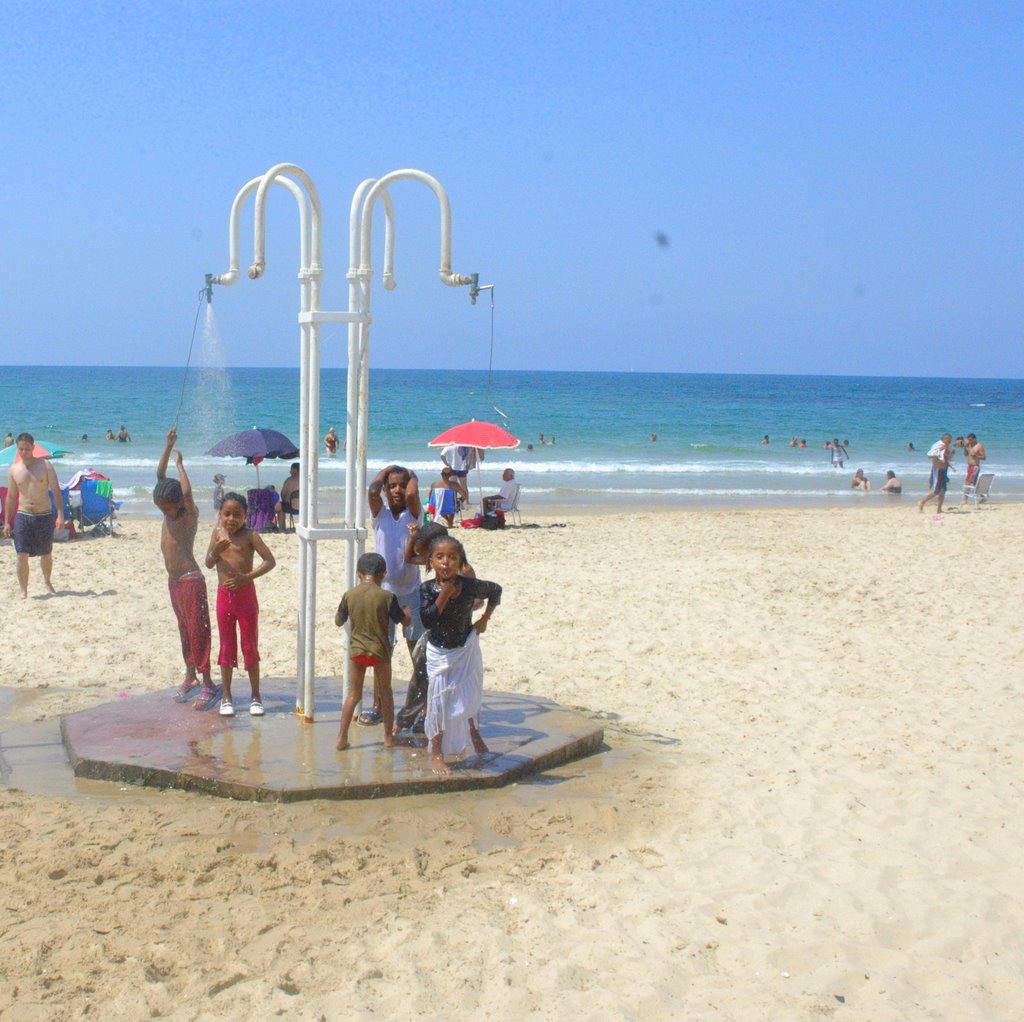
Jabaliyah Beach today is one of those places in which Jaffaites from all social strata and ethnic groups meet, Al Ajami's Palestinians and gentrifying Jewish yuppies, recent migrants from the ex-Soviet Union territories, who live in Jaffa's public housing estates (Yafo Daled and Yafo Gimmel), Ethiopian jews, "illegal" labor migrants from Jordan, Egypt as well as Palestinian laborers who have managed to sneak into Israel for work purposes from the Gaza strip, children & adults, young boys washing their horses and donkeys in the sea water, women in tini bikinis next to fully dressed devout Muslim women; During the early morning and late evening hours you can still encounter many fishermen.
We all meet at the beach and enjoy a slice of cold water melon or an icicle, while hearing the shouts of the lifeguards in both Hebrew and Arabic telling this child or that woman to "immediately get between the flags", where they can be watched, as today the currents and waves are high, strong and dangerous".

The beach has well developed facilities, bathrooms, changing rooms and a first-aid post, all for free. There is lots of parking space.

That is, when the facilities are avaiable. Lately we have seen more and more occasions on which private companies simply cordon off a part of the beach and ALL of the facilities in order to hold private parties.
They put guards at the entrance to keep us out.

The beach is public and belongs to all of us. The facilites are there to serve the Jaffa population, not party goers from north Tel Aviv who want an "authentic Jaffa evening on the beach" while guarded by their own gorrillas so, money forbid, one of us might sneak in and grab a pita from the buffet.

Seeing it stolen from us by the well-to-do with their catering services, security companies and Dj's REALLY pisses me off.

The image shows an event organized by a company called "artnet" for their staff and select customers, yesterday evening.