Showing posts with label amidar. Show all posts

Wednesday, February 4

Home demolition this coming sunday

Although we're still fighting it in court, this Sunday (February 8) they may try to demolish Itidal's home in the "Dalek" orange grove in Jaffa.

We'll need you all there, in order to save the home of Itidal and her two school-age children.
The one parent family has nowhere to go. Itidal is seriously ill (just back from the hospital) and has no help from anywhere.

Those of you living in the area, please stay tuned in and ready for action!

Wednesday, December 24

Amidar rennovates, the roof comes falling down

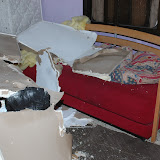
Natalie Hasian was fast asleep at 4 o'clock this morning, huddled underneath a thick winter blanket, which saved her life, when the ceiling came falling down on her.
About half a year ago her home was renovated by the owner, the Amidar public housing company.
The municipality demanded Amidar to renovate the home. The old roof was made of asbestos. Natalie's mother, a widow raising her children alone, couldn't afford to do so on her widow's pension. Nor should she, the family live in public housing after all. There is an owner, who is supposed to be responsible.

Natalie is a student and a social activist, born and raised in Jaffa. She is active in the popular committee against home demolitions.
She noticed the builder was doing a shoddy job. The overseer from Amidar told the builder "not to use so many materials, to keep it as cheap as possible". The family noticed the job wasn't done very well, but the builder said that "this is what he is told to do".
Yesterday winter started. Heavy rains and strong winds. The roof let the water through and the water seeped into the ceiling, which became water logged and too heavy for the small screws that attached it to the ancient half rotten wooden beams which had not been replaced.

Natalie was asleep when the ceiling came down on her. Thankfully the blankets protected her and although she has a big bump on her head, and felt a bit fuzzy, she wasn't badly wounded. Her room is destroyed and wet, her computer screen and her brother's laptop which were on the table have been destroyed and her study books are gone. The same goes for her clothes and the rug.

Natalie called the Amidar company who came over and laughed. No repairs have been carried out until now.
Natalie will sleep in the icy living-room tonight. Amidar demanded Natalie's mum to participate in the cost of the renovation.

Public housing in Israel....


Home Natalie


Posted by Picasa

Thursday, August 7

Municipal Generosity

Yediot Ahronot carries an interesting article today about affordable housing in Tel Aviv.
The Tel Aviv Jaffa municipality will subsidize 2000 appartments for young couples in Tel Aviv, or so the title says.
However, when you read the article, one starts to wonder. The suggested solutions relate to young families with a monthly income of 9000 NIS. Now what?
The average income in Israel is about 7.300 NIS.
The minimum income stands at about 4.000 NIS.
Families on welfare need to survive on as little as 2.000 NIS a month (and sometimes receive rent subsidy for another 500 NIS).
To my understanding it is the poorest who need housing subsidy the most.
Yet this "revolutionary" project doesn't take them into account at all. Supposedly the housing ministry assists the very poor, therefore the municipality wnats to assist those who need it but do not receive aid. But in reality that assumption is a farce, the poor are becoming homeless quickly as they cannot afford the rent and the queue for public housing takes years and years. The tiny rent subsidy they receive -if they're lucky enough to navigate the burocracy involved- covers the rent of a doghouse at most, not a 1 room flat in Tel Aviv, for a family with 3 children...
The municipal (remember it's municipal election year?) "generosity" relates to wealthier groups of of young professionals perhaps.

Saturday, April 19

Halamish's little bag of tricks

In Jaffa there are several public housing apartments boarded up instead of being in use by the 200+ approved families on the waiting list.

To be approved for public housing, you need to be very poor (completely long term-dependent on social insurance payments only, due to e.g. disability and have at least 4 children, or a one-parent family social insurance dependent family, with at least three children). You need to take out an eligibility document, which needs to be renewed every 2 years (which costs money and is quite a procedure).

Families stay on the waiting list for many years. Some get tired or are to poor to renew the eligibility document (or realize that it leads only to more waiting so why bother?) so they no longer appear on the list, as they move in with family to live under impossible conditions (18 people in a small 2 bedroom flat) so the real needs are even more than appear on the list.
More over, there are some 500 eviction and demolition orders so the list will become even longer.

We (the popular committee against home demolitions, of which i am an active member) are trying to find out exactly how many flats are not in use. We know for a fact some flats have been empty for more than a year.
Halamish explains the flats are not fit for living because the Housing Ministry is not providing the money for the necessary renovations.
In a few cases i know for a fact this isn't true: there might be need for some minor repairs, but not more. e.g. the flat squatted by H and her 8 children (from which she was kicked out this week, onto the streets) was in a very fair condition, the windows had been taken out by Halamish themselves) to prevent squatting yet the flat had been empty for over more than a year.

Of course in other cases it may be quite true, but it isn't the whole truth. Last January Oreib Said Ahmad and her family were evicted from their home in Al Ajami's Etrog Street. The apartment they lived in had been renovated some years ago in a sloppy and dangerous manner and 2 of the rooms have serious problems. However, these are construction problems of a type that can be easily taken care of. The apartment is large and could easily house a family with 8 children. Yet it stands empty and boarded up since the eviction and the renovation has not started.
Yet there are 200+ families on the waiting list.

No money for renovations?
Weird, because that same Housing Ministry pays the 200 + families on the waiting list 1.200 NIS rent subsidy every month for renting housing on the private market.

Somehow the facts don't add up.

Or perhaps they do. Because when M. a disabled woman in the 4th month of her pregnancy and her disabled husband asked for public housing (they live in a privately rented flat on the 3rd floor no elevator). M has been informed by her doctor that from the 5th month of her pregnancy she will need to be in a wheelchair and her disabled husband will not be able to carry her in her chair up and down the three floors. They have been trying to find another flat (bottom floor or in a building with an elevator), but nothing they can afford (with rent subsidy), is available.
Halamish offered them a solution "within 48 hours" - if they will move to Lod. Right, to Lod. This is what they offer other families as well.
M. and her husband need and regularly receive the help (due to the couple's disabilities) of their extended family, who all live in Jaffa. In Lod , that help will not be available, therefore that "generous offer" is NOT a solution.
Jewish families can move to other public housing in Tel Aviv (e.g. or perhaps Bat Yam), but Arab families do not have that choice, as there are no Arab schools, mosques nor churches in Tel Aviv nor in Bat Yam. Therefore, Jaffa is their only option.
If all these poor and often weakened families move to Lod (which already is a completely marginalized slummy dysfunctional town), Lod will become even more desperate, as will the families, when their social networks will be broken.
The logical thing would be to construct more public housing in Jaffa. Not as another slummy estate, but as a part of each new building erected.
Building permits should be conditional upon allocating at least 15% of the flats for public housing in EACH project constructed in Jaffa, to be certified, guaranteed and maintained by the housing ministry.

Yet Halamish is doing something completely different: they are now offering people on the waiting list a deal: 10 years of larger rent subsidy (up to about 1800 NIS monthly) without having to renew the eligibility document. On first view, this sound like a good deal. The private market rent of a 2 bedroom "shikun" flat on the southern part of Jaffa's e.g. Jerusalem boulevard is about 2800 -3000 NIS. The offer takes the family off the waiting list for ten years. It SEEMS like a good deal and attractive to some of the absolutely desperate waiting list families.

But the deal carries a payload: 10 years is a long period of time. When a family enters a public housing flat, it's for life. If , however, the family accepts this deal, after 10 years the children will have grown up and once a child is 18+, he or she is no longer counted. Thus, the family may no longer be eligible for public housing after 10 years, as they no longer meet the criteria. Yet knowing the poverty life cycle, they probably will be as poor as before if not poorer. Halamish shorten the waiting list using a trick, but not really solving the problem.

The true solution (as poverty will not be ended so easily) lays obviously in construction for public housing.
Not 1 public housing flat has been constructed in Jaffa over the last 10 years, (although Halamish bought one small building with very large flats for eligible large and poor families) and that is where the root of the problem lays.
Jaffa has a very large poor population. The prices of housing have risen beyond all proportions. And Jaffa's sons and daughters (even of the middle class) can no longer afford housing in Jaffa. For Jewish families other neighbourhoods in Tel Aviv are an option. For Arab families this option doesn't exist, as there are no schools nor community and religious services in those areas. Their only option is in Jaffa.

Halamish and Amidar do not even consider construction in Jaffa. The municipality calls it "attracting strong populations" and i call it ethnic cleansing.

Passover, 2008


Friday, March 28

Land Day in Jaffa - Yom El Ard, YomHadama

Posted by Picasa

Over one thousand people marched in Jaffa, against the ethnic cleansing carried out by big money in close cooperation with the public housing companies and the municipality. Representatives from all factions in Jaffa and beyond stood together, united. Jaffa's people, women, men and children, marched together for the future of their city, for their own future.
"Together we will stop the bulldozers", "The municipality destroys, the community builds" were some of the slogans carried by the participants.
After the march we convened in the park on Yefet Street, "Gan HaShanyim", where representatives from the various groups making up the Jaffa "popular committee against home demolitions" and political parties spoke about what they believe Jaffa's future should be. From sheikh Raed Salah, through Balad Knesset member Dr. Jamal Zehalka, "City for us all" (עיר לכולנו) representative Dov Khenin and Knesset member sheikh Ibrahim Sarsur to activist Reuven Abergil, of Panther fame, the message was clear: Jaffa is for its people, who will not move.


Wednesday, February 13

Yet another eviction order...

H. is 88 years old. A very gentle man, but his memory isn't what it used to be. Alzheimer, so they say.
His smile lights up his face and his little grand daughter loves him.

Amidar, the public housing company decided to evict him from his home.
Why? Only hell knows, and apparently Amidar. Or maybe they and hell are more or less the same.

Thursday, January 24

The Ethnic Cleansing of Jaffa

Oreib's stepson, Nabil, his wife Hayat and their 2 young children were forcefully kicked out from what used to be the family's home at 4 HaEtrog Street in Jaffa.

Their story can be told in dry words or in tearful detail, but little can be done about it now.

What is amazing , is the ease of carrying out the ethnic cleansing of Jaffa, bit by bit, home by home.

Tough words. Yes, indeed.
But all too true.

Earlier this week, Sunday morning, the Tel Aviv peace court. Attending are the judge, Avi Shalev, SH's lawyer and a lawyer representing Amidar, the public housing company, called Amihay. SH is threatened with eviction from his Jaffa home at Yefet street.

After the official part was finished and all of us were gathering our things, about to leave the court, the judge turned -informally- to lawyer Amihay and asked him why Amidar are undertaking all these evictions. After all it is a lot of legal work which costs much money. As most of the evicted people are very poor, after the eviction, that same company Amidar(or the one of the other public huosing companies) will have to provide them with alternative housing or rent subsidy, so what is the point? Moving people from one home into another at great cost, why?

Amihay's answer exposed the ugly truth: "well, we (Amidar) sell the Jaffa home for a lot of money, and with that money we can buy 3-4 flats in Lod, so we can move "them" to Lod."

Right, get rid of Jaffa's poor Palestinian population, said loud and clear.
Wrong, violent racism, (ab)using the law. that's what it is.


Wednesday, August 15

Another Jaffa family facing eviction and demolition

The house itself was constructed sometime during de 19th century, in the style typical for that period: vaulted ceilings, 90 cm thick walls built from local limestone. Small windows high up in the walls, almost a fortress.
The H. family have lived here for ever, the great great grandfather was born in this house. The elderly grandmother, a widow who is still alive, was born here as well, long before 1948. All of the extended family have always lived here and they have ample proof.

Some years ago, one of the ceilings caved in, while grandmother Zeinab was in her room. Wounded, she was brought to the hospital and after a few days returned home. Her son and daughters repaired the roof and replaced it with brand new roof tiles. While at it, they also painted the old walls in a fresh bright pearly white.
That's when the first strange letters started arriving: the municipality claimed they had illegally added a room.
The family answered that they had merely replaced the roof which had caved in. The roof was new, but the room wasn't. The municipality sent over a guy to check, who was so impressed by the new paint, that he decided most of the house (compound really) had been newly constructed. The family showing him the high vaulted ceilings and thick walls constructed from huge limestone blocks in obvious original Ottoman style, weren't able to convince him.

Then something even weirder happened, the Amidar public housing company sent them a court notice to inform them they had to leave their home, as it wasn't theirs.

Now the H. family can easily prove they lived in the house way before 1948. Grandma was born their and registered. As was common in those days, poor people didn't have testaments, they simply lived in the same house, generation after generation and all of the community simply knew the compound as the "H compound".

But Amidar have strong lawyers, and the H family are poor and not all of the older generation are literate. So they are faced with a demolition order for part of the home and an eviction order for all of the compound.
The H family are one of the families from Jaffa, from Al Ajami faced with demolition and eviction orders. Needless to say, they are an Arab family. The naqbe goes on and on.
The H family are trying to fight back.

Jaffa, summer 2007

Saturday, March 3

"God bless this home"

On the wall of the dining room a framed, glass-covered painting still reads "God bless this home" and yesterday afternoon, indeed, a miracle happened.

Family dinners are normally a happy affair for this Jaffa family: children, parents, aunts, everybody gathered around the table. Delicious food, the latest story from the children's school, perhaps some neighbourhood gossip. A weird noise from coming above makes the father feel uncomfortable: "Something is not right". A gut-feeling. He shouts that every one should get up and run, NOW. And they do. A few seconds later the ceiling caves in. No one hurt. A miracle.

All furniture has been destroyed. The children's school bags are somewhere underneath the rubble of very heavy concrete slabs, stones and rusty iron support bars, that until yesterday afternoon made up the roof of the family's home.

The family lives in an ancient house in Ajami's HaMifras street, just off street nr. 60, or Kedem street, as it is called these days.

The home was owned by Amidar, a public housing company, who, so the father told me, "didn't bother to keep up and maintain the house". The father, although this is really the house owner's (Amidar) responsibility, put up concrete support beams outside and in the kitchen a few years ago after he realized the walls were coming apart. In some spots the cracks are so large you can actually see the sky through them.
The house is close to the sea and to Jaffa's harbor. It has a beautiful view. All around the house large new homes for the extremely wealthy are being constructed.

The story of Amidar's horrid maintenance policy is not a new one in Ajami. Many of it's old houses are literally crumbling down. The lovely old houses have been built with "kurkar" stones, a soft natural sandstone that easily crumbles due to the humid sea air. It needs maintenance and upkeep. The lack there of turns the homes over time into dangerous buildings. The high ceilings were constructed making use of iron support beams and when the roof is not regularly treated, the winters rains start finding their way in through the small cracks, thus creating an oxidation process in the thick iron support rails, which eventually weakens the ceiling's construction.
Amidar never did any of these things, which as owner, they should have done.

The heavy concrete coming down yesterday all but destroyed the family's living room.
A building safety engineer sent over by the municipality declared the whole building as unsafe and the ceilings as well as the walls of the other rooms may cave in as well, any minute. A social worker sent over by the municipality wanted to give the family of five (one of them severely disabled) 400 NIS to go and stay in one of Tel Aviv's rather seedy youth hostels for the coming three days. The family has nowhere to go. No insurance either.
Obviously a family of 5, one of them disabled, cannot find a place for three days (because of Purim the municipal welfare department will be closed tomorrow) even in the most seedy hostel in Tel Aviv with a mere 400 NIS. So much for the municipality's emergency treatment.

Some years ago, the family was offered to buy their house from Amidar. The program initialized by the government to allow inhabitants of public housing to buy their homes from the housing companies wasn't very successful in Jaffa. The reason being simple: the prices of the houses are way simply too expensive for Jaffa's poor and not so poor families. The gentrification process in Ajami has turned the smallest hovel into a potential millionaire's abode, especially if it has a beautiful view of the sea or the harbour and the prices went through the proverbial ceiling, literally sky rocketed.
A house developer offered to help the family buy their home, if they would give him, in return, the right to construct another 2 floors on top of the original one story. The family took up the offer, but the developer never started the construction, thus leaving the family in limbo. For seven years already.
Nor did the developer do necessary maintenance work. The family did whatever they could afford by themselves.
Now they are homeless.

They are not the only family in Jaffa.

Once upon a time, before 1948, Ajami was a wealthy neighbourhood, with beautiful, comfortable houses , constructed for people who had done well in the oranges trade. Jaffa had grown wealthy, its oranges exported through its harbour all over the western world as well as the Mediterranean, were the city's main source of income.
In 1948 Ajami became a barbed wire surrounded prison camp for the 3000 or so Palestinians who had not left for Gaza, Lebanon or the West Bank.
Quickly afterwards, poor Jewish migrants moved into the neighbourhood, sharing the houses with the Palestinian families still living there. In each room a family. Bathroom and kitchen were shared by all. Everybody was poor and the Palestinian and Jewish families shared what little they had. the mothers often becoming good friends, the children of all families feeling at home in each family's room.Over time Ajami's Jewish families started to move out, to Bat Yam, to Jaffa Gimmel and Daled, to Rishon leZion. Ajami became an almost Palestinian neighbourhood once more.

The houses were managed by Israel's public housing companies, Amidar and later Halamish as well. "Managed" is perhaps a grandiose word for what they did. In reality the housing companies did little else than taking the monthly rent. They didn't bother to maintain, and over time the salty sea air and humid climate took their toll: Ajami's beautiful houses became dilapidated, partially ruined.
Once the houses had been declared "dangerous", the original inhabitants were offered small public housing apartments in Jaffa's slummy housing estates in return for the houses they had often lived in almost all their lives. The houses were then repaired and sold for millions to wealthy Israeli's who had come to understand the true value of the lovely big high-ceilinged villas with a view of the sea. Ajami is undergoing a process of gentrification. House prices have rocketed and only the very wealthy can afford to buy a flat.
This leaves the local Palestinian as well as the poorer Jewish population with very little choice: they are simply forced out.

The lack of maintenance by the public housing companies pays off. Once the poor families have left the dangerous buildings, a quick restoration process starts and the buildings are sold for millions to those who can afford it.

Jaffa's poor are left to fend for themselves. This often results in "illegal" construction. People have no choice. Over the last few weeks, several Ajami families have been given demolition orders.
A well planned public and affordable housing policy can solve the problem. But it does not seem the municipality is interested in this.
They'd rather see the rich and wealthy take over. No one cares very much about the poor. And actually, it's not only the poor who are slowly being kicked out of Ajami.