Saturday, August 11

Reconstructing the Al Adassi Home once More, We Won't Give Up

I'm still a little shocked.
On my way to the first stage of the 2nd reconstruction of the Al Adassi home a silver coloured Peugeot 206 car slightly bumped into me from the back , while i was walking along with other activists through Al Ajami. It happened so quickly, i didn't understand what had happened until the car was gone already. Hardly anyone noticed it.
I think it was on purpose, as a few seconds before the car had stopped and we tried to convince the driver and another elderly woman sitting next to him to join us. We explained what the demo was about. The car was in the middle of a slow moving demonstration, when it suddenly started driving quickly. I was , well, shocked.
My friend Eli gave me some cold water to drink and i marched on. Hardly anyone noticed what had happened. I guess i was very lucky.

Some 40 Jaffa activists met this afternoon to march from the HaShnaym Park to the site where we started rebuilding the Al Adassi home last week. Last Wednesday the municipality arrived with some 40 "yasam" (special units) police men and 2 bulldozers to destroyed the foundations and plant adult olive trees taken from one wonders very much where.
They placed guards as well, but one guard against 40+ construction volunteers doesn't work out, so after telling us he was going to call the police (which he did, they arrived in a squad car but didn't interfere, i guess they prefer the quiet morning hours when there aren't many activists around) he preferred to sit in the shadow.
We worked, evening the land to prepare for laying foundations once more. We had to do it by using the old back-breaking method as it's impossible to use a small bulldozer due to the trees. This involved working with our hands.
In fact, yesterday three activists tried to use a small bulldozer to prepare the land in which case we would have started to lay the foundations today, but the police interfered and for three activists lacking back up (and no camera carrying press present), the chance of being arrested and getting beaten up was to big. So they retreated. After the preparations were finished, some of the activists picketed along Yefet Street.

We came back today in full force. And some time this week we will start with the foundations. Information about the exact date and time will be passed on using the regular message network.


Friday, August 10

Almost an olive grove

If you wouldn't know better, or look closely, it looks like a nice little olive grove, right in the middle of Jaffa. It grew there, in one day.
The trees may well have been stolen from the territories, the main source of Israel's adult olive trees.
They were planted by the municipality over night, where last week the foundations for the new Al Adassi home were laid by the Jaffa community. A few bulldozers, some trees and we have an instant "park". They even placed two guards, to guard the trees. They tried to tell us to leave, When we insisted on staying, saying it's a public place after all, they gave up after having contacted their supervisors or commanders or whatever.
Tomorrow we'll show the municipality we are NOT giving up the struggle. Be there at 12.00, at the corner of Ehrlich and Yefet Street. Be there!

Thursday, August 9

Demonstration in Jaffa, Tomorrow, Friday at 12.00

Tomorrow at 12.00 o'clock, at the corner of Ehrlich and Yefet Street (Gan HaShnayim) a demonstration against the home demolitions will be helt.
We do not only demand a stop to all demolitions, but also the right to receive housing solutions for all in Jaffa.
There is no problem with wealthier people moving in, as long as the poor and their children are not being kicked out. As long as their is viable housing for everyone.
However, what is happening in Jaffa is something entirely different: With the help of the municipality, the wealthy are moving into Jaffa, at the cost of the people from Jaffa, who are being kicked out systematically. Out into the streets that is, as they have no where else to go.

Yeterday the municipality destroyed the foundations of the new Al Adassi home. The Al Adassi family is still homeless, the children and mother living with different relatives, the handicapped 12 year old son in a foster family and the father where ever he finds a place.

The housing situation in Jaffa is beyond hope and getting worse and when the situation is desperate, it is time for equally desparate measures. Like many, the Al adassi family have no place to go. The municipality hides behind little rules and bylaws and does not provide a solution. A roof above one's head should be a basic right and a responsibility of the community to provide for its members.

The municipality planted trees in the place where the home was and where the new foundations were constructed last friday. One wonders where these olive adult trees came from. Were they stolen from Palestinian families in the occupied territories?


The New Al-Adassi Family Home Destroyed As Well

Last friday activists form Jaffa helped the Al Adassi family rebuild their home, after their previous home was destroyed some weeks ago. Yesterday the municiplaity's bulldozers completely destroyed the foundations of the new home.

Friday, August 3

The Al Adassi Family Home is Being Rebuilt by the Jaffa Community

"No to Home Demolitions!" is the Jaffa community's answer and today some 50+ people turned up, to start rebuilding the Al Adassi family home, which was destroyed by the Israel Lands Administration a few weeks ago.

On one of the hottest days of the year, in the blazing sun, when sitting on the beach with some water melon would be the most logical place to pass a lazy friday afternoon, the Jaffa community showed what it can do: In solidarity with the families, whose homes are being threatened, we started rebuilding the home. The foundations were finished today.
In addition a large tent has been erected so the fmaily and sympathisers will have at least a temporary roof above their head.
A police van turned up to ask what we were doing. The guy close to the concrete mixer explained the policeman he was running a workshop teaching people how to make concrete. The policeman left the scene. :)
Materials have been donated by Jaffa building & construction workers and hardware stores.


Thursday, August 2

August 31st - BlogDay

Picked this up somewhere:

BlogDay was created with the belief that bloggers should have one day dedicated to getting to know other bloggers from other countries and areas of interest. On that day Bloggers will recommend other blogs to their blog visitors.
With the goal in mind, on this day every blogger will post a recommendation of 5 new blogs. This way, all blog readers will find themselves leaping around and discovering new, previously unknown blogs.


Blog Day 2007

Wednesday, August 1

Child Slaves in Israel

Sana, aged 12, makes 5 NIS an hour rolling stuffed vine leaves for a catering service. She's happy with her job, as finally she has some money for herself. She loves to buy tattoo stickers, ice creams and a pink t-shirt with a glittering heart.

Others are 15, or 14 and sometimes as young as 10 years old.
They work in stores, in fast food joints, building sites or carry your groceries to your well air-conditioned car in the supermarket's parking lot.
Some carry heavy loads in the market, others work in hothouses, where crops have been sprayed with dangerous chemicals. Sometimes you see them in construction sites, not wearing a hard hat, as there are none in their small head sizes.
They earn as little as 10 NIS an hour, although there were cases in which they received only 5 NIS. Many work long hours, without a break, often in the sun and sometimes with dangerous materials, without sufficient protection.

They are our very own children.

Some days ago the Ministry of Industry & Labour sent its supervisors to check on the employment conditions of minors doing summer jobs.

Guess what. In 70% (that's right, seventy) of the cases, they were employed in an illegal manner. In most of the cases, they earned way below the minimum youth wage. They do not receive payslips, nor are they given breaks. they are often employed for long hours or on saturdays. I could go on.

It makes me wonder. Who are those children? Whose children are they?

Frankly, i have to admit not being surprised by the employers. In the same manner they abuse migrant labourers, and adult employees from weakened backgrounds, they will abuse children as well, if and when they can get away with it. And that's an easy one, given the fact that children are little aware of their rights and even small amounts of money may seem a lot.

What does it say about our society? If this is how we treat our own children , how we teach them that it's OK to cheat them, that's it's just fine and dandy not to protect them against abuse, then why should we be surprised they turn out holding views we might not like so much?


So What?

There were little brownish black things, scurrying away from the sudden light, as i opened the flour container this morning. I tend to buy flour, rice etc. in bulk, on the market, not wrapped up. It's cheaper that way. Besides, you see what you buy (or so i thought).

The price of wheat flour, corn, soy beans and other basic food will be going up sharply all over the world, so the media informed me this morning.
Once upon a time 1+1=2, but that was in first grade.
On a global scale, things appear to work rather differently; 1+1=6, if you control the supply chain and it happens to please you.

True, droughts here and there, floods somewhere else and climate change all over. Petrol prices going up and the use of bio-fuel becoming more attractive, thus turning valuable agricultural areas, previously used for food production, into bio-fuel land.

Because isn't that what this is all about? Large conglomerates taking over control, investing where it serves them best, driving up the price here and lowering it there, so they can take over yet a little more.
Local farmers becoming (often underpayed) farm employees, working on the same land on which they previously grew their own communities' food, growing crops serving far away communities' needs for bio-fuel or animal feed, while creating local food shortages.
Logistics and transport fees drive up the price of foreign crops exported/imported world wide.

Global shortages are artificially created, on order to drive up the price, while large stocks wait in warehouses just for that moment, when the price is right (or wrong, depending on your point of view).
Agricultural subsidies are cut thus serving international conglomerates rather than the local farmers and local markets.

Perhaps it is much better to control the basic food market world wide, in order to promise adequate food supply for all. But the conglomerates and their political cronies wouldn't like that, would they?

And on a more local level, i expect the price of the basic controlled food (milk, eggs, bread, flour, rice, soy bean oil etc.) to go up. They are creating the "right" (=wrong) climate for the price hike, explaining it's a world wide trend. Of course the country's poor will receive a small subsidy in the form of 2 NIS or some such, to be slowly added over the next few years, as compensation.
It will be presented as a true victory for "social justice".
I just love the newspeak of those "PR" professionals employed by Elite Strauss, Tnuva etc. etc and the politicians. "we have no choice to blah blah blah". Yeah right.


Tuesday, July 31

The unbearable lightness of cynicism

The wonder boys of the ministry of finance are at it again. They have served our (?) politicians with a wonderful mix of measures, presented in one booklet, to be voted upon in one go. Needless to say, they are talking about budget cuts. Where? From the poor, obviously, where & what else?

The idea is of course, that when these suggestions are made within the context of a few hundred others, no one will truly pay attention and all will be passed, as is usual, in one single vote.

I will highlight only one: child allowances will only be paid for children who go to school. Right. No wrong, bloody wrong.
In Jaffa the school drop-out rate is 49% from all Arab children enrolled in the sub standard public school system. When taking a closer look, you'll find out that many of these children come from extremely poor families, often cut off from the electricity grid, no running water, no adequate medical services nor adequate and healthy food.

When looking at drop out rates in all of the country, the picture isn't very different. Children who drop out of school, often come form poorer and more weakened families.
So instead of assisting those families and investing MORE in their children, in order to give them a bigger chance, perhaps invest in back to school programs (what about maybe ADDING to the child allowances of poor families?) they want to punish these families by REMOVING the child allowance.

Brilliant, absolutely brilliant. And our blind politicians will probably vote in favor, as the suggestion is stuck somewhere between x & y within a whole bunge of other small measures no one really pays attention too.


Sunday, July 29

Rebuilding the AlAdasi Family Home

Three weeks ago, the Al-Adasi family's home in Al Ajami neighbourhood in Jaffa was destroyed. This weekend we'll rebuild it with the help of the Sedaka Reut youth movement, the Jaffa popular committee and various Jaffa building materials shops and specialists who will donate (mostly) their materials and services.
Join us in rebuilding the home this weekend.
We'll meet this friday, August the 3rd at 14.30 at the corner of "Gan HaShnayim" on the corner of Yefet and Ehrlich street, Jaffa.

Jaffa is for its people. Not for the wealthy property developers and their cronies.

Rebuilding the destroyed property is part of an effort to find a liveable and comprehensive housing solution for all of Jaffa's residents as well as the for next generation.

Saturday, July 7

All the way from Darfour and ... back?

Olmert intends to send back Soudanese refugees, who crossed into Israel from Egypt, to their deaths.

Some years ago, an Israeli cargo-ship captain discovered a few African stowaways on his boat. He forced them into a life-raft (with a few bottles of water) directly into the shark filled sea.
He knew they wouldn't be able to reach safety, that he was basically killing them. They knew it too, and one of them tried to resist. He was beaten up.

One of the appalled crew-members filmed it, the materials made it to the media and the captain was brought to justice. The public were outraged and rightfully so.

I do not see the difference between Olmert and this captain. The crew of that boat were appalled by their captain's act.
Except for a few members and activists of human rights organizations, very few Israelis are as appalled and willing to do something about it.

And in case anyone thinks in Egypt the refugees are safe, watch this
Or the movies "A Long Walk Home" or "The Art of Flight" about the dangers facing Soudanese refugees in Egypt.
Stating they will not be in danger when sent back into Egypt, or worse, into Soudan is playing with their lives, sending them to the sharks.


UNHCR on protecting refugees

The photograph, made 2 weeks ago, shows a young refugee girl in Jaffa's Arab Jewish Community Center


Friday, July 6

Not only bread

Since a day, it has become impossible to buy fresh "standard bread", that simple bread known as "white" or "brown" or simply as "sliced". No need to add the word "bread".
In Jaffa this means, pita bread only from now on.
No doubt there is little change in the fancy stores in Tel Aviv's northern neighbourhoods, where fancy "designer" breads from various boutique bakeries fight for shelf space. At 15-20 NIS a loaf, these breads are never seen in Jaffa (for comparison, a standard bread costs about 3.70 NIS). The large industrial bakeries, who make hundreds of thousands of standard breads every day, wish to raise the price of these loaves by 12.5%, due to the raise in flour prices world wide, or so they claim.
As the price of standard bread is controlled (just like that of a few other standard foods, such as flour, sugar, salt, milk, soy bean oil, simple rice, eggs, butter, white and cottage cheese etc. in order to enable the poorest of poor at least food security) by the government, they need permission for a hike.
As permission has not yet been given, the bakeries have simply stopped making the standard breads, thereby making it impossible for many families to buy that very basic item, which makes up a significant part of their menu.
Moreover, they threaten to fire 800 employees, if they will not be allowed to sell the bread for more.
In the mean time, they make more fancy bread, which they can sell for much higher prices.
The minister of trade & industry, Eli Ishay states he will not allow the raise, unless the poor families are given a slight raise in their social security allowance, of 2.5 NIS a month.
Yeah right, that will surely reimburse them! 2.5 NIS a month covers the price hike for exactly 5 standard loaves!

The point of course is not the price of bread, but rather the continued cuts in social allowances, the refusal to hike up the minimum wage in any significant way and the lack of effort to control all those private manpower agencies, who are today the main employer of people employed in low wage jobs, such as cleaning, secretarial work and security guarding.

The problem is poverty. Poverty is NOT solved by adding 2.5 NIS to the social security payments.
Poverty is not solved by enforcing low basic food prices.
Poverty is solved by a combination of higher minimum pay, better social security payments, enforcing labor laws in regard to employment conditions as a higher minimum wage, as well as advancing education and vocational training for all.

Yes, it is bad if bread will be more expensive or not available. It is horrid if indeed 800 bakery workers will be made redundant (i don't entirely buy that story by the way), the discourse on bread puts the emphasis in the wrong place.
Poverty is at the source of the problem and the bread price will not solve that.
The solution lays elsewhere.

And in the mean time, pitot and home baked bread!


Explosion on Yefet Street - Update

One dead, an as yet unidentified man in his forties, and 7 wounded, one of them badly.
The damage is extensive. Huge 1.5 meter pieces of razor-edged metal roofing and isolation material, belonging to the truck that carried the gas containers are laying about on the street, some 30 meters from the place where the explosion took place.
Coming closer, the street is covered with bits and pieces of unrecognisable things.
The truck itself was blown into the small public garden "Gan HaSnaym". Not much is left of it. Some 10 damaged cars crashed one in into the other stand about, in the middle of the rubble. Some are quite badly smashed.
The truck appears to have belonged to a catering company. More gaz cannisters, fridges with their contents spread out over the street, crates of food, huge bags of quickly melting icecubes etc.etc. Someone's party is going to be less fun than expected.

Mrs. Yahne is sitting outside of her small house. she lives on the corner of Yefet and Ehrlich streets, where the explosion took place. When it happened, she was sitting in her living room. All windows have been destroyed, the light fixtures came down, as did the mirrors. She's still in shock. Unable to say much more than "i thought a bomb had fallen on my house."
Her next door neighbours, the Ohnisian family, have similar problems, although the damage done to their house seems to be a little less extensive. They're in shock as well.
The windows of the nearby "Alrabita" (The Association of the Arabs of Jaffa, a Jaffa based NGO) have been blown out as well.

Yefet Street is still closed off. the electricity company are working ro reconnect cables that were cut off due to the explosion. No traces of explosives have been found. It appears one of the gaz cannisters tranported by the truck may have leaked. A spark did the rest


Explosion on Yefet Street

A very loud bang was heard about half an hour ago in Ajami.
It appears a gaz container exploded, killing one and wounding 4.

Yefet street has been closed to all traffic in the area of GanTamar

Wednesday, July 4

Omar and Zeinab Adasi and their 4 children became homeless today

Zeinab and Omar Adasi woke up to the sound of a huge bulldozer today. Some 500 policemen, many of them from special units ('yasam"), surrounded their small 3-room home at 6 o'clock this morning.
The bulldozer started working before they were able to take all their things from the house which had been their home for the last 26 years. Zeinab was still in bed and barely got out of the house before its walls caved in into what only half a minute before had been her bedroom.
Zeinab and Omar have four children. the youngest of them (a 12 year old boy) is severely handicapped.
Omar used to be a construction worker, but today he lives of social security payments, due to an illness he suffers from. Zeinab spends most of her time taking care of their youngest handicapped son, who needs much attention.
All around the small family home close to the harbour new luxury buildings are being erected for the very wealthy. For 26 years Omar and Zeinab lived in the house which Zeinab's father had bought for them from its previous owner.Over time Omar added a small room, as his family became larger. They also developed a small garden next to their house. The garden land, so Omar admits, didn't belong to him.

A few months ago they were served with a demolition order. Apparently Zeinab's father had not bought all of the house or sold a room of it. The demolition order however, was taken out on all of the home.
Zeinab and Omar don't know how to read Hebrew very well and they tried to do what they could, to no avail.
This mornng they tried to convince the police to give them an hour, in order to run to the court and take out a prevention order. Their request was refused. The house was destroyed in a few hours and except for the mountain of rubble, it almost seems it never was there.

The older son was upset and screamed at the police, tried to stop them, and as a result was arrested Later today he was released.
The story is typical of what is happening in Ajami.
Many families live in what now it prime development land, close to the sea, with a lovely view. It's easy to remove poor people from their homes, especially when their reading skills aren't too developed. When they don't know their way around the bureaucracy.

The family members have nowhere to go. The handicapped child was place in foster care, the mother went to an uncle and the other three children each to another relative.
And Omar? Omar walks around in circles, crazed, in what once was his home.
I think there were tears in his eyes.

Jaffa, summer 2007

Monday, July 2

Shafdan Found Guilty

Last week, the "Shafdan" company was found guilty by the peace court of having seriously damaged Israel's marine environment some years ago.
They were fined 800.000 NIS, which is quite a pathetic joke, considering the extent of the damage done.
The Shafdan company is responsible for the waste water management in the Tel Aviv metropolitan area. For many years, they did not bother to maintain Jaffa's rather ancient sewage pipe system, until, one hot summer day, the main pipe basically exploded. A 10 meter high pressure shit fountain was the result. Houses were flooded, cars swept away and the smell...
No words can describe it.
As repair was going to be a time-consuming business, they decided to simply chuck the metropolitan raw sewage directly into the the sea for a period of approximately 2 months. No swimming, no fishing, no beach and yes, the smell, that too.
Fishermen went broke, kids were frustrated and nobody asked the fish and other marine creatures what they felt about their environment.
The lovely azure water close to the beach looked sort of brownish for months.

The shafdan constructed an huge monster of an elevated sewage pipe in Jaffa, adorning our main boulevard for about a year, while laying a new permanent pipe system.

Sewage pipes don't simply crash one day, they crash when they are not properly maintained in an ongoing regular manner. But that was beyond the Shafdan management 's considerations, who, by the way, make huge salaries.
Irresponsible? Unprofessional? Insensitive? All of those, but, as the court decided, foremost criminal.

Zalul

Friday, June 29

Mr. ehhh, president?

They shut a deal, the state attorney and Katzav's lawyers. They must be pleased with themselves. The now ex-president will not spend time in jail and he'll pay some damage money to his 4 victims.


He's, it's official now, not a rapist. How wonderful. What a feeling of release. The state's honour has been truly saved. Hallelujah. Praise the Law!
OK, so he's "only" guilty of indecent conduct, sexual harassment of his employees and a few other nasty deeds.
Katzav happened to be the president of Israel and like Haim Ramon (minister of (in)Justice) and Itzik Mordehay (IDF general and politician) he abused his power to force sexual acts upon women who worked for him. It was easy, as he was a powerful politician and "they" were just secretaries.

THEY were women. They were victimised, their feelings disregarded, their bodies turned into objects. They, human beings with thoughts, feelings, sentiments, wishes, hopes, dreams, professions, fantasies and yes, their bodies, in short, multi faceted, female human beings, were objectified, turned into will-less "things" in order to serve the sexual needs of a powerful creep, their boss. The president.

It takes a lot of courage to file a complaint against a powerful man, who has used every tool in his hands to paint those women in an ugly light, to portray them in a horrific way and shame them.

Meny Mazouz's decision not to prosecute for rape (the police state they have ample and sound proof) but instead close a cheap plea bargain for a number minor crimes against some of the victims, shows it completely clearly: Women who have been victimised, should NOT expect Israel's legal system to support them.
Nor should they expect the politicians to support them (after all, Haim Ramon is offered a cosy minister's job). Women have learned one lesson: shut your mouth, don't complain. It's you who will pay the price, not the perpetrator.

Do something about it? Let them hear our voice, tomorrow, saturday evening at 19.30, Rabin Square in Tel Aviv.

Katzav should be tried. For rape and sexual molestation of 4 women. Nothing less.


Help! Xenu landing in Jaffa

Way before 1948 Jaffa was a Palestinian cultural center, "arus el bahar" (bride of the sea in Arabic) as Jaffa was known. And as befitting a lovely bride, Jaffa was richly bejewelled: Book printing houses, theatres, poetry clubs and a few cinemas, one of them the beautiful (if you're able to look beyond today's grime) art deco "Al Hambra" cinema.

Famous Egyptian singer Om Kolthoum performed there during one of her 2 Jaffa visits. People paid as much as two monthly salaries to attend the performance.
The Al Hambra, located in Jaffa's fancy Nouzha neighborhod (today's Jeruselam Boulevard) was the fanciest of all Jaffa theatres.
The AlHambra is a protected building, owned, so it is said (not sure it is true), by the Israel Discount Bank. Apparently the previous owner went bankrupt and the bank confiscated the building or some such. The building is in dire straits and in need of a serious renovation. In the mean time, it is used by two wonderful fringe theatres, the "Notzar" theatre and the "Klipa" theatre.

Todays Ha'aretz carries an article about a new central branch of the Scientology cult to be opened in Jaffa, in the Al Hambra Theatre. Ouch. Hell. That's really what we have been waiting for in Jaffa.

Now writing something even slightly critical of that particular cult on the web is often answered by legal demands immediately removing it "or". The "or" implying legal fights.
So it this post goes awol sometime soon, it will be because i really do not have the finances to fight them (Scientology) legally.
If you want to know what Scientology appears to be all about, you can do it two ways, pay a hell of a lot of money to become "clear" on an "advanced level" after so many years of "auditing" or read the "Xenu" leaflet" in one of many languages:
"The Xenu leaflet tells in some detail the story the big secret that is in the OT III level. It tells of the alien galactic ruler Xenu who was in charge of Earth and 75 other planets in this part of the galaxy some 75 million years ago and how he cured overpopulation by paralysing the people of the other planets, flying them to Earth in DC-8 space planes, arranging them round a volcano to murder them with H bombs. Not done with that these souls of these murdered people were gathered up and boxed, taken to cinemas and shown films for several days. The end result being that the souls clustered together and now inhabit people in their thousands. And of course they must be removed at huge expense."
I really don't mind if people like to believe in ancient green aliens as the source of all evil. Although i personally favour the Flying Spaghetti Monster as a more plausible way of explaining why and how we are here. (Besides, doing a little piracy is more fun than being "audited" as any true pastafarian knows).
However, why oh why the AlHambra? Let's turn it into a pasta place!


Saturday, June 23

Emile Habibi Road - finally.

"The madman, in the meantime, was busy painting a wall with a brush tipped into a bucket with no bottom. When the lawyer returned, sweat streaming, the madman asked, "Well, did you uproot the tree?"
"Yes I did," the lawyer replied. "I uprooted it completely, but didn't find your treasure."
"Get yourself a brush and a bottomless bucket and stand next to me and do some painting," the madman suggested."

From "The Secret Life of Saeed, the Pessoptimist" by Emile Habibi

Once upon a time the streets and neighbourhoods in Jaffa (well those that had names at least, many were known by the numbers, such as "60 street", - today's Kedem Sstreet) had Palestinian or Ottoman names, Boustrous, Nouzha, Jamal Pasha, Manshiyeh and Ajami, to mention just a few.

After 1948 everything was done to wipe out Jaffa's Palestinian character and street names were changed. Nouzha became Jerusalem Boulevard and Boustrous was changed into Raziel.
In all of Jaffa there are 4 or 5 streets with Arab names.
For many years now requests have been submitted to the municipality to name Jaffa's streets after Palestinians. The municipality had refused these requests for a variety of reasons, until now.
Finally, after many long years, a little justice. The municipality has authorised the request to name a street after Emile Habibi (1921-1996), author, politician (Knesset Member for the communist party), editor of the Al Itihad daily newpaper and Israel Prize for Literature recipient.

Other streets in Jaffa will be named for Ibn Khaldoun and others.
It's about time.


International Refugee Day - Activities in Jaffa


Last night some 25 refugees from Soudan crossed into Israel. Leaving behind them the horror of Darfour, they hope to find a safe place for their children and themselves.


So you'd like to do something for them? You can.
Today.
Today, at 16.30 at the Arab Jewish community Center in Jaffa (at the Kedem - Mendes France crossing) there will be a festivity in honor of the International Refugee Day.
The activities start at 16.30 and include a panel, games for children, ethnic food stands and a football game.
The festivities are organised by "Doctors for Human Rights", Mesila and other NGO's.

Almost every night refugees travel by foot through the hot dry and dangerous desert to cross into Israel, to save their lives. At the border, they are picked up by the army or the border police and dumped in Beer Sheva, where volunteers from NGO's and a few social work students from Ben Gurion University try to find solutions for each and every one.
Some of the refugees have been assisted by Bedouin volunteers from Lakiyah's women's organization.

A few days ago a young Sudanese woman gave birth at the border. She was taken to Be'er Sheva's Soroka Hospital by an army ambulance and called her newborn son "Israel". A day later her husband and their 2 young toddlers joined her.

The work with refugees is carried out by volunteers and so far, the state has taken few responsibilities.
This coming week a special meeting at the Knesset will be dedicated to finding solutions for the Soudanese refugees, whose numbers are increasing day by day.

It is time our voice is heard. We DO have a responsibility for these people.

Some 65 years ago a boat, packed with Jewish refugees, left a German harbour. They hoped to sail to a safe place, but no country was willing to accept the refugees. The boat sailed back to its German harbour and almost all the refugees died in concentration camps. they could have been saved. They almost WERE saved, but no one cared enough. The world stood by.

Some 50 years later, a few small ships carrying Vietnamese "boat-people" were picked up by a ZIM merchant container ship. They were given Israeli citizenship and in fact many of them, their children and grand children, live in Jaffa up to this very day.

Cambodia, Rouanda, Sebrenice, the list is long. The world stood by and did nothing.

Today we CAN do something. albeit something, something small.
So come over to Jaffa today, and see how and where YOU can help.


Wednesday, June 20

Death Song

The AlSeraya theatre in Jaffa (part of the Arab Hebrew theatre) currently presents "Death Song" (in Arabic) by the Egyptian playwright Tawfik AlHakim, directed and Oleg Radovilsky.

The play tells the story of a widow, whose husband was murdered, when their son was 2 years old.
Finally the son, now grown up, returns home from his religious studies at the Islamic university.

His mother welcomes him by giving him a knife, to carry out her long planned revenge.

However, the son's religious studies have transformed him into a peace loving, deeply religious man, not interested in taking another person's life.

Beyond anger and shame, the mother gives the knife to a cousin, with tragic results.


Monday, June 18

No exit?

Several people are stuck in "Erez" Crossing, trying to get out of the Gaza Strip.
They are stuck, unable to go back into the Gaza strip, where they feel their lives are in danger and unable to cross through Israel into the West Bank.
There are no facilities at the checkpoint. But that's something one can, perhaps , live with for a while.
However, what is scary, is the shooting today into the checkpoint area.
Israel claims a grenade was thrown by Hamas, who also shot into the crossing. Israeli soldiers shot back. The Hamas spokesman claims the opposite, more or less.
It doesn't really matter, one person was killed and there appear to be some 10 wounded. That's the point. People, children among them, are being killed.
If these people will not be let quickly into the West Bank, there may well come about a blood bath, another Sabara & Shatila.
What are we waiting for? For yet more wounded and killed?

This is a catastrophe waiting to happen.
A preventable horror


Sunday, June 17

Khalil lives in a house he squatted some years ago. It had stood empty for many years, its wood work blackened and rotting, after a fire raged through the old building and gutted most of it.
Once upon a time, before 1948, the building was home to a Palestinian family. It then became a synagogue, and after that a storage area for used car tyres. It was torched and then stood empty, a shell registered as property belonging to the Israel Land Administration.
Khalil moved in, after he was thrown out of his previous home and with him came a pair of wild little birds.

During the day they fly around and do their birdy things. At sunset, they return home, fly around a while in Khalil's high ceilinged living room, until they go to sleep in the nest they built underneath one of the heavy iron support beams.

Usually they move around as a pair. However, sometimes, one of the birds comes home alone and waits for its partner. Occasionally the single bird will sit there for hours, alone, waiting, singing, until its partner returns.
Together they'll move into the living room, fly around and while and go to rest in their small nest. Day after day, the same routine. A peaceful routine. A simple life. Nature's course.

Undoubtedly like some of the birds in the Gaza strip.


Saturday, June 2

Fleamarket Fire

Heavy black smoke was the first sign. The wind was coming from the north west, so the smell became obvious only when coming closer.
Then i saw the flames, high, scary.

An old building form the Ottoman period burnt down in Jaffa's flea-market area this afternoon.
On the roof of the ancient building next to the long defunct Siksik Mosque someone had constructed a storage room for who knows what, flea market stuff. But until the fire was detected, it had spread to the other floors as well.
The fire brigade had a difficult job, as the location was hard to reach, between other buildings.

Several fire trucks and a long row of ambulances stood ready.
Police kept the public at bay.
A guy in a light blue t-shirt, who claimed to be the owner, was questioned by the police. He talked about an electricity failure, whereas others mentioned possible arson. Who knows.


GanTamar... Hadj Kakhil square

GanTamar is a central area of Jaffa, pronounced as if it is one word with the stress on Gan. I've asked different people why it is called that way and got different answers. It made me wonder about the names in the 'hood. Some streets are still numbered, others have names which have nothing to do with Jaffa and yet others may have official names, but no one uses them and very few even know them. In Jaffa places have their own names, often with roots that go back before 1948. Others.... i don't really know, here goes:

Hadj Kakhil square is a central point in Jaffa. It's not the official name of that little square (i don't really know how it is called, if at all), but the huge red neon light name pronounces the name fiercely, in Hebrew, "HADJ KAKHIL SQUARE", as if it were.

Not surprisingly, the small square connecting Shivtey Israel street and Yefet street is surrounded by small businesses owned by the family of that name; a restaurant, a grocery store, a pita bakery, a frozen yoghurt & fresh juice stand, a falafel joint, a toast counter and a smaller "humus only" restaurant. A few meters away there is also a counter of that name selling the best ma'amoul cookies in Jaffa and even a little further away along Yefet street another Hadj Kakhil store selling herbs and spices as well as various items said to be effective against the evil eye. I've probably forgotten a few other stores, but you get the point. (and no, they did not pay me for this article, yes i do by my grocery products in the slightly overpriced grocery, it's closest to my home and i'm lazy).
The Hadj Kakhils are not a large clan, but no doubt they're good business men and women. Nice, helpful and friendly people too, so it's pleasant to frequent their various establishments. By now the square is a landmark used by taxi and bus drivers and everyone else.

The other corner of the square is taken up by the "green house", another point of geographic reference. It's difficult to miss, a highe, 5 story green palatial house, surrounded by high walls. Today the military prosecution offices and the military court.

Once upon a time (read prior to 1948), the lovely house belonged to a wealthy orange-grove owner Khalil AlBanna. Old aerial photographs of the area show it to be located on the very outskirts of Jaffa, from here to the south west there were orange groves.

Khalil AlBanna was a wealthy man, father of 11 children, when he married a second wife, a 16 year old Alawitin, who bore him his 12th child, Sabri Khalil AlBanna in 1937.
After the father died in 1945, the young wife and her small son became unwanted outcasts in the wealthy AlBanna family who in 1948 fled to the Gaza strip, and after some time move to Nablous (then a part of the Jordanian kingdom), where Sabri grows up to become a very angry young man, who at the age of 18 joints the ba'ath party which soon becomes illegal.

Sabri runs away, and in Riyadh marries a refugee from Jaffa, Hiyam Al Bitar. They have three children, the oldest son is called Nidal. From then on, Sabri is known as Abu Nidal.
Rings a bell?
Exactly, the terrorist Abu Nidal.


Wednesday, May 30

Shooting in "GanTamar", Jaffa

A young man, apparently from the Ashur family (although not from THE famous Ashur clan, who apparently have been involved in a bloody vengeance war over the last several years), was shot this afternoon in Yefet Street, close to the junction with HaLotus street. While leaving a small store on Yefet street, the man was shot twice from a Renault car passing by. His wounds are said to be not severe. He's hospitalized in nearby Wolfson hospital.
The incident happened on once of Jaffa's busiest junctions at 16.15 o'clock.
It was witnessed by the police (!) who managed to arrest the driver and the shooter in Kedem street after a chase. During the chase the gun was thrown from the car and recovered by the police.

A few words from the bystanders: "i hope he dies, he's a violent creep, the victim". "Enough, those idiots, we've had enough violence. Let them all rot in jail" and other similar statements.
There was very little sympathy and much anger. The young guys hanging around on my street's corner are conversing among themselves. The women are worried, sitting outside on the porch and discussing the case amongst themselves, afraid for their sons. Only the small children run around with their kites and bicycles. Unaware and not yet involved.


Sunday, May 27

Home demolitions

A balcony, a wooden entrance door with a brass knocker instead of a bell and a hamsa, for good luck. Home to a young couple. No children as yet. A living room and kitchen, a bedroom, nothing luxurious, but it's a home.
The curtained windows look out over what once was an orange grove, green trees, shacks, muddy streets, car repair workshops, Jaffa's neighbourhoods on the far horizon: the grey apartment blocks of Yafo Daled and Gimmel, the pastel coloured ones of the border with Bat Yam.
There is something inherently evil about destroying a home.
The land of Pardes Dake belongs to the people living there. Many of the homes were constructed prior to 1948 yet after 1948 no regional development plan was made for the area and as a result it is not possible to receive a building permit, even if you ask very very nicely.
Over the years the family grew larger, and the sons constructed their homes in the pardes, close to those of their fathers, as is the tradition in this part of the world. Illegal? Yes, in a strictly legal manner of speaking yes, illegal. But they had no choice as there was no way to get a permission. Why is there no development plan for the pardes? There is no regional development plan for most of south Tel Aviv and Jaffa, as a matter of fact. But there were ways to circumvent this and somehow building permits were given to those close to the hearts of the municipal regulators and surprise surprise, the Dake family are not that close.

however, a home is a home, a roof over one's head a very basic necessity. The quick gentrification in Jaffa (as in Tel Aviv) is forcing many people out of their homes which are bought by the rich, strong and wealthy. Illegal building rules don't really apply to them, it's amazing how much illegal construction goes on in Tel Aviv. But when you are strong and have good lawyers, who cares? Even if that illegal manner of construction seriously damages the life quality of your neighbours. As i said, when you are rich here, the rules don't really apply to you. and if they do not fit, you just buy your way into changing the rules. So yes, a roof IS a basic necessity, but no longer does the state see itself responsible to ascertain that all its inhabitants can afford a decent home. As such, "home" no longer is something to be assumed as "certain". More and more people are loosing theirs in Jaffa. they do not necessarily move into the streets (although some do), many move in with family members, the kids in oje place, the parents in another, the family falling apart. Small 2 bedroom flats having become home to 20 people is no longer a rare occurance in Jaffa. Living in cramped quarters influences children's lives in many ways. It is difficult to concentrate on your homework. Small spaces often lead to much tension, which sometimes develops into violence in the family, often against its weakest members.
Several years ago people live in tents. When they had enough of it, they squatted several homes in Jaffa.
there has been no social housing construction for a great many years now. No building permits have been given to people living in public housing. The situation is desperate.
The Dake home is one of many.

The municipality calls it "the free market forces". I call it a crime against society's weaker members.


News Update on Pardes Dake

Some 60 activists, yours truly included, gathered today on the roof of the four-family home in Jaffa's "Pardes Dake", when police forces and municipal employees arrived in order to carry out the demolition order.

Omar Siksik of AlRabita, Fadi Shabita of Reut-Sedaka and labor party knesset member Nadia Hilu (a Jaffa resident herself) and ofcourse Moussa Dake, the house owner, undertook lenghty talks with the representatives, while receiving on-line legal advice.
Right now we are at a standstill. The demolition order has been postponed until June the 4th in order to try and receive some sort of legal understanding which will, hopefully, allow the family to stay in their home.
It's really important to find a viable legal solution, as this will reflect upon other homes in the Pardes Dake compound.

Violence is scary and police presence, amongst others in form of a border police jeep automatically raises fears.

At the same time there was something moving in seeing so many people from Jaffa involved and showing their solidarity. People from different families, political groups and backgrounds, from all ages, Palestinians and Jews together struggling for the right to viable housing.


Saturday, May 26

House demolition at Pardes Dake, take 2

The threat over Mousa Dake's family's home is up once more and it appears the bulldozers may come tomorrow morning, Sunday May the 27th.
So demonstrators will meet at the corner of Yefet / HaBa'al Shemtov street at 8.30 in the morning.

The house to be demolished is a two story building. It serves as a home to 4 families. The bottom floor was constructed prior to 1948, the second floor was constructed some 7 years ago. Without a building permit, true, but that is because it is not possible to get a building permit in the Pardes area, as there is no general municipal building plan for it. The area, 22 dunam, belongs to the Dake family.
Parts of the land have been sold in principle to Flatto Sharon, however, nothing has been paid for and offcially the land still belongs to the Dake family. The sale is supposed to go through in another 18 months. It makes one wonder why the municipality is so intent on destroying the home now, when they KNOW the family will leave in another 18 months.

The family doesn't plan on leaving. In any case, they have nowhere to go.


Thursday, May 24

So far it is quiet in Pardes Dake

"Pardes Dake" is not a place one easily walks into. It used to be an orange-grove many years ago, owned by the Dake family. Over time it became a living compound where car repair shops, shacks, garbage-strewn unpaved streets and alleys run haphazardly. Some nice 2 story houses, next to asbestos-roofed shacks give it the look of a refugee camp rather than a Jaffa neighbourhood. On my walk around, i saw a sort of cage looking like a compound for dog fights. there is much poverty. The compound doesn't have a very good name.
The Dake family tends to keep to itself. Some are said to be involved in crime, others are highly educated young professionals. The Dake family has special standing in Jaffa. Lately there have been rumours some of the Dake family started to sell their lands to wealthy developers, such as Shmuel Flato Sharon. 250.000 $ for a small 2-room shack, so the rumour goes.Apparently some papers have been signed, but so far none have received money. It has happened before in Jaffa, that people were swindled out of their homes, and Flatto Sharon, a convicted crook, doesn't have an honest reputation. They say Sharon wants to construct another gated compound in the area.
Life in the pardes is not easy, especially during the winterdays, when the houses are often flooded.

Moussa Dake has lived in the Pardes all his life, born during the British mandate period, he has seen it all.
He is a practical man, who has lived all his life, in the house in which he was born, prior to 1948. The lands are registered in his name in the "tabu" and there are no disputes over his ownership.
Over time the family increased and his son added a second story on top of the old family house. True, he had no building permission, but the family paid all the fines and that seemed to be it. Until last night, when the announcement of the coming demolition of ALL of the house (including the pre-1948 bottom floor) arrived.
The news passed quickly amongst the various Jaffa activists and some 40-50 people turned up this morning in the Dake compound to peacefully resist the destruction of yet another home in Jaffa.
The bulldozers didn't arrive. But it doesn't mean the home of Moussa is safe.
So far so good...


Wednesday, May 23

Prevent a house demolition in Jaffa tomorrow, Thursday May 24th

The home of the Thakka family is in danger of being demolished tomorrow morning. The house is located on the border between Ajami and Jabaliya neighborhoods in Jaffa. It was constructed on land owned by the family ("Tabu").
Activists and sympathisers will meet tomorrow morning, Thursday, May the 24th at 9 o'clock on the corner of Yefet and HaBa'al Shemtov streets in Jaffa, to prevent a family from loosing their home.

Saturday, May 19

The Jaffa Heiress

Intissar is seventeen, bright, funny, streetwise, the youngest of 10 children and until yesterday, full of hopes and dreams. A knock on the door of the small apartment where she lives, ended those dreams. Her sister's little, 3 year old, boy opened the door and several police men entered, with arrest warrants for Intissar, her elderly disabled mother and all of her nine sisters and brothers (2 of them disabled as well). That's 11 arrest warrants in one go.
Why?

Because of debts, not even theirs. Debts they inherited.

The story goes back a long time. Intissar's mum developed a mental disease, when Intissar was very young, a tiny toddler, and became unable to care for her children. Intissar's father was addicted to to drugs and alcohol. The welfare department removed all children from the home and placed them in boarding schools. Intissar was only 2 years old, when they took her from her parents' care and placed her in a home, in order to give her a chance, by juvenile court order.

Intissar's father died about 4 years ago. Junkies with alcohol problems don't live long. After his death, all minor children were returned home by the welfare department. Their mum is still suffering from the same severe psychiatric disorder she's had for many years, and not really able to care for her daughters. But Intissar is strong and in spite of many difficulties, she copes, somehow. But how can a 17 year old girl cope with her "heritage of debts"? Because that's the problem here.

In Israel, when a person dies, and he or she leaves behind money or other possessions, these are shared by the inheritors according the the person's last will or, if there is no will, according to the law on inheritance.
BUT, if the person died owing money, his or her inheritors inherit his or her debts. If the person owned a house, usually the house can be sold, the debts covered and the remainder shared among the family, the cat or dog or whoever else.
Yet, in Intissar's case there is no home to be sold, there are no possessions. Her large family lives in a tiny public housing apartment in one of the worst slums in Jaffa.

All of the children grew up in boarding schools and children's homes. They hardly ever saw their parents. Their father was interested in one thing: getting high before cold turkey sets in.
Over the years he made incredible debts. How exactly is only partially clear. Each time the water. electricity or phone were cut, he renewed the connection not by paying the bills, but by putting the new bill in the name of the next child of his 10 children. Thus, all of the 10 kids, while they never lived at home and were minors, ran huge debts at the various utility companies without knowing anything about it.
I do not exactly understand how the utility companies accept contracts made by minors who are not present at all. Minors who have been made "wards of the state" and are under the responsibility of the welfare department.
But these are not the only debts. There is an "inheritance" of over a million NIS shared by all of the family members, and arrest warrants against all, including minor Intissar (which is illegal, by the way) because of those debts.
Intissar comes form a very weak background, but she is a fighter. Life in the many homes she stayed in, has toughened her. But she has no tools coping with this. In a few months she will be 18 years old. Instead of starting a career, and doing things 18-year olds like doing, she'll be facing impossible debts, her "inheritance".
When she works, most of her salary will go towards paying those debts. She'll become a slave to her father's "inheritance" of debts.
Through legal aid, she may be able to pay off those debts in monthly instalments always facing arrest if she doesn't meet them. Career? Study? Intissar can forget about those for years to come and perhaps for ever.
There is something VERY wrong with a system that allows this kind of injustice.


Intissar is not her real name, for reasons of confidentiality. The story is true, i wish it weren't

Friday, May 18

Something not so weird in Jaffa - Drugs

Last night, a police heli keeping me from concentrating on my book ("Bnot HaDrakon") by hovering with its powerful searchlight over my house, occasionally keeping me in its blinding focus.
Two streets more or less from my home, at Donollo HaRofe street, a huge drug search had been going on, successfully apparently.
Drugs and Ajami go pretty much hand in hand. And it was no secret to anyone from our 'hood that some of the inhabitants of that particular home were deeply involved. No longer so. Sixteen police cars came and the Israeli keystone variety arrested and carried off several people suspected of being involved and that trade.

Thursday, May 17

something weird is going on

Right now a police helicopter has been hovering above my house for several minutes. A strong light beam circles our rooftops, apparently searching for something
What? Who? Why? Hell knows.
Most of my neighbours are out on their balconies, rooftops and the street. Nobody seems to know much.
Perhaps this will turn into a developing story...

So far, not really.
It costs over $1000 per hour to keep a helicopter in the air. That's a lot of money for the short funded Jaffa cops, so it must have been something major. But there isn't a thing about it in the papers or on the news sites.

It feels exposed, to stand on one's rooftop balcony in the focus of a blinding search light.


Friday, May 11

Boycot "Mul Yam"

Today's Ha'aretz carries an amazing article, which just goes to show how much employers care about their employees' safety and health:
Mul Yam, a very fancy and expensive seafood restaurant in Tel Aviv's harbour is owned by Shalom Mahrovksy, who's most proud of keeping the names of his clients, some of them quite famous and others perhaps rather infamous, confidential, even when they try to abuse his employees.

According to the article in Ha'aretz, two female employees who volunteered to stay working late after the restaurant closed (and the rest of the employees had gone home after a long day and night of work), but a party was still going on in one of the private VIP rooms.
Both employees were offered a sip of wine by the client whose name is kept confidential by Mahrovsky.
Soon after that fateful sip, they started to loose consciousness. Another employee, who had not tasted the laced wine, managed to release one of the employees, when the guest tried to push her into a waiting taxi.
The other employee was too much out of it, to even close the restaurant.
Te next days both employees woke up after many hours, dizzy, confused and unable to remember anything from the previous evening. Symptoms consistent with so-called "rape drugs", like ketamine and others. The victims went to the hospital, but as these drugs break down quickly in the body (which is exactly what makes them so "attractive" for pervs and creeps) obviously it was too late to detect any signs.
Both employees were sacked (to be returned to their work later, when Mahrovsky understood all of the 48 man strong staff were very angry with him because of the victims' dismissal).
At the same time, Mahrovsky stated he keeps the name of the client confidential, but told him "not to come to his restaurant any longer". Which basically proves two points: Mahrovsky KNOWS exactly who the guy is, and protects him and his own business rather then his replaceable employees.
I suggest hitting him where it will hurt him most: his pocket. Boycot "Mul Yam".


Tuesday, May 8

So angry

Sometimes, i suppose, it 'd be much healthier not to read the paper early mornings.
Today's Ha'aretz tells me the minister of welfare wants to re-establish food coupons for the poor, to ensure they will receive food safety. What about paying liveable wages (some 40% of Israel's poor are employed full-time, but do not make enough money, the so-called "working poor") and enforcing these? And returning the horrid cuts in social security payments? These will do much more for food security.
The brilliant plan is an answer to the demand of various food charities, who believe they should not be held responsible for something so basic as food security. They are right of course, but a coupons program is NOT the answer.
Simply: PAY more.
Funny enough that has worked in several countries where it was tried. No, people did not loose their jobs and factories were not closed, and no there was not more unemployment as some of the cronies of the very wealthy want us to believe, whenever raising the minimum wage (and bloody well enforcing it) is mentioned.
Another "lovely" one from the Ha'aretz front-page: Netanyahu our next minister of defence? Noooooooooo, tell me i'm still asleep, please.

Which reminds me of the fact pointed out by "New Voices" that 18 families in Israel
"earn one-third of Israel’s commercial revenues, totaling approximately 44 billion dollars. This revenue counts for 32 percent of income within the State of Israel, but does not reflect the families’ inherited wealth, savings or any income from investments outside the country. The families’ earnings increased four percent from the previous year".

The same article also points out 7 of those families are friends of our beloved chairman (aka Olmert) , who, with Netanyahoo, sold them many of the country's assets in the framework of their beloved "privatization".

Where's the emergency exit?

Monday, May 7

Les Miserables, in Jaffa, in a way.

Several years ago i lived in a small street, just behind the "Nouzha" Mosque, in Victor Hugo Street. What i loved most about the small house, was its garden. I planted a vine, rosemary, morning glory "Leylet el kader" (a big green bush with tiny white flowers opening only at night, with a wonderful smell) flowers, herbs; my own small paradise.
I thought i would always live there.
True, the two drug-dealers in the street operating their business like a banking machine (put your money in a slot, collect your wares through the window) wasn't exactly my idea of "nice neighbours, but i loved the street, the house and the garden i planted.
Victor Hugo Street connects between Dante and Michelangelo streets. Somehow referring to both hell and heaven.
And yes, there were some really wonderful people living there too. And some very funny ones. Opposite my house there was a small 2 room apartment. The owner filled it up with 3 layer bunk beds and some 22 (yes twenty two) Chinese workers lived there. Only one of them knew English and none knew Hebrew nor Arabic. The English speaking Chinese guy had become a good friend over time, and spent the Seder night with us and many a regular evening in the small garden, joining us for some tea with nana or luisa.

Then, the shooting started. . Automatic guns, that is. A hell of a sound to wake up to. The greengrocer on the corner had been shot. Everybody out in the street at 4 o'clock in the morning. Shouting, scared, angry, fed up.
And me? When the lease ran out, i moved out of my little paradise.
I kept contact with some of the (other) neighbours.

Yesterday evening, the neighbours in Victor Hugo Street sat outside, as usual. People carry some chairs, a small table outside and enjoy the mellow evening temperatures with a tea, a coffee, a water-pipe, some sweets. The children play in the street. Just another evening, like so many others.
The sudden sound of shooting, automatic fire, rapid. Muhamad Zeynab, falls down, mortally wounded. His wife and a female neighbor are wounded as well.

Les miserables, Victor Hugo Street, Jaffa, 2007

Saturday, May 5

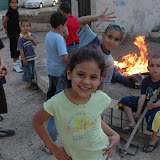
Lag Ba'Omer in Ajami

Some holidays are simply made for all.
On Purim all kids in Jaffa, including young Muslim children, dress up. Little girls in long flower-fairy dresses, little boys running around proudly as as spiderman or ninja turtle.
Some adults criticize this trend, but try kids to convince them NOT to dress up.

Towards Lag Ba'Omer Ajami's many villa building sites put up extra guards, as Jaffa children, ALL of them, walk around with old shopping carts (and some not so old ones) gathering wood for the their "LagBa'Omer fires": the higher the better and nowhere you find as much wood as on building sites. After the place has been selected, the kids start bringing out the wood they have been gathering (and carefully hiding) for a few weeks. While bringing on more wood, they always leave a kid behind to guard the growing pile from other groups of equally ardent youngsters.
Tonight it's "big fire" night in Ajami.


More images:
Lag_BaOmer


When a brothel goes on fire...

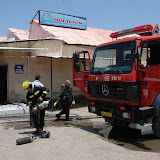
Shivering in spite of the strong midday sun, the clients stand, rather wet, in their underpants. A uniformed policeman takes their details. their ID-cards are still inside. Most of them look very young, in their late teens and early twenties.
The smell of smoke, burnt plastic and soot hangs heavy in the air.
The area is ugly, small industry, second hand car lots, right behind the new regional police headquarters in Salame street.
It was called the "Aquarium Spa", but the business-cards laying around in the mud, around the place leave no doubt, this was no health spa or naive "massage" parlour, but a brothel. The women are no longer there. Perhaps they ran off through a back-door. I hope none are still inside, the firemen enter the place wearing oxigen tanks on their backs and the burn smell, also outside, is overpowering.
The heavily tattooed, Russian looking "manager" (pimp is perhaps a better word, or maybe he was a guard) is being questioned by a policeman. He shouts at me when he notices i shoot his picture. the heavy Russian accent leaves no doubt. He's angry, but realizes he cannot do much, with police and firemen present.

A little further away a white, new Volkswagen with the number 98 613 24. A woman with Slavic features stands next to it. She looks worried, scared, keeps her mouth covered with her hands. It seems she has tears in her eyes, but maybe i am imagining things. She quiet, doesn't say a word.
The clients are worried, their things are still in side. One of them tells his friend he's pissed off, as he paid money, but had not yet received "service". After a while they laugh and ask me to take their picture in front of the fire truck.
A fireman brings a pair of brand new sports shoes outside. A wet flowered underpants wearing teenager picks them up. They are still white and new looking, and wet. The young man is pleased. He looks like any other young guy. Shoulder length hair, a beaded necklace, a kid from "Sheinkin".

No one talks about the true victims, the women.


more images:
Fire


Wednesday, May 2

"Bimkom" Conference in Jaffa

"Bimkom" a non-profit organization of Planners for Planning Rights with the goal of strengthening the connection between human rights and spatial planning in Israel, in cooperation with the Arab Center for Alternative Planning held a two-day conference on civil society's right vis-a-vis the establishment.
The second day of the conference was held in Jaffa at "AlRabita" and dedicated to the fight for affordable housing and against the demolitions and ethnic transfer of the Palestinians from Ajami and Jabaliya neighbourhoods.
As i make it a point never to work on the first of may, happy mayday, by the way, i decided to attend the second day of the conference.
As the demolition problem is urgent, in Jaffa most of us concentrate on the immediate, preveting the close desistaster of ethnic transfer. Yet it truly is important, to pay muoch attention to the larger implications and the long run effects of the activities as well.
What is happening today in Jaffa, is part of a wider tendency, by which extremely wealthy developers and their cronies, all out to make a quick buck, push away very basic human rights, such as affordable housing and sustainable community life. On their way, like a bulldozer, they do away with whathever bothers them even slightly.And they can do so, as they know how to have the law on their side, and if they don't they have enough power to manipulate it to be on their side.
True, Jaffa in general and Ajami and Jabaliyah in specific the problems are more urgent than anywhere else. And it is important to loose every round in the fight to save those neighbourhoods as the Palestinian neighbourhoods they are and have always been.
The fact that the lands and houses were originally Palestinian property taken away from the owners in 1948 by the Israel land administration which then made the owners pay rent for the properties they had been robbed of, makes it al the more horrid.
Yet similar processes take place in Florentin, Kfar Salame and other southern Tel Aviv neighbourhoods: huge office buildings and dwellings for the very rich are being put up at the cost of the inhabitants who are in danger of being kicked out. The developers and investors make tons of money "living of the rent" or making much money by buying and then selling when the price is even better. Thus housing no longer is a need and a right, but a commodity, cynically manipulated for making tons of money by those who already have a lot of it.
The community? The people? Affordable housing? Historic neighbourhoods? Ecology? Who cares. Money, money money...

Architect Busayna Dabit (see image) from Ramle put the discourse in its historical, political, cultural and spatial context, of house demolitions of former Palestinian property in Ramle, Lod and now in Jaffa.
Michael Edwards (UCL, London) provided a description of the very long struggle against developments in the Kings Cross area in London, a struggle which initially was successful in preventing massive developments which would have left the local population homeless as well as destroyed many historical landmarks, yet the war has not yet been won, as a new, only slightly less horrid development plan has been introduced and it has much support from Blair's cronies and much money stands to be made.
Yet, at the same time, the inhabitants of the area have started direct talking with the developers, instead of the discourse being mediated by the establishments' various organizational bodies. An interesting approach, possible, because the their are a few large developers. In Jaffa the situation is different in that respect. Yet to be learned, analysed and adapted in other areas in the country.
Emily Silverman of the Technion described various interesting models of "improving without moving": gentrification without kicking out the original population. Mixed income neighbourhoods as an alternative to gentrifying an slummy but attractive area by kicking out the poor to nowhere. Some of these models might be excellent for Jaffa and i believe suggesting an alternative plan incorporating solutions of this kind, might be a good long term housing and community solution for Ajami and Jabaliyah.
Erez Zafdie emphasized the problematic dynamics happening "below the surface": the colonialist tendencies as well as the ethnic nationalist logic's dynamic interaction with the economic "development" principle. The Israel land authority owns most of the land in Israel since 1948. By using a development logic it serves other needs as well. As these incredibly discriminatory methods are difficult to defend in court, the tactic is carried out through privatization of the development. Thus "community settlements" can defend their racist "admitting committees" etc..

There is no doubt the municipality wants to turn Jaffa's Ajami and Jabaliyah into a Jewish neighbourhoods. In fact, the major refused to use the term "mixed city" and describes Jaffa as a Jewish city with a small other ethnic and religious minority, thereby wiping out Jaffa's proud cultural past and much of its current identity as a Palestinian city.
The question of Jaffa becoming a separate municipality was rightfully raised in this respect.

During the afternoon various practical workshops concerning the fight for a Palestinian Ajami and Jabaliya were held, and the results will be obvious in the field.

images:
"Bimkom" conference in Jaffa