Tuesday, August 8

In Jaffa, the muse continues singing (for the time being)

Jaffa, prior to 1948, was Palestine's cultural center: printing houses. poetry-readings, performances, cinemas, newspapers etc. characterized Jaffa. Both Palestinian and Jewish artists worked in Jaffa.
All that was lost in 1948. The so-called "artists quarter" of Jaffa's old city is not much more than a fake, set up for tourists' sake and not a very successful one at that. True, it is a lovely area, but it's dead inhabited by ghosts and very wealthy tourists, some galleries and shops catering to foreigners looking for kitschy memos of their visit to the holy land.
The old city is too expensive for most artists and there isn't even one Palestinian living there these days.
Once upon a time, not so very long ago, Jaffa's old city was a quarter where the poor fishermen and harbor workers lived in cramped conditions. No runnig water, no electricity, but it was alive. children running and playing in the streets, women meeting each other for a chat while on their way to or from the market, or shouting from one rooftop to the other, while hanging the laundry. All that is gone now. The beauty is still there, but she's asleep and it is not clear if and when the prince will arrive.

But not all is bad.
The lighthouse gallery, located close to the harbor at 13 HaMigdalor street, opens a group exhibit this coming saturday evening, August the 12th at 20.00 o'clock.

The exhibion is being curated by Ruth Yakobson, the participating artists are:

Rachel Shavit, Itamar Siani, Edna Meron Wavner, Lihi Gandler Talmor, Dorit Yakobi, Yaffa Meir, Ami Shnar, Etty Mor, Ilana Appel Admon, Margarita Naot, Gilad Duvshani, Dror Almagor, Hanan Shafir, Shlomo Levi and Ayelet Frank.


Friday, August 4

Funny green container with disturbing information

Following Nasrallah's warning about launching missiles aimed at Tel Aviv, the municipality published a list of public shelters on its website. Currently the shelters are locked, but, so the municipality stresses, they will be opened according to the guidelines provided by "pikud ha'oref" (home command or some such).
I guess that means AFTER things start going badly (hoping ofcourse they won't). The shelter relatively close to my home is more than 1 minute of very quick running away. And i am a good sprinter. I heard we'll have a 1-minute warning, so that will leave me kind of outside.
The shelter's also locked. Over the years it has been turned into a youth club, well equipped with computers (connected to the internet, so assuming electricity and connection to be up during and after the attack, i can continue blogging in real time), airconditioning etc. and this being Jaffa, a series of very well locked doors. The key is with those responsible for the club, not the municipality. At least the shelter is clean and in a reasonable state. Who knows what the condition of other shelters in Jaffa is. Over time some became homes for the homeless, other good hiding places for drugs stashes and some others yet nice, fancy living quarters to our local rat population.

Suddenly some very large green containers started to sprout in Jaffa, carrying signs suggesting they are sort of, well, situation related. Ofcourse they are also locked, i guess one can call the phone numbers provided, when needed (hoping the system will not be dead and the mobile system overloaded by everyone and their grandmother calling to ask everyone else if they are OK.

I guess i like to think they won't be needed, so why bother. I hope i am right.

And i better be; it appears there is no one truly responsible for whatever happens to Israel's civilian population. The government does not wish to officially declare war nor emergency, as that would imply finanacial responsibilities rather not taken by the ministry of finance. Money's always first on their minds, "kibinimat the people". (how does one translate "kibinimat", anyone out there?)
Over the last several years so many services have been privatised, that well-meaning but not necessarily efficient NGO's have taken over many functions previously undertaken by the goverment. The state no longer is responsible. And that means you gotta be lucky or well-connected to receive good assistance. Often NGO's provide local or area-wide services. Sometimes by well trained volunteers which is ok, but what if one needs expert professional services? And, during time of war, what about the commitment of those well meaning volunteers? And the infrastructure supporting the services?
I do some work at a Jaffa NGO. We have no shelter, nor a windowless room. The one story building is old and there is no "mamad". The closest shelter is way further than 1 minute of very quick running. Would it be responsible to continue providing services under those conditions or would it be lacking responsibility to do so? After all, protection is far away. Both clients and staff would be in danger.
There is no minister of welfare and that says it all. Eighteen ministers, several portfolio-less, but no minister of welfare.
You think the US government's response to hurricane Katrina was inadequate? Wait till the shit hits the fan here (and it is hitting the fan big-time in the north of the country). For years we have been lulling ourselves to sleep thinking "private services" are much more efficient than state-run ones. I suppose there will be an enquiry committee which will publish a long report with many suggestions on improving services. The state nor the municipality see themselves as responsible for the welfare of the people.
And that's way beyond semantics.

And for the Hebrew challenged, the image shows a sign pasted on one of the large green containers. It states the container holds emergency equipment.

Once upon a time there was a beautiful princess or, why do we hate the Andromeda compound that much

Once upon a time, long ago, here in Jaffa, lived a beautiful young princess, named Andromeda. Her family loved her. She was pampered as befits a princess. A wonderful future awaited her, so all expected.

However, horrible times came upon Jaffa: a monster from the deep sea started to devour the city's fishermen, one after the other. Each morning, at sunrise, many little boats left Jaffa's natural harbor for another day of hard work. Every afternoon, when the little aflucas* came back to the harbor, there were some missing. Initially one, then two, but the monster became hungrier and the fishermen stopped going out to sea and the city's people became hungry as well; Something had to be done.
All kinds of tricks to submit the monster were tried, to no avail.
Only one thing would pacify the the monster: Andromeda.
To save the city from hunger, her father had her chained to the rocks at the harbor entrance as an offer. Thankfully Andromeda (as well as the city) were saved by a chivalrous hero who then married her and they lived happily ever after, had many children and Jaffa flourished. Until this very day, Andromeda's rocks are still there at the harbor's entrance; a reminder of the dangers at sea, a lovely bride and her hero. And Andromeda's great great great grandchildren (some at least, since 1948 many live in Jabaliya refugee camp and what is left of Beirut and Ein ElHilwe) still enjoy Jaffa's beautiful sea and harbor.

Fairytales are one thing, reality is somewhat different or, as Neri Livne put it in this week's Ha'aretz weekly rag:
"Wait, wait, don't rush home to write," said A., one of my colleagues at the newspaper. "Maybe a missile will fall on Tel Aviv and you won't have to do your column." That's not funny, I told him. "Okay, but if a missile does fall in Tel Aviv," he added, "at least let it fall on Kikar Atarim." Tel Aviv has loads of places that may be worth getting rid of: Kikar Atarim, City Hall, Dizengoff Square and especially that monstrous sculpture, the hotels on the beach, the Andromeda Hill project in Jaffa. "It's lucky," I said to him, "that at least it's impossible to destroy the underground transportation system here."
True, i had a laugh, and then i started to think. How is it, that so many of us in Jaffa automatically cringe when we hear the name "Andromeda Hill" and think of a medusa rather than a lovely princess?
The gated compound of that name, located at the northern end of Yefet street, was constructed some years ago, on land bought from the Greek Orthodox patriarchate by means of a sales procedure which has left, reportedly, quite a few questions unanswered and not according to the wishes of many from the local Greek Orthodox community: the majority of Jaffa's Christian Palestinians.

The compound has a wonderful view on Jaffa's harbor and the sea, which are no longer visible from Yefet street.
Right in the middle, there is a PUBLIC pedestrian pathway which is supposed to be open to the all of us. However the securityguard at the entrance doesn't allow anyone through, unless they live in the compound or have been invited by the compound's residents. So what if the municipal construction permits specifically state the path is public? The compound's wealthy inhabitants don't want us, locals, hanging around in the middle of their fancy 'hood.
Another one of the conditions of the building permit was the construction of an additional little park or kindergarden for the good of the Jaffa public as part of the project. So far, although people moved in to live there several years ago, the cornerstone for those buildings for the public good has not been laid.
Apparently the real estate company, who claim they have not yet finished building all buildings for which they have a permit, "will do so after completing construction of the private appartment buildings". Translation into Jaffaite: forget about our public commitments, we'll never completely finish the private construction, so just wait patiently, forever, we don't want you here, unless it is to clean the pool, the appartments or maintain the garden".

But there is more; The land was owned, as stated, by the Greek Orthodox community for future public developments, such as additions to the school, a kindergarden, a community center or perhaps a church, as needed by the people of that community, an option now forever lost.
The marketing of the gated Andromeda compound was more instructive than the project's developers perhaps intended: The saleslady after having stressed the beaulty and romance of the "oriental location" went on to stress its safety
"no Arabs live in this area and the municipality will not allow it, this is part of north Jaffa, the Maronite neighborhood, in which there will be no Arabs, just like the old city of Jaffa and in any case, we will not allow the local community to enter the compound which is guarded 24 hours a day by a private company, so you don't have to worry, you are completely safe here".
Yeah right, "Araber-rein" perhaps? Replace Arabs with "Jews" and Jaffa with, let's say an American, Canadian or European city name and the anti-defamtion league or the Wiesenthal Institute would be all over them, and righfully so.

Other than that, taste is ofcourse a very personal matter, but the massive, artificial stone covered orientalist kitschy constructions are as close to "originally Jaffaesque" as the appartment blocks in Jaffa Daled, Gimmel or "Shem HaGdolim" public housing estate in southern Givat Aliya (Jabaliya) neighborhood. I 'm sure they are comfortable inside and have a nice view and the people living in the compound enjoy a high standard of living with their private swimmingpool, healthclub and restaurant. The presumed architectural dialogue of Andromeda Hill with Jaffa's sad, but lovely, Old City takes place more in the realms of cultural imperialism than in those of "authenticity" and (i'm on dangerous ground here) good taste.

But there is more: by constructing a gated (and well guarded) compound for the very wealthy only, another dialogue, or perhaps a lack of dialogue, has become more than obvious: the social gap between the fantasy-land compound (them) and us, living in real Jaffa (the Jaffa of poverty, of bad social and educational services, of violence, crimes and drugabuse) is wider than ever.
The ideas of "bringing strong populations to the weak neighborhoods" doesn't work, when the gaps are this big and gates and guards create high physical borders, when the land was taken from the local community and when the compound's inhabitants are not a part of Jaffa, but a separate an alien entity in our midst.

Moreover, the "strong people, living in their multimillion houses have driven up the prices, and the local people can no longer buy appartments for their children, who are forced to live in "illegal" constructions or move to other areas in Jaffa or to Lod or Ramle. And perhaps that is what the municipality has in mind, perhaps that is what gentrification is all about: get rid of the poor (who will become somebody else's responsibility) and make it nice an cozy for the wealthy. That's why i don't like that piece of prime property named after a beautiful Jaffa princess, Andromeda.

No, i don't want any missiles destroying Andromeda or any other part of Jaffa, i believe in non violence. I'm sure the flats in Andromeda all have mamadim (shelters) unlike the place where i live. Maybe the Andromeda people can make something good and welcome Jaffa's poor from the shelterless housing estates to their mamadim?

*an afluca is a small traditional fishermen's boat, they can still be seen in Jaffa's harbor to this very day.


.


Wednesday, August 2

"Days of Darkness" by Gideon Levy (Ha'aretz)

In war as in war: Israel is sinking into a strident, nationalistic atmosphere and darkness is beginning to cover everything. The brakes we still had are eroding, the insensitivity and blindness that characterized Israeli society in recent years is intensifying. The home front is cut in half: the north suffers and the center is serene. But both have been taken over by tones of jingoism, ruthlessness and vengeance, and the voices of extremism that previously characterized the camp's margins are now expressing its heart. The left has once again lost its way, wrapped in silence or "admitting mistakes." Israel is exposing a unified, nationalistic face....


Gideon Levy expresses it much better than I, yet the article reflects exactly what i feel, so:

Read the full article in Ha'aretz

Monday, July 24

Nasrallah the folk hero?

I've been thinking for more than 24 hours now whether to write the following text or not.
It's easy to misinterpret or otherwise abuse the information.

I do some community work in Ajami, the neighborhood where i live. I work with girls and young women, some of them from extremely impoverished homes, where they are faced with various forms of violence, drug abuse etc.

The majority of them are Palestinian girls, although they will not define themselves as such, they have very little political awareness, or... do they?

Yesterday, in spite of the very hot weather, we sat in the garden, in the shadow of a huge "toot" tree, drinking cold water and eating" majadara". Talking about this and that.
Thirteen year old Aisha* said; " You know Yudit, in the X store in "Gantamar" (a part of Ajami) they sell posters of Nasrallah, they have different sizes, i want to buy one to hang in my room. Nasrallah is the only one who cares about the Palestinians".
Sixteen year old pious Mervat* agreed with her, and spat on the photographs of fallen soldiers, on the "Yediot" front page she was holding while saying they were "maniakim". I knew she was waiting for my reaction. Would act in anger? Would i be distressed?

We started talking. Mervat told me she'd spoken yesterday to her sister, who lives in the Gaza strip with her children. Although the sister has a blue, Israeli id card, the sisters have not met for years, as her Gaza-born children cannot travel with her, and they cannot get an entry permit to Israel.
Mervat, who herself was born in the Gaza strip to an Israeli mother, carries an Israeli ID, so she cannot go to visit Gaza, to meet her family.
The only way the sisters can meet, is abroad. As people in the Gaza strip have little money, that road is open to few.
Mervat 's sister's home has been destroyed. They can talk only occasionally, when there is enough electricity to charge the batteries of the sister's cellphone. The sister and her children live with her husband's family now. All stay in one room. The children, traumatized by the noises, the loss of their home, the lack of hope, the poverty, the stress, find it difficult to cope.

Mervat is angry. she knows very little about politics and only occasionally watches the news. But she is certain of one thing : Nasrallah is the only one who cares about the Palestinians, he has given her hope. She sees him as an honest man with honor, a hero, not scared of the "zionists who kill our children".
Aisha agrees with her.

Then they say "don't worry Yudit, you are not like them, we know you are ok".

Two little girls from Ajami saying it more clearly, if we'd only listen "the Israeli emperor's new clothes are non-existent".

But we don't listen, or perhaps we don't want to listen. No, Aisha and Mervat are not dangerous extremists. what they see in the news upsets them, deeply. Hundreds of Lebanese civilians get killed, murdered. While all eyes are trained on Lebanon, no one pays attention to what is happening in the WestBank and the Gaza Strip where people are killed as well and infrastructure and houses destroyed.

Aisha and Mervat don't know much about the politics, the dynamics and the "expert opinions" of this or that (ex) general. In fact, they never watch the Israeli Hebrew language channels. They watch AlJezeera etc, where they see the violence, the horror, they talk to their relatives and they perceive one thing: Nasrallah makes promises which he keeps.
Whether that is true or not, doesn't play much of a role. they perceive it as true, honest and honorable.

Their lives in Jaffa are poor and they have few chances.

Aisha and Mervat are the future. They can change a lot, in any direction. We better listen to them and take them very seriously.
They are two very innocent well meaning and sensitive young girls.
They don't believe the Israeli version, they know they have very little to expect from life and if someone gives them hope, they'll take it up, with all the vigour of the very young.

*Not their real names

Saturday, July 22

Sending direct mail to the world's leaders in order to convince them to act to stop the war


On the Hebrew website "
Avoda Shora" there is a call to all bloggers to write the leaders of the world to do their bit to stop the war, NOW.
(When i write the word "leaders" i cringe. Lately i seem to have developed a great distaste for that word, or perhaps the people who are supposed to function as leaders).
The e-mail addresses of the relevant leaders are provided. It is, after all in their hands and without international pressure on Israel and Hizb'Allah, nothing will stop.

The text is being translated into English right now, so hopefully i'll be able to put up a link shortly.

Bloggers for peace unite!


What else can we do?

Those of you in Israel, Come to the demonstration against the war this evening starting on Rabin square at 18.30.

It's being organized by Ta'ayush, Women for Peace groups, Gush Shalom, Shministim etc etc.

Transport is provided from:

Haifa, 16:45, Kikar Solel Bone. Binyamin: 050-535-8601

Jerusalem, 17:00, Gan Hapamon. Gilad: 050-868-2992

Nazarat, 16:00, Beit Hayedidut, Zahar: 050-314-8805

Blood revenge in Jaffa just never stops

The police and news mention it as "mysterious murder of business man in Rishon leZion", yet in Ajami we know better.
We may not know who exactly shot the man 2 days ago, but we know the story: He's from Jaffa, from Ajami, to be precise.
A good guy, hard working with a young family, no criminal connections.
But two of his brothers are involved, so the story on the streets goes, in Jaffa's underworld. And they have been in hiding for a long time now.
And if you cannot get at them, well, then you just shoot their brother. That's the logic of gangwar here.
The brother, after all, is easy to find. He has a business in Rishon and works long hours every day to provide for his family. So you send out your assasin(s) and that's where you hit.
Another victim of the bloody crimewar in Jaffa.
Or, as my neighbor puts it "there is no way how you can stop this. Two things in Jaffa, revenge and a woman's honor, will always lead to violence".


Wednesday, July 19

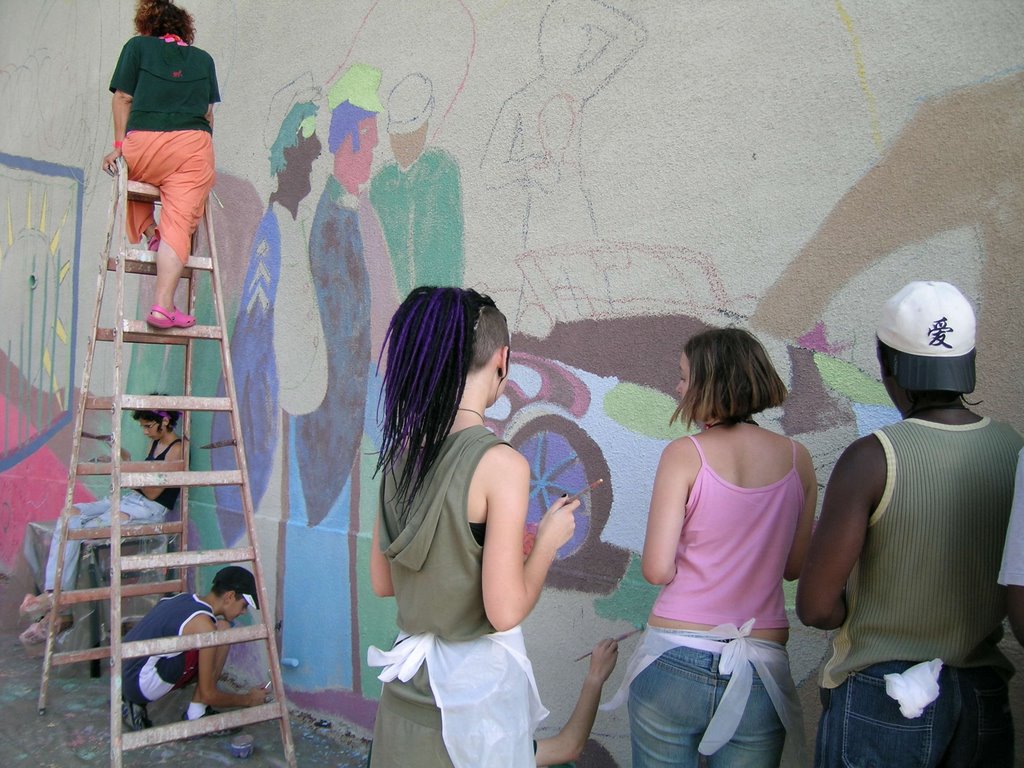
Palestinian and Jewish kids from Jaffa make a huge wall drawing

Some things are still somewhat normal in Israel, in Jaffa: On the corner of Yehuda HaYamit / Yefet street (the "Yefet bridge") in the direction towards the harbor, kids from all over Jaffa are cooperating in painting a huge wall drawing.


They started this morning and will continue to work on the project all week through, until next monday. Each day, between 9-12 and 15-19 o'clock, Jaffa's children are invited to join the kids from "Reut-Sedaka" (the Palestinian - Jewish youth movement), the scouts, girls from the Women's Court, boys from the Jasmin hostel, children of migrant workers and many others in making a huge wall drawing.

The design was made cooperatively by all groups, by means of a long process of meetings in which all children voiced their opinions, selected imagery, symbols and colors they like. The final design based on the results of the process and put together by professional artists, was ok-ed by the kids' representatives and the Tel Aviv Jaffa municipality.

Later today images will be available on "picasa".

You can do something and join us!

Saturday, July 15

Stop the War! Halt the bloodshed! Demonstration sunday July the 17th

Tomorrow, sunday, July the 17th at 19.00,
Come to the Demonstration
against the war in Gaza and Lebanon
Give peace a chance!
We'll meet at the
corner of Frishman and Shderot Hen in Tel Aviv.

My gun is bigger than yours, majnounim of the world unite

Katyusha rockets being shot at the north of Israel, Qassam rockets at the south, Beirut, Sidon and Tyre being bombed by the Israeli airforce. Villages in south Lebanon being hit by intense artillery fire. Yeah, the villagers have been told to leave their homes for their own safety, but with the road and bridges infrastructure destroyed that's kind of hard to carry out.
How the hell did this mess come about?
OK, Hizb'Allah are not nice. In fact, anyone saying they have a direct line to god who commands him or her to act violently against another human being, belongs in the majnoun category imho.
But we have our very own crazies as well. It's so easy to escalate a problem and so difficult to climb down from those very high trees.
I didn't have many expectations from cfhief of staff Dan Halutz: after all he has already proven his very doubtful human rights record, by carrying out bombardments in Gaza, killing several children and other completely innocent civilians and justifying those acts as "targeted acts against leading terrorists". Acts, which in many other places might be condoned as warcrimes.
However, i expected Amir Peretz to be slightly more patient with his finger on the trigger.
After all, our triggers operate bigger guns and it is so easy to get ourselves once more into the Lebanese mud. Getting into it is easy, getting out of it????
And all of us, Israelis and Lebanese, will be paying, once more, the horrid price.

Saturday, July 8

Ghassan Kanefani would have been 70 years old today

Had it not been for a car bomb, which exploded in 1972, killing both Ghassan Kanefani and a young niece, Lamis, Palestinian author Ghassan Kanefani would have been 70 years old today.
Instead, he died at the age of 36.

Instead of writing much, and forcing you, one of my 2-3 readers of having to do with my poor prose, go out and get yourself a copy of "Men in the Sun". He says it all, much better.
Or try "Land of Sad Oranges", which has been translated into English and focuses on Palestinian refugees from Jaffa.
Ghasssan Kanefani was born and educated in Jaffa. He attended St. Joseph, a Jesuit run, French spoken school, still educating Jaffa's elite.
As a young boy he experienced the naqba when he and his family were forced to flee from Jaffa to the north. On their way they bought sweet large Jaffa oranges, a last tangible memorial from their beloved city, the "Bride of the Sea", or, in Kanefani's words, "The Land of Sad Oranges".


one more NIMBY in Jaffa, from Heller to Hell

Jaffa has twice as much air pollution and 50% less parks and green areas than all the rest of Tel Aviv.
The Jaffa "Heller" park serves a lot of people, especially those living in the public housing estate next to it.
So, in order to make Jaffa even less attractive and worse for our health, the municipality came up with one more brilliant scheme: turn the "Heller" park in to hell: yes, instead of grass, trees & shadow, a few flowers and a children's playground the ultra-gifted urban planners have done it again: the small park, serving thousands of people living in the immediate vicinity, will become a road, so it will be easier to access the nearby other monster-nimby (not in my backyard, for the politico-lingo challenged) of the Ayalon highway, which borders on the east side of that very same neighborhood.

Ofcourse we protest against it, but not too many hear our voices. After all, it's only Jaffa, or perhaps we should start to say "jiffa"*, a much more applicable name.

* Jiffa (Arabic) is used in Israeli slang to express slimy filth


Monday, July 3

Bauhaus in Jaffa, the exhibit and a waft of orientalism

"Bauhaus in Jaffa, Modern Architecture in an Ancient City" was opened last thursday at the Tel Aviv Bauhaus Center, 99 Dizengoff Street, Tel Aviv.

The gallery, located on the 2nd floor of the center, is open sunday - thursday between 10.00 - 19.30 and on friday between 10.00 - 14.30.
A catalogue in Hebrew and English accompanies the exhibition, which has been curated by architect Shmuel Yavin.
Bauhaus is part of modernism. The invitation to the opening and the graphics of the catalogue front page are in a semi "Arabic" script on an Arabesque background. Pure orientalism. I wonder why.
And that is as close as you will get to Arabic script in this exhibit.

The exhibition consists of photographs, old and new, architectural drawings and maps as well as a short video on the Rahim House.
The text material is in both Hebrew and English. No Arabic. Jaffa, especially the part of Jaffa related to in the exhibit is historically Arabic, then and today.
True, the written material does relate to this, but how can you possible hang an exhibit in this manner and not provide Arabic texts as well?
That by itself is a statement. Sometimes saying nothing says it all.

When i asked about it, one of the people from the Bauhaus center said "they hadn't thought about that and that "they" (Arabs, y i.) don't much come to exhibits in any case", the other representative mentioned that "they actually had thought about an Arabic translation, but it was too expensive".
There was money for English, but Arabic, nada כלום

The short movie (shown on a computer with not the greatest visual quality) about the Rahim House (currently the residence of the French ambassador, see picture) is partially in Arabic, but that is simply not enough. True, Fakhri Geday, the old Palestinian pharmacist who still rembers the time before 1948 and who is interviewed in the movie speaks in Arabic and so do family members of the Rahim family, who used to own the house..

The exhibit as such is rather educational in its approach and although the materials are interesting, there appears to be a mix-up in some of the details between the French hospital and the Dajani hospital. In some cases the Arabic street and neighborhood names are mentioned, not in other cases, almost as if Jaffa's Palestinian character, culture and narrative are of little consequence, of small importance.

Very sad, very symbolic.

Why would Jaffa's Palestinian population come to the exhibit, when there are no explanantions in Arabic? When the Palestinian narrative is mentioned as a side motive rather than a central thread?
Arabic happens to be one of Israel's 2 official languages, but that's only "officially" on paper.

Reality is a different story all together.


Gimme a beer or i'll kill ya?

Early today a man was shot in the head in a Jaffa pizza parlor in 131 Yefet street ; from what they say, it all started with a bottle of beer.
The guy, reportedly from Lod, was wounded in the head,and brought to Wolfson hospital by some of the witnesses. Rumours in Jaffa say he died of his wounds some hours ago.
Apparently the police arrested several suspects, among them the shooter.

The violence here just goes on and on and on.


Friday, June 30

38 million $ police station, Jaffa's being sold to the highest bidder

The old Jaffa police station (the Kishle) was reportedly sold for 38 million $ to the Nakash brothers (or rather Orchid Hotel Ltd, a company owned by them), who will turn it into a boutique hotel. They are interested in buying more property in the clock tower square and area.
The now "protected building" was constructed in the 19th century as a Turkish police station and jail.
The Brits used it for the same purpose and after 1948 it was used by the prison services and then by the police, who left it for the big new police station on Salameh Street about a year ago.
Since then the property has stood empty, except for occasional use as a background for movies (e.g. the French movie "Delphine", currently shot in the country) and sleeping place for some of Jaffa's countless homeless.
The front entrance was properly shut off, but the backdoor was always open. The ancient cells made easy bedrooms i guess.
Yehuda Feigin is reported to be the architect responsible for the renovation, which is supposed to start in a few months.

Thursday, June 29

Bauhaus in Jaffa, Black Beauty Exposed?

"Bauhaus in Jaffa - Modern Architecture in the Beauty of the Sea" is the name of an exhibition which will be opened today in the Tel Aviv Bauhaus Center (99 Dizengoff Street, Tel Aviv).
The exhibition aims to expose the "white city hidden behind the black city" (See Sharon Rotbard's excellent book " White City, Black City", עיר לבנה, עיר שחורה published by Bavel, 2005) .

The exhibition, curated by architect Shmuel Yavin, relates to 5 different areas in Jaffa:
  • Yehuda HaYamit street (King Feisal Street prior to 1948)
  • The "garden city" alongside Yefet street
  • The area close to the Gesher Theatre
  • The "French Hospital" (Yefet Street, close to the road leading to the harbor, once the Mental Health Clinic serving Jaffa)
  • Abdul Rahim's house in Mendes France / Toulouse street, today the official residence of the French ambassador.
A catalogue has been published as well, containing articles by Palestinian and Jewish authors.

I'll let you know more after my visit.

In the meantime, for more info, see an article in today's "Ha'aretz"

Tuesday, June 27

Jaffa for Sale

Once upon a time, many many years ago, Jaffa was the entrance port to ancient Palestine; weary travellers, whether on business or on pilgrimage to the holy sites, disembarked in Jaffa after their often long sea journeys.
Jaffa had luxururious hotels for the wealthy and simple guesthouses and beds in the various khans for the less well to do. Pilgrims often stayed at the church-run hostels, each church catering to their own pilgrims.

When ships got bigger, they could no longer enter the Jaffa's natural harbor which is protected, but also limited, by natural rock formations, many underneath the sea surface.
They had to anchor outside the port and small boats would be rowed or sailed alongside to bring passengers to the shore and returning passengers and oranges on board.
In the early years of the 20th century a small railway was constructed right into the sea, to reach the ships for disembarkation right where they were anchored.
However, a big storm came and destroyed it, right before it was put to use. They rebuilt it, yet, as expected, another big storm came and it was destoyed once more.
Jaffa has a long history (or perhaps mythology) of sea related events, from Andromeda through Jonah and his whale and Nikanor and the temple doors, so i guess the effort was doomed from the beginning, just listen to the old fishermen, as my friend Abu George would say.

New modern harbors were contructed, and Jaffa's once important harbor lost its monopoly and finally its function as an international harbor. Oranges were shipped through Ashdod and Haifa, and perhaps today, after many of the citrus groves have been cut down and turned into neighborhhoods for the wealthy, there no longer is much citrus export. Spain, north Africa and Florida have taken over. Canned orange juice made from industrial concentrate have replaced what used to be Jaffa's main source of income.

The hotels were closed or were turned into offices, homes for the elderly, or appartment buildings or simply broken down. The khan was turned into a series of iron workshops where old fridges and other steel pruducts are being given a new life
Close to the clock tower square, there is a small building. The cellar is really an ancient excavation, which can be seen through the glass first floor, consisting of high ceilinged rooms, once belonging to a church as can be seen from the old stone masonry on the outside walls.
The higher floors were built much later, a small "boutique" hotel which never opened.
I heard the place is for sale now, just as part of the other buildings along Jaffa's clock tower square (once Jaffa's vegetable market).

Another piece of history up for the highest bidder.

Will it be sold to a local family, or perhaps Palestinian expatriates or just another wealthy conglomerate, to be turned into another Disneyland-like "Old City of ... " ?

Why can it not be turned into something serving us, the locals? Don't misunderstand me, i'm all in favor of bringing new business to Jaffa. But i would like it to be Jaffa owned and Jaffa run, for us, not for some big hotel magnate sitting somewhere else.


Saturday, June 24

"Death in Gaza" by James Miller

Sometimes there are documentaries, about which you cannot say much, except for: watch it, please.

James Miller Z"L was a British documentary movie maker who intended to shoot a movie about children in Gaza and in Israel.
On the last night of his work in Gaza, he was killed by a (stray???) bullet, shot by an Israeli soldier.

For the sake of all our children, watch his movie "Death in Gaza", please.

The movie can be seen in full on Google Video, see the link on the left


Thursday, June 22

Designer Fleas, original import from the north

Jaffa's fleamarket is famous throughout the country.
A wonderful place to find the strangest objects, vintage clothing, good simple food, lovely crockery items from international compies' no longer continued lines, wooden sculptures from Thailand, Indian clothing, glass lampshades and what not, all for fairly reasonable prices as well as doubtful antiques and archeological findings recently released from factories in China or some other globalised sweatshop "free trade zone' somewhere in East Asia.
Once upon a time, not really all that long ago (before 1948), it was a meat market. There were also areas dedicated to herbs and vegetables and houseware.
In the early hours of the morning, the meat was most expensive, later on, depending on the heat, it would be cheaper, when it's quality went down, time for the poorer people to come and buy some meat.
The last to buy meat, were the nuns from the monastery-orphanage, poor orphans, i guess.
In the area of the clock tower square "diligences", horse driven carts waited to take their passengers to various parts of the country as well as to the nearby Turkish trainstation. Later they were replaced by buses and taxis. There were many coffeshops where men would meet all day long over endless small cups of coffee and a nargileh, playing sheshbesh or discussing the latest news or some business oportunity.

All that has been gone, yet during the day hours, still something of that old market atmosphere can be felt.
Some of the store owners are Palestinians, others are Jews. Usually the relations are friendly and cooperative. When someone goes to lunch, his neighbor will watch the store. When a client is asking for something the owner doesn't have, there's alsways a way to find out if the neighbor has the item.
There are small, almost hidden little clubs for card players, gamblers really who, depending on the hour of the day, play their cards and tount Lady Bountiful, accompanied by a coffee (morning) or Araq (afternoon).
True, sometimes there are fights, but not more than in any other market place. Jaffa is Jaffa, after all.
This month, on thursday evening, things are different.
A huge happening, involving several designers (and quite a few wannabees) flock to Jaffa, bands play music in the streets and huge crowds of people come from other areas, to buy the latest gadgets and "enjoy authentic Jaffa".

Now that's ofcourse where the problem starts. The evening market, although colorful and fun to walk around in itself, is as authentically "jaffa" as Tel Aviv's bauhaus buidlings are authentically "Dresden": the music is western, the very large majority of the designers and their clients all come from far away. during the week they sell their stuff at Sheinkin Street, on thursday night it suddenly becomes "authentic" Disneyland-Jaffa.

To enter the matket, you have to pass a security guard and show the contents of your bag, as is the standard in most social events in the country, Normal, regular, but it means that for many of Jaffa's Palestinian population entering the area becomes unpleasant, and indeed, except for very few (e.g. my 9-year old friend Yasen, who sells little bags of turmus during all hours of the day and night in the area), Jaffa's Palestinian population stay away.

Perhaps it is indeed nice that finally people "come back to Jaffa", and perhaps it is a business opportunity for some of the salesmen and store owners in the area. Perhaps i should be less critical, and praise the mishlama "for putting Jaffa on the map", but if this is the way they do it....
then this Jaffaite doesn't like it.


Rotweiler Boulevard

Rotweilers and pitbulls are the favored dog breed amongst quite of few the young men of Jaffa. Walking around with a huge dog apparently adds, at least in their eyes, to their masculinity, or so i thought.
It took me some time, but now i really know why.
Dogfights are an almost weekly event and large amounts of money pass hands while betting on the expected winner. As to the looser?
That one doesn't survive, the dogs fight for their lives. The dogs are a source of income.

The locations of the (illegal) fight are always secret and passed on at the last moment by SMS or phone.

The - usually- all male audience place huge bets. The winning dog brings his owner honour and mostly money.

Poor dogs