Saturday, September 30

"Ringo & Taher", a Jaffa movie

Joni Arbid's movie "Ringo & Taher" was screened last thursday at Jaffa's "Al Seraya" theatre. The movie, entirely shot in Jaffa, tells the story of a little boy, Taher, who finds a puppy he names Ringo.

Taher tries to raise Ringo against all chances and especially against his father's wishes.

Taher lives a life like many little boys in Jaffa; his family is poor and they have a hard time getting by, putting food on the table. His brother gets pulled into a life of crime, as there appear to be little other options.

Some of the actors are professionals, others are my neighbors, playing more or less themselves, the acting is good.
The soundtrack, composed by Ala Abu Amara, is special and impressive.
The editing is so good, it saves the movie from its weaker point: its photography, which is problematic.

Definitely worth a view.

Chopping off the trees & robbing the bats

Next to my house there is a little square with beautiful ancient ficus trees, huge ones.
On old aerial photographs of Jaffa, made by the British in the twenties, it's always easy to recognise my street, because of those trees, they were mature already in those far away days.
They were home to many birds as well as numerous small fruit-bats flying out at night.
They provided shadow as well as a green feeling: When sitting on my rooftop balcony, i felt as if in a wood, while looking in the direction of the trees, seeing only green, as if in a forest.

Last thursday they turned up, the guys with the big saws.
I live close to the sea and during winter the winds can get very strong. Thus, every few years the trees are pruned a little. However, what happened last thursday wasn't "a little pruning", like they used to do.

Suddenly i have a "skyline", seeing other rooftops, balconies, drying laundry and solar waterheaters. The trees have been cut down to about 1/3 of their original size, both in height and general size. Barely a few branches have been left.
In true "Jaffa style" the cut-off branches have been left in the street, and no one , so far, has picked them up.
As sad reminder of what was home to many bats and birds, a nice view and a green feeling. I hope enough of the trees has been left so they can grow back to their original size once more.


Friday, September 29

Gallery Talk at the Lighthouse Gallery in Jaffa

Once upon a time Jaffa was the cultural center of Palestine. There were book publishing houses, literary clubs, cinemas and theatres, but all that came to an end in 1948 (or to be exact, much of it had been gone already by 1947).
Jaffa became a slum, and the only galleries existing in the so-called "artists quarter" (Jaffa's old city, not even one Palestinian family or artist live there, are really tourist traps, with kitschy souvenirs passing for "art").

Over the last few years alternative and not so alternative theatres and galleries have started to open their doors in Jaffa and something is happening. Although Jaffa's former proud Palestinian cultural past is not related to in many of those galleries and art spaces, the very existence of the new spaces is a happy event. So:


Gallery talk at the Lighthouse Gallery in Jaffa (13 HaMigdalor Street)

in relation to the curent exhibition by Osnat Balkind.

Saturday the September the 30th at 12 o'clock


Thursday, September 28

Awaiting death


Yefet street, fairly close to the Ba'al Shem Tov junction a little slaughterhouse sprung up on the street opposite the well-known ""Hinnawi" butchery over the last few days. A Hebrew sign simply reads "Kaparot".
On the sidewalk a large truck unloads crates of chickens, packed tightly together, one on top of the other.
A queue of elderly people and some mothers with small children wait patiently on the side walk. Each of them selects a chicken and pays the young man attending the ever-growing row of people.
The shohet, (kosher butcher) murmurs a blessing while holding the struggling chicken above the head of the first person in line, who repeats the blessing.
The chicken is then turned upside down and its head sort of bent backwards, while the butcher thoroughly checks its neck feathers and then, with one quick strike of his knife, cuts through the main artery and drops the still moving chicken into a specially prepared bucket.

Cleaned of his (or her) sins, the first person in line thanks the shohet and continues with shopping, it's Yom Kippur after all, in another few days and one needs to make preparations.
The day on which we ask for forgiveness. Our sins sent away together with the chicken's life, a reminder of far away, biblical times, when there still was a temple.

In a few months it will be Id ElAdha, sheep will be slaughtered on Jaffa's streets for the same purpose more or less.
A reminder of ancient times, age old rituals, something raw and almost primitive (in the true sense of that word) , but then, i am a vegetarian.


Employers = Thieves (well, not ALL of them) and Bastards

An article in yesterday's "Ha'aretz", somewhere in the back pages, describes the results of an operation carried out by the Ministry of Labor: Over the last few weeks some 300 controllers went to many workplaces in the south and central area of Israel, to check upon employees' conditions.

The result: 90% (NINETY, yes NINETY, this is not a mistake) of the employers were found to disregard their employees' rights, in most cases paying less than the minimum wage.

And what does that mean? Let me give you an example. No, it's not out of Dickens, but today, in Jaffa:

My dear friend Aisha* works full time in a store in Jaffa. What do you mean by full time? Seven (7) days a week, between 10 - 14 hours a day.
She receives less than minimum wage, no over time, no holidays.
Her break?
What do you mean break? She doesn't have one (unless 15 minutes of coffee, once a day, while sitting on the floor behind the meat counter is considered a break).

She is the only one who receives a payslip (which never states her hours, only the global pay) at her place of work, because she insists on it.
None of the other girls receive pay slips. She suspects the employer doesn't pay social security and other payments for those girls. Each payslip staes the current month as her first month of work. Her employer refuses to sign the payslips.

She works as a check-out girl at a small but very successful minimarket. She is a very good worker, never late, quick and attentive, polite to customers, always doing her job well.

She also has a full matriculation certificate, is VERY clever, has good computer skills and has a certificate as kinder garden assistant.

So, why doesn't she leave that horrid job?
Because no one wants to employ her: She's a young religious Muslim woman, long dressed and head-covered. She has submitted countless CV's. Called employers, but the jobs are never available.

As a test we sent an identical CV with a Jewish name. We then called twice, once with Aisha's name and once with a Jewish name.
When Aisha called, using her own name, she was told, the position was no longer available. When she called using a Jewish name (5 minutes after the first call) she was given an appointment for a job interview.

She supports her whole family (parents and brothers) and her salary is their sole source of income right now. So she's scared to complain, afraid of loosing that miserable job.


*Aisha is not her real name. All details are true.

Saturday, September 16

Evil Private Owners, Rent Control and Public Housing

Ha'Ir , one of our local rags in Hebrew, runs a series of articles of on rental housing in Tel Aviv. (Jaffa is a part of the Tel Aviv - Yafo municipality).
This week's article is on rent control and i can only say one thing: RENT CONTROL NOW!!

Tel Aviv's (and Jaffa's) greedy and mostly evil house-owners are inventing tricks to raise the rent on a weekly base. Contract? Whadayamean you have a contract? So what "contract"?. Thankfully, my own current house owner has been decent so far, and the rent i pay (so far, so far) is reasonable. (touch wood, cross my fingers, hamsa hamsa hamsa). You think i'm superstitious? Actually i'm not, but having been forced to move from one appartment to the next so many times, "one cannot be careful enough", so there i go, "hamsa hamsa" once more.

Rental prices in Jaffa are on a continuously rising slope. The worst hovels go for prices for which you can rent a villa in the rest of the country. Contracts have become monstrous and nobody seems to care very much.
People pay more than 50% of their income in order to rent a small flat.
As Israel's housing market is basically based on home ownership, it means you can never save enough to make the first downpayment for a mortgage to buy your own home.
The problem is has been getting worse over the last few years and house owners can basically do what they want. Flats which 2-3 years ago costs 400 - 500 $ a month go now for as much as 700 - 800 $ a month, whereas wages have not gone up.

Free market economy? Supply and demand? We seem to be going towards a social catastrophe!
Poor people are supposed to receive aid in housing, but that aid is limited. Social housing projects are bad and have turned into slums over the years. The better ones have been sold on the private market and in all of Jaffa only one social housing building has been contructed in the last 10 years!!

We can learn form other countries: rent control is one idea.
Another good idea is to have social housing as part of regular housing, that is, council houses are not all concentrated in one neighborhood, but a certain percentage of all housing projects constructed in the area. It prevents the creation of slums and allows also the poorer people to live in a decent environment, with decent services and good condition houses.

Jaffa's public housing estates are literally falling apart. Much should be done about this, but first of all, decent housing for a reasonable price should be seen as a basic human right.

Short and long term planning should be part of the municipality's program for Jaffa and Tel Aviv.
The private rental market is driving people towards more poverty, as well as homelessnes.

A first good step would be rent control.


Friday, September 15

Sounds of Jaffa

A rather nasty eye infection forces me to do without lenses and glasses give me a headache, so i spend most of my time inside, listening, as even reading and web browsing for more than a few minutes have become an effort.

Jaffa has its sounds, that are different from those in other places, specific for each hour of the day.

Early morning the muezzin, then the sounds of the first birds waking up, the neighborhood cockerel making its first announcements of the day, then the soft cooing noises of the pigeons waking up (they sleep on a ledge of my neighbors' house) , the louder crow, the first buses passing on Yefet street. Sometimes the sound of the bricks and tiles thrown by my neighbor at the cockerel (and his swearwords when he misses said animal, as he always does).

An occasional ambulance on its way to nearby Wolfson hospital. My espresso-making "machineta" announcing coffee is almost ready, the news, the electronic sound of the onset of yet another school day at the "Hasan Arafe" school (or does it come form the Ahva school?) Or perhaps from "Terra Santa" or from all three?), Jaffa's fully awake by now.

Cars, screams, the occasional carpet seller or fish monger passing the street.
In the afternoon the electronic sound of the sugar spin couple, announcing their arrival to the neighborhood kids, who all come down to buy a pinky-sweet sugar spin, the sound of kids playing football, the testing of the sound system at the Muslim club (yet another wedding held there today), the sound of fireworks announcing the beginning of the wedding, the loud music (depending on the type of wedding traditional songs, or any combination of popular Lebanese singers) and ofcourse every few hours the muezin from one of Jaffa's many mosques and the churchbells, the loud bass sounds emitting from the cars owned by Jaffa's young men (car worth 5000 NIS, stereo valued at at least 30.000 NIS) usually playing Haifa's last song, then fireworks once more.

Suddenly the sound of automatic gun fire (warning shots? another murder?) cars, sirens, screams, fireworks, yet another wedding. At night it all slows down. When it is reallly late, i can hear the surf of the sea, the wind in the big ficus trees, night once more.

Hopefully my eyes will be ok tomorrow.

Saturday, September 9

And the earth trembled

Sitting on my rooftop with the first espresso of the morning (the most important one of my day), reading "Ha'Ir" on the intrinsic evilness of Tel Aviv houseowners, a topic i identify with , as i had to move suddenly, a few months ago , after my previous flat had been sold before my rental contract ran out and the new owner (EVIL owner) came to threaten me that if i would not be out by the end of the month, he would throw me and my stuff over the balcony. As the guy is gorillasized, i immediately started looking for another flat. Anyway, so i was sitting on my rooftop balcony (with a view of one of my favorite blog-topics, Jaffa's rubbish mountain, and beyond that, the, Mediterranean i suddenly felt something moving, moving weirdly, completely and i am not talking about an emotional experience, the earth moved beneath my feet, so to say, or, in a more clear language, an earthquake.

Now ofcourse, my three steady readers, know that i will always connect anything to what's happening in Jaffa in the wider sense, so , in order not to disappoint you, dear 3 readers, here i go again:
The earthquake committee which investigated the preparedness of Israel (physical and human infrastructure) came to the conclusion that "We are NOT prepared" and especially older buildings (and in Jaffa in general and in Al Ajami in particular) are not safe enough and "something should be done about it by someone". So a few months ago the municipal tax and water bill came with an attached brochure on "what to do when there is an earthquake", I guess that means that "something has been actually done by someone". We have been warned, but when it happened i didn't even think of jumping underneath the table, as, according to the booklet i should have done. It was just weird.

Afterwards i read on ynet, the earthquake was 4.4. on the Richterscale and its epicentre in in Jordan Valley, a little north of the Dead Sea, on the SyroAfrican Rift.

Monday, September 4

Border police in Jaffa

Jaffa, Yefet Street, early morning. Three border police soldiers patrol on foot. All three carry m-16 rifles, bullet-cartridge inside and ready for shooting.

Any young "Arab-looking" man is stopped and asked for his ID card. They are stopped one after the other and their details checked against those in the computer terminal in the close-by jeep.
If they don't carry papers, they are handcuffed, hands behind their backs, immediately. Sometimes the checks take time but each of the young men knows that if you dare to challenge the border police, you can be easily arrested and taken for a tour to the police office. And you stand the chance of being beaten up on the way. After all, it is your word against theirs. So you keep quiet, and you wait.
After a while you are released, the handcuffs cut, free again. for a while, until tomorrow.

The young men in Jaffa have learned it already, even when you go downstairs to pick up the newspaper, throw out the garbage or pop into a nearby store for some fresh rolls and chocolate milk for the kids, you better take your ID card with you. You 're always a suspect.

Image taken this morning on 142 Yefet street, in Jaffa

Friday, September 1

Rubbish and more rubbish (including asbestos), instead of a park

Jaffa has a lovely beach, but it is a relatvely small one.

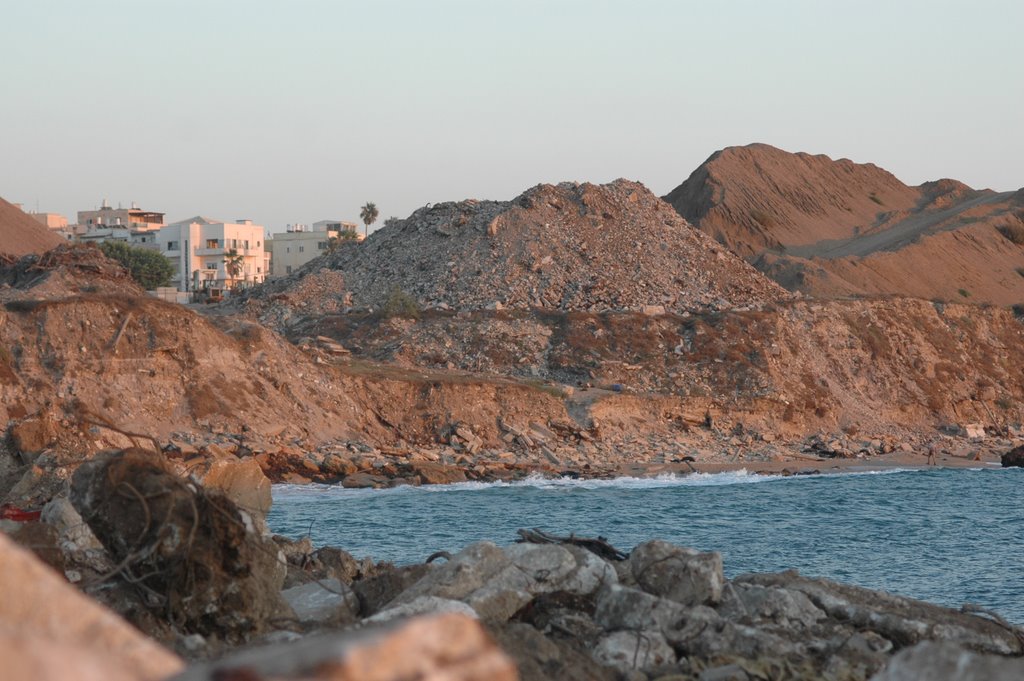
Jaffa also has a huge mountain, covering what used to be Jaffa's gorgeous ancient Al Ajami beach. A mountain made up entirely out of rubbish, a true monster.

Most of Jaffa, as can be seen from aereal photographs from as late as the 1960-ies, used to have a very long beach, running from south of Jaffa harbor to today's beach, all along Street nr. 60 (or Kedem street as it is called nowadays). A wonderful beach, used by fishermen and all locals for swimming and recreation.
By the 1960-ies many of Jaffa's once magnificent "Arab" houses had started to delapidate as a result of the complex social processes as well as the continued influence of of the salty sea air on buildings which are not properly maintained. Over 7000 houses were subsequently destroyed, their rubble simply dumped into the sea. The Jaffa beach had become the place to dump building rubble and as well as other rubbish completely for free. Contractors from all over the country came with their truckloads which soon turned into a huge mountain, where there once was a beach and water, where fish swam and children played. The mountain runs along the coast for about 2 km's, is about 500 m. wide and is today more than 20 m. high at some places. A mountain made entirely out of rubbish. Some of it Jaffa's beautiful old houses, a true grave for Jaffa's Naqbe.

The idea behind the mountain was to create a piece of artificial seafront land on which villas for the very wealthy would be constructed. The arrival of those very wealthy people would "raise the level of the locals" (yeah right, we really need that).

But, the mountain was dumped in such a way that it proved unstable. So large construction on top of it would be very problematic and unsafe.

The mountain also cut of Al Ajami from the sea. Streets which once had a gentle slope towards the sea now end in a huge mountain, suddenly rising out of nowhere. The fresh seawind in summer and beautiful view has been blocked. On top of the mountain wild plants started to grow and in winter, at some hours of the day, it is almost beautiful.

When the first and the second gulf wars came around, the US army placed a battery of Patriot anti-missile missiles on top of it, surrounded by barbed wires and guards. We in Al Ajami were woken up by American marching music competing with the muezzin, a weird sound, but all that is now memory (and it better stay memory).

This time the Jaffa people (by means of Al Rabita and Yafo Yefat Yamim, two NGO's, one a Palestinian NGO, the other a mostly Jewish NGO) decided not to play the municipal planners' game and took the municipality to court and won. Moreover, the recent law concerning construction on public beaches has saved our beach, so we hope for ever, from real estate interests.

As a result the mountain is to be turned into a park. Jaffa has about 50% of the green areas per resident as compared to the rest of Tel Aviv. Thus, a park serving everyone is actually quite welcome.
The municipality (by means of our local branch, the so-called mishlama) even met with different groups of residents, in order to hear about our needs and share in the planning (which at the time of the meetings had been almost finalized, so perhaps the meetings were meant more to pacify as than anything else) .

The park plan includes grinding the mountains huge concrete and other blocks into smaller stones and sand, completely changing the mountain's shape in order to make it into a natural part of Jaffa, sloping towards Al Ajami and towards the sea and re-creating a few pieces of beach.
The plants used will be natural mediterranean and there are supposed to be bike paths, places for children to play etc. etc. In theory not a bad plan at all.
The grinding of a mountain this big scared us, residents, a lot (and still does), because of the dust and other particles it would create, which are all carried inland by the winds coming in from the sea.
The planners told us not to worry, the dust would be monitored and on very problematic days, the work would be stoppped and solutions find. Whenever i am told not to worry, i tend to get VERY worried.

About a year ago some huge machines arrived on top of the mountain. Walls made out of industrial steel were put all around and the work started.
My house is dustier than ever, but the work seemed to be going quickly and the mountain indeed started to change its shape. Close to the harbor (the northern part of the mountain) it is now gently sloping, more to the south it is twice as high as before. Huge new mounds of differently sized blocks, stones, sand and iron top it off on its southern end.

My house is dustier than ever and my lungs don't seem to like it too much either.

Then all of a sudden the work stopped. They say their is a fight between the contractor and the municipality. As a result, we are stuck with an even bigger monster, twice as high as before, no park, no beach and what is scarier, very unhealthy air.

On my last walk on top of the "thing", yesterday, i noticed lots of small pieces of asbestos roofing. Apparently they have also ground tons of asbestos that were buried in the mountain. I assume that when you grind asbestos, its fibers come loose and the wind carries them inland. And keeps carrying them inland.

So what is the sum of our "beachpark" sofar: 1 monster, no park, no beach, no view, lotsa asbestos dust.
Thank you very much, mayor.

GivatHaZevel, the Rubbish Mountain
Jan 9, 2005 - 33 Photos


Thursday, August 31

Jaffa beach privatized....

Jaffa has a lovely beach, Jabaliya beach, or, as it is called in Hebrew, "Givat Aliyah Beach".
Jabaliyah was the name of a small Palestinian fishermen's hamlet, just south of Jaffa.
Over the years (before 1948) it developed and became a part of Jaffa. "Jabaliyah" is also the name of the Gaza refugee camp, to which many of Jabaliya's residents escaped in 1948.
The Hebrew name Givat Aliyah sounds like Jabaliyah, although in it really means "Hill of the (Jewish) Migration to Israel".
Jabaliyah Beach today is one of those places in which Jaffaites from all social strata and ethnic groups meet, Al Ajami's Palestinians and gentrifying Jewish yuppies, recent migrants from the ex-Soviet Union territories, who live in Jaffa's public housing estates (Yafo Daled and Yafo Gimmel), Ethiopian jews, "illegal" labor migrants from Jordan, Egypt as well as Palestinian laborers who have managed to sneak into Israel for work purposes from the Gaza strip, children & adults, young boys washing their horses and donkeys in the sea water, women in tini bikinis next to fully dressed devout Muslim women; During the early morning and late evening hours you can still encounter many fishermen.
We all meet at the beach and enjoy a slice of cold water melon or an icicle, while hearing the shouts of the lifeguards in both Hebrew and Arabic telling this child or that woman to "immediately get between the flags", where they can be watched, as today the currents and waves are high, strong and dangerous".

The beach has well developed facilities, bathrooms, changing rooms and a first-aid post, all for free. There is lots of parking space.

That is, when the facilities are avaiable. Lately we have seen more and more occasions on which private companies simply cordon off a part of the beach and ALL of the facilities in order to hold private parties.
They put guards at the entrance to keep us out.

The beach is public and belongs to all of us. The facilites are there to serve the Jaffa population, not party goers from north Tel Aviv who want an "authentic Jaffa evening on the beach" while guarded by their own gorrillas so, money forbid, one of us might sneak in and grab a pita from the buffet.

Seeing it stolen from us by the well-to-do with their catering services, security companies and Dj's REALLY pisses me off.

The image shows an event organized by a company called "artnet" for their staff and select customers, yesterday evening.


Wednesday, August 30

One out of every three Israeli children is poor

, about

The Social Security Institute published its bi-annual report on poverty and things are poor indeed.
TWENTYFIVE % of Israelis are poor and one out of every three children is poor.
There will be headlines for a day or two, and demands for "a clear policy in order to eradicate poverty", then some other item will take over our attention, until the next report, and the next.

The poor don't need the report, they experience poverty daily. And they also know something else, it's not going to end soon. Many were children of poor parents, and their children will probably be poor as well. "That's how it goes". Or is it? Why?

Israel has 4 (or was it three?) ministers without portfolio, but there is no Minister of Welfare, after all in that particular field all is "well".

In Jaffa, poverty means no electiricty and water (or illegal connections, circumventing the meters, which is quite dangerous as it goes).
It means not having enough food (i'm not talking about quality, but about quantity).
It means not buying prescription medicine for your child as you cannot afford it, or it would imply not buying bread for all of the family. It means not having schoolbooks. It means not attending schooltrips, because your parents haven't paid the bills for those for many years now, it means sharing one pair of shoes with another family member, never getting a real present when the holidays arrive, it means never having visited Tel Aviv although you live a 10-minute busride away in a suburb, Jaffa. It means having no glass in your windows, so it gets really cold, drafty and wet inside the house during winter. It means being kicked out of your council housing 3 days after you came home from a cancer operation, stitches still bleeding, sleeping outside, when you come back, sick, from chemotherapyIt means a 18 year old girl leaving school to provide for all her brothers and sisters, as the family has no other income from her underpaid job as a checkout girl, it means a 12 year old child going into prostitution and i can go on and on and on.

ALL details here are based on families i know myself, personally.

"One out of every 3 children" is not a ststistic newspaper heading, to be forgotten tomorrow, it's reality.

And it is a problem that CAN be solved. It's a matter of priorities. But the needs of those who have appear to be stronger than those who don't have, after al, according to the same report, the rich have gotten richer.
No and food parces are NOT than answer, nor is donating your old computer to a kid that has none. It's about deviding resources more equally, about providing real chances, about raising the minimum wage, about no more welfare cuts, about having a minister of welfare!

The image shows the entrance to the main Jaffa office of Municipal Welfare Services and Halamish, the public housing company.
I manipulated the image as an illustration of what i think about the level of service they provide.


Saturday, August 26

And some more shooting...

Last night, 23.30 o'clock, Yefet street, shooting time again.
Apparently the police have arrested a suspect or so they claim. It isn't even news any longer, we've simply gotten used to the sound of shots, or so it seems.

Sunday update: someone on a motorbike, unrecognizable because of his visored helmet shot (but missed) the brother of a good friend of mine, in front of her eyes.
The guy is married, with young children and has no connection to the criminal world.

Hell, that's close by in more than one sense.

On the meaning of social statistics and discrimination

With your head in a freezer and your feet in an oven at the same time, you may feel quite well, on average, that is, were we to believe the numerical implications of social statistics.

I just read 15 million (fifteen million, no, not a numerical mistake) people in China are currently homeless as a result of typhoons. A catastrophe of a size we cannot even begin to imagine. I truly hope the Chinese have better logistics, welfare, contruction, health etc. etc. professionals than we have here in our northern district.

And on a much more local scale:

I also read in the weekend papers (our local "HaIr", to be exact), the Tel Aviv municipality has canceled 226 (two hundred twenty six) welfare and social work jobs over the last 5 years, a trend they intend to continue also during the coming year. It is impossible (for me with my limited means) to figure out how many of these jobs were canceled in Jaffa as the municipal statistics presented to the public, are constructed in such a way, it is impossible to analyze them by sub-district and the concept "south Tel Aviv" also includes the Shapira, Florentine, Kiryat Shalom and other neighborhoods, which are not part of Jaffa.
However, from my experience and talks to people here, i know a thing or two about what is happening in the Jaffa welfare scene.

Jaffa has e.g. two separate "advancement of youth" ("kidum noar) municipal systems, one for Arab speakers , the other one for Hebrew speakers. Both groups work with street youths, school drop-outs, kids in danger of becoming marginalised. They work only with kids until the age of 18. After that, the municipality provides nothing, zil, zero, efes (0 in Hebrew), sifer (0 in Arabic), who cares.... (sure there are a few NGO's doing a great job, but they are not part of the municipality). Apparently when these kids reach the age of eighteen, their problems are all of a sudden, as if by magic, solved. In this context, it is fair to state i do some work for one of the NGO's with girls and young women in the ages 18 - 25.
More over, the employees of the Jewish system do all have "steady jobs" as municipality employees, whereas the employees of the Arab system have temporary contracts for part time jobs, which can be deminished easily. And many have been made redundant, or have their jobs cut to part-time jobs over the last few years.
No doubt, there is distress and danger of marginalization for most of Jaffa's youth, both Jewish AND Palestinian (or Arab Israelis, as the media and the municipality like to call them).
Yet services for both groups are not the same.

Ideally, in a society which holds equal chances and social justice as important values, where the needs are biggest, is where you should spend the most. Thus, in south Tel Aviv in general and in Jaffa in specific, relatively more should be spent on welfare and (in) formal education than in, let's say Ramat Aviv Gimmel or Bavli or any of the other wealthy and rich neighborhoods in Tel Aviv's north.
Moreover, more should be spent in order to assist Jaffa's Palestinian population, as even the municipality admits, this is by far the weakest population in the Tel Aviv-Yafo municipality (source: the municipal "Jaffa Conference for Wlefare and Education, held in December 2005).

However, the opposite appears to be the case. The poor get poorer and the services provided to them get worse, thereby deepening the problem. Especialy for children, this is detriment. Their chances are minimalized and a 3rd and 4th generation to poverty is in the making.

The cancellation of 266 welfare jobs does very little to solve that.

The welfare system in Jaffa is little more than a sad joke, no longer believed in by anyone, the population nor many of its demoralized employees.
The decisions to cut welfare jobs and where to cut them are part of a policy, someone makes those decisions and another group of people authorize them.
Is it social justice that guides them, or perhaps something else, such as the wish for continued support from their buddies in the northern neighborhoods where many of the policy makers live.


Thursday, August 24

Communal Taxis in Jaffa!!! Finally

Wonder of wonders, somebody "up there" read this morning's earler post about the bad service we Al Ajami residents receive from the Dan bus cooperative?
Waiting, yes, once more, for busline 46 to arrive and complaining just like all other people waitng with me, a yellow communal taxi passed by & stoppped.
Since 3 days communal taxi nr. 4A provides services to Jaffa residents! At the price of 5 NIS it is actually cheaper than the bus, which costs 5.10 NIS, moreover they stop on the route, wherever you want them to .
The taxi's leave from Balfour (Bat Yam) through Yefet street, make a turn through the flea market in Yehuda MeRaguza street, then left again at HaEshel (the Flea-market)
street, then the clock tower square, along the beach until Allenby and from Allenby to the Central bus station.

The driver happened to be the one of the big bosses of the communal taxi firm, Johanan Shapira who said that if the request will be big, they can drive every 5 minutes! So far people make little use of the new communal taxi line, as it is new and they are not yet aware of it.
He also told me about a similar experiment in north Tel Aviv that has proven to be very successful, but it depends on us, Jaffa residents, to make use of it the new line and turn it into a success.
In north Tel Aviv the line was successful and then by means of community action by r4esidents andf drivers, expanded to a larger area along the Dan bus routes, who suddenly started to feel the competition and improved their services. Now both the taxis and the Dan buses there compete, and the people living there profit form improved services.
The phonenumber of the communal taxi firm for any complaints or suggestions: 050-8330176 or 050-8330164


Dan buslines in Jaffa - Bad Service as a norm

I recall the days buses had those hard blue sticky plastic seats and you could smoke in the back. All windows were open, to let in some "fresh" air in our hot and H U M I D summer. There was usually only standing space and the busstop i hated most, was next to the fish stores in Jaffa, the overpowering fish smell adding that "little something" to the summer bus odors (i guess deodorant was very expensive at the time) , which just made me... ok i don't want to put you off just yet.

Today's Dan Cooperative Busses are red, usually the airconditioning works (except for the back part in the large "harmonica" busses), the seats are comfortable and some even have space for wheel chairs.

BUT...

When the 2nd intifada erupted in 2000, there were a few demonstrations in Jaffa. We even heard about a stone thrown at a bus. In reaction, the Dan company changed its routes "for so called safety reasons" or some other funny explanation I don't remember.
As a result a large part of Al Ajami neighborhoodwas left bus-less, implying elderly, children and generally speaking all of us not owning or wishing to use a car, have to walk long distances to reach the closest bus stop.

Some modifications in the route have been made since then, and the Dan public transport cooperative denies we are receiving a collective punishment, but that's exactly what we perceive. Public transport deteriorated and keeps deteriorating.

In the mean time, the municipality started roadworks here and there in Jaffa (which have been going on for years now) and bus routes are modified on a whim, without informing the public, the clients, who often wait (in this very hot and humid weather) in busstops that were cancelled a week ago, but no body has bothered to put up a sign, so there we wait, the old and infirm, the poor, the children, in the hot summer sun.

Ofcourse in Jaffa a bus stop is in many cases just a sign, there are no seats, nor bus stop shelters, no shadow (Allthough i must thankfully admit this week they finally placed an actual real touchable, non virtual shelter close to my house, in Yefet street!), so yes, we all wait in the sun.

It gets worse, however. Once upon a time bus line 46 had a bus every few minutes, during peak hours. Lately i have found myself waiting over 30 minutes for the bus nr. 46. No, not a freak incident, everybody has noticed there are less buses at all hours of the day.

Bus line 10 (we only have 2 Dan lines in Al Ajami) has an old VERY bad record with a bus every 20 - 25 minutes, but we know that, so unless i absolutely must, i don't use that line, it's quicker to take 46 to wherever and hop on another busline, but now "our" 46 busline has started messing up.

Why? No one (except for the Dan Cooperative ofcourse) knows. Perhaps they even deny it, but, come on guys, we are your clients and don't think we don't "notice it", when we have to wait 30 minutes for the bl**** bus to arrive.

(and thanks for the new bus stop shelter at Yefet, we appreciate it, just make sure to keep working on the other ones as well)


Wednesday, August 16

Shooting, assault, it's all as usual in Jaffa

Just over these last 2 days: a guy was shot at ( in the Noga area), a car shot at in Zhihatly street and stabbing and fighting between groups of young men in Jerusalem boulevard, everything "back to normal" or perhaps just "as usual" in Jaffa.

In many of the cases the police is not at all involved. That's also part of "usual".

Tuesday, August 8

In Jaffa, the muse continues singing (for the time being)

Jaffa, prior to 1948, was Palestine's cultural center: printing houses. poetry-readings, performances, cinemas, newspapers etc. characterized Jaffa. Both Palestinian and Jewish artists worked in Jaffa.
All that was lost in 1948. The so-called "artists quarter" of Jaffa's old city is not much more than a fake, set up for tourists' sake and not a very successful one at that. True, it is a lovely area, but it's dead inhabited by ghosts and very wealthy tourists, some galleries and shops catering to foreigners looking for kitschy memos of their visit to the holy land.
The old city is too expensive for most artists and there isn't even one Palestinian living there these days.
Once upon a time, not so very long ago, Jaffa's old city was a quarter where the poor fishermen and harbor workers lived in cramped conditions. No runnig water, no electricity, but it was alive. children running and playing in the streets, women meeting each other for a chat while on their way to or from the market, or shouting from one rooftop to the other, while hanging the laundry. All that is gone now. The beauty is still there, but she's asleep and it is not clear if and when the prince will arrive.

But not all is bad.
The lighthouse gallery, located close to the harbor at 13 HaMigdalor street, opens a group exhibit this coming saturday evening, August the 12th at 20.00 o'clock.

The exhibion is being curated by Ruth Yakobson, the participating artists are:

Rachel Shavit, Itamar Siani, Edna Meron Wavner, Lihi Gandler Talmor, Dorit Yakobi, Yaffa Meir, Ami Shnar, Etty Mor, Ilana Appel Admon, Margarita Naot, Gilad Duvshani, Dror Almagor, Hanan Shafir, Shlomo Levi and Ayelet Frank.


Friday, August 4

Funny green container with disturbing information

Following Nasrallah's warning about launching missiles aimed at Tel Aviv, the municipality published a list of public shelters on its website. Currently the shelters are locked, but, so the municipality stresses, they will be opened according to the guidelines provided by "pikud ha'oref" (home command or some such).
I guess that means AFTER things start going badly (hoping ofcourse they won't). The shelter relatively close to my home is more than 1 minute of very quick running away. And i am a good sprinter. I heard we'll have a 1-minute warning, so that will leave me kind of outside.
The shelter's also locked. Over the years it has been turned into a youth club, well equipped with computers (connected to the internet, so assuming electricity and connection to be up during and after the attack, i can continue blogging in real time), airconditioning etc. and this being Jaffa, a series of very well locked doors. The key is with those responsible for the club, not the municipality. At least the shelter is clean and in a reasonable state. Who knows what the condition of other shelters in Jaffa is. Over time some became homes for the homeless, other good hiding places for drugs stashes and some others yet nice, fancy living quarters to our local rat population.

Suddenly some very large green containers started to sprout in Jaffa, carrying signs suggesting they are sort of, well, situation related. Ofcourse they are also locked, i guess one can call the phone numbers provided, when needed (hoping the system will not be dead and the mobile system overloaded by everyone and their grandmother calling to ask everyone else if they are OK.

I guess i like to think they won't be needed, so why bother. I hope i am right.

And i better be; it appears there is no one truly responsible for whatever happens to Israel's civilian population. The government does not wish to officially declare war nor emergency, as that would imply finanacial responsibilities rather not taken by the ministry of finance. Money's always first on their minds, "kibinimat the people". (how does one translate "kibinimat", anyone out there?)
Over the last several years so many services have been privatised, that well-meaning but not necessarily efficient NGO's have taken over many functions previously undertaken by the goverment. The state no longer is responsible. And that means you gotta be lucky or well-connected to receive good assistance. Often NGO's provide local or area-wide services. Sometimes by well trained volunteers which is ok, but what if one needs expert professional services? And, during time of war, what about the commitment of those well meaning volunteers? And the infrastructure supporting the services?
I do some work at a Jaffa NGO. We have no shelter, nor a windowless room. The one story building is old and there is no "mamad". The closest shelter is way further than 1 minute of very quick running. Would it be responsible to continue providing services under those conditions or would it be lacking responsibility to do so? After all, protection is far away. Both clients and staff would be in danger.
There is no minister of welfare and that says it all. Eighteen ministers, several portfolio-less, but no minister of welfare.
You think the US government's response to hurricane Katrina was inadequate? Wait till the shit hits the fan here (and it is hitting the fan big-time in the north of the country). For years we have been lulling ourselves to sleep thinking "private services" are much more efficient than state-run ones. I suppose there will be an enquiry committee which will publish a long report with many suggestions on improving services. The state nor the municipality see themselves as responsible for the welfare of the people.
And that's way beyond semantics.

And for the Hebrew challenged, the image shows a sign pasted on one of the large green containers. It states the container holds emergency equipment.

Once upon a time there was a beautiful princess or, why do we hate the Andromeda compound that much

Once upon a time, long ago, here in Jaffa, lived a beautiful young princess, named Andromeda. Her family loved her. She was pampered as befits a princess. A wonderful future awaited her, so all expected.

However, horrible times came upon Jaffa: a monster from the deep sea started to devour the city's fishermen, one after the other. Each morning, at sunrise, many little boats left Jaffa's natural harbor for another day of hard work. Every afternoon, when the little aflucas* came back to the harbor, there were some missing. Initially one, then two, but the monster became hungrier and the fishermen stopped going out to sea and the city's people became hungry as well; Something had to be done.
All kinds of tricks to submit the monster were tried, to no avail.
Only one thing would pacify the the monster: Andromeda.
To save the city from hunger, her father had her chained to the rocks at the harbor entrance as an offer. Thankfully Andromeda (as well as the city) were saved by a chivalrous hero who then married her and they lived happily ever after, had many children and Jaffa flourished. Until this very day, Andromeda's rocks are still there at the harbor's entrance; a reminder of the dangers at sea, a lovely bride and her hero. And Andromeda's great great great grandchildren (some at least, since 1948 many live in Jabaliya refugee camp and what is left of Beirut and Ein ElHilwe) still enjoy Jaffa's beautiful sea and harbor.

Fairytales are one thing, reality is somewhat different or, as Neri Livne put it in this week's Ha'aretz weekly rag:
"Wait, wait, don't rush home to write," said A., one of my colleagues at the newspaper. "Maybe a missile will fall on Tel Aviv and you won't have to do your column." That's not funny, I told him. "Okay, but if a missile does fall in Tel Aviv," he added, "at least let it fall on Kikar Atarim." Tel Aviv has loads of places that may be worth getting rid of: Kikar Atarim, City Hall, Dizengoff Square and especially that monstrous sculpture, the hotels on the beach, the Andromeda Hill project in Jaffa. "It's lucky," I said to him, "that at least it's impossible to destroy the underground transportation system here."
True, i had a laugh, and then i started to think. How is it, that so many of us in Jaffa automatically cringe when we hear the name "Andromeda Hill" and think of a medusa rather than a lovely princess?
The gated compound of that name, located at the northern end of Yefet street, was constructed some years ago, on land bought from the Greek Orthodox patriarchate by means of a sales procedure which has left, reportedly, quite a few questions unanswered and not according to the wishes of many from the local Greek Orthodox community: the majority of Jaffa's Christian Palestinians.

The compound has a wonderful view on Jaffa's harbor and the sea, which are no longer visible from Yefet street.
Right in the middle, there is a PUBLIC pedestrian pathway which is supposed to be open to the all of us. However the securityguard at the entrance doesn't allow anyone through, unless they live in the compound or have been invited by the compound's residents. So what if the municipal construction permits specifically state the path is public? The compound's wealthy inhabitants don't want us, locals, hanging around in the middle of their fancy 'hood.
Another one of the conditions of the building permit was the construction of an additional little park or kindergarden for the good of the Jaffa public as part of the project. So far, although people moved in to live there several years ago, the cornerstone for those buildings for the public good has not been laid.
Apparently the real estate company, who claim they have not yet finished building all buildings for which they have a permit, "will do so after completing construction of the private appartment buildings". Translation into Jaffaite: forget about our public commitments, we'll never completely finish the private construction, so just wait patiently, forever, we don't want you here, unless it is to clean the pool, the appartments or maintain the garden".

But there is more; The land was owned, as stated, by the Greek Orthodox community for future public developments, such as additions to the school, a kindergarden, a community center or perhaps a church, as needed by the people of that community, an option now forever lost.
The marketing of the gated Andromeda compound was more instructive than the project's developers perhaps intended: The saleslady after having stressed the beaulty and romance of the "oriental location" went on to stress its safety
"no Arabs live in this area and the municipality will not allow it, this is part of north Jaffa, the Maronite neighborhood, in which there will be no Arabs, just like the old city of Jaffa and in any case, we will not allow the local community to enter the compound which is guarded 24 hours a day by a private company, so you don't have to worry, you are completely safe here".
Yeah right, "Araber-rein" perhaps? Replace Arabs with "Jews" and Jaffa with, let's say an American, Canadian or European city name and the anti-defamtion league or the Wiesenthal Institute would be all over them, and righfully so.

Other than that, taste is ofcourse a very personal matter, but the massive, artificial stone covered orientalist kitschy constructions are as close to "originally Jaffaesque" as the appartment blocks in Jaffa Daled, Gimmel or "Shem HaGdolim" public housing estate in southern Givat Aliya (Jabaliya) neighborhood. I 'm sure they are comfortable inside and have a nice view and the people living in the compound enjoy a high standard of living with their private swimmingpool, healthclub and restaurant. The presumed architectural dialogue of Andromeda Hill with Jaffa's sad, but lovely, Old City takes place more in the realms of cultural imperialism than in those of "authenticity" and (i'm on dangerous ground here) good taste.

But there is more: by constructing a gated (and well guarded) compound for the very wealthy only, another dialogue, or perhaps a lack of dialogue, has become more than obvious: the social gap between the fantasy-land compound (them) and us, living in real Jaffa (the Jaffa of poverty, of bad social and educational services, of violence, crimes and drugabuse) is wider than ever.
The ideas of "bringing strong populations to the weak neighborhoods" doesn't work, when the gaps are this big and gates and guards create high physical borders, when the land was taken from the local community and when the compound's inhabitants are not a part of Jaffa, but a separate an alien entity in our midst.

Moreover, the "strong people, living in their multimillion houses have driven up the prices, and the local people can no longer buy appartments for their children, who are forced to live in "illegal" constructions or move to other areas in Jaffa or to Lod or Ramle. And perhaps that is what the municipality has in mind, perhaps that is what gentrification is all about: get rid of the poor (who will become somebody else's responsibility) and make it nice an cozy for the wealthy. That's why i don't like that piece of prime property named after a beautiful Jaffa princess, Andromeda.

No, i don't want any missiles destroying Andromeda or any other part of Jaffa, i believe in non violence. I'm sure the flats in Andromeda all have mamadim (shelters) unlike the place where i live. Maybe the Andromeda people can make something good and welcome Jaffa's poor from the shelterless housing estates to their mamadim?

*an afluca is a small traditional fishermen's boat, they can still be seen in Jaffa's harbor to this very day.


.