Saturday, June 23

Emile Habibi Road - finally.

"The madman, in the meantime, was busy painting a wall with a brush tipped into a bucket with no bottom. When the lawyer returned, sweat streaming, the madman asked, "Well, did you uproot the tree?"
"Yes I did," the lawyer replied. "I uprooted it completely, but didn't find your treasure."
"Get yourself a brush and a bottomless bucket and stand next to me and do some painting," the madman suggested."

From "The Secret Life of Saeed, the Pessoptimist" by Emile Habibi

Once upon a time the streets and neighbourhoods in Jaffa (well those that had names at least, many were known by the numbers, such as "60 street", - today's Kedem Sstreet) had Palestinian or Ottoman names, Boustrous, Nouzha, Jamal Pasha, Manshiyeh and Ajami, to mention just a few.

After 1948 everything was done to wipe out Jaffa's Palestinian character and street names were changed. Nouzha became Jerusalem Boulevard and Boustrous was changed into Raziel.
In all of Jaffa there are 4 or 5 streets with Arab names.
For many years now requests have been submitted to the municipality to name Jaffa's streets after Palestinians. The municipality had refused these requests for a variety of reasons, until now.
Finally, after many long years, a little justice. The municipality has authorised the request to name a street after Emile Habibi (1921-1996), author, politician (Knesset Member for the communist party), editor of the Al Itihad daily newpaper and Israel Prize for Literature recipient.

Other streets in Jaffa will be named for Ibn Khaldoun and others.
It's about time.


International Refugee Day - Activities in Jaffa


Last night some 25 refugees from Soudan crossed into Israel. Leaving behind them the horror of Darfour, they hope to find a safe place for their children and themselves.


So you'd like to do something for them? You can.
Today.
Today, at 16.30 at the Arab Jewish community Center in Jaffa (at the Kedem - Mendes France crossing) there will be a festivity in honor of the International Refugee Day.
The activities start at 16.30 and include a panel, games for children, ethnic food stands and a football game.
The festivities are organised by "Doctors for Human Rights", Mesila and other NGO's.

Almost every night refugees travel by foot through the hot dry and dangerous desert to cross into Israel, to save their lives. At the border, they are picked up by the army or the border police and dumped in Beer Sheva, where volunteers from NGO's and a few social work students from Ben Gurion University try to find solutions for each and every one.
Some of the refugees have been assisted by Bedouin volunteers from Lakiyah's women's organization.

A few days ago a young Sudanese woman gave birth at the border. She was taken to Be'er Sheva's Soroka Hospital by an army ambulance and called her newborn son "Israel". A day later her husband and their 2 young toddlers joined her.

The work with refugees is carried out by volunteers and so far, the state has taken few responsibilities.
This coming week a special meeting at the Knesset will be dedicated to finding solutions for the Soudanese refugees, whose numbers are increasing day by day.

It is time our voice is heard. We DO have a responsibility for these people.

Some 65 years ago a boat, packed with Jewish refugees, left a German harbour. They hoped to sail to a safe place, but no country was willing to accept the refugees. The boat sailed back to its German harbour and almost all the refugees died in concentration camps. they could have been saved. They almost WERE saved, but no one cared enough. The world stood by.

Some 50 years later, a few small ships carrying Vietnamese "boat-people" were picked up by a ZIM merchant container ship. They were given Israeli citizenship and in fact many of them, their children and grand children, live in Jaffa up to this very day.

Cambodia, Rouanda, Sebrenice, the list is long. The world stood by and did nothing.

Today we CAN do something. albeit something, something small.
So come over to Jaffa today, and see how and where YOU can help.


Wednesday, June 20

Death Song

The AlSeraya theatre in Jaffa (part of the Arab Hebrew theatre) currently presents "Death Song" (in Arabic) by the Egyptian playwright Tawfik AlHakim, directed and Oleg Radovilsky.

The play tells the story of a widow, whose husband was murdered, when their son was 2 years old.
Finally the son, now grown up, returns home from his religious studies at the Islamic university.

His mother welcomes him by giving him a knife, to carry out her long planned revenge.

However, the son's religious studies have transformed him into a peace loving, deeply religious man, not interested in taking another person's life.

Beyond anger and shame, the mother gives the knife to a cousin, with tragic results.


Monday, June 18

No exit?

Several people are stuck in "Erez" Crossing, trying to get out of the Gaza Strip.
They are stuck, unable to go back into the Gaza strip, where they feel their lives are in danger and unable to cross through Israel into the West Bank.
There are no facilities at the checkpoint. But that's something one can, perhaps , live with for a while.
However, what is scary, is the shooting today into the checkpoint area.
Israel claims a grenade was thrown by Hamas, who also shot into the crossing. Israeli soldiers shot back. The Hamas spokesman claims the opposite, more or less.
It doesn't really matter, one person was killed and there appear to be some 10 wounded. That's the point. People, children among them, are being killed.
If these people will not be let quickly into the West Bank, there may well come about a blood bath, another Sabara & Shatila.
What are we waiting for? For yet more wounded and killed?

This is a catastrophe waiting to happen.
A preventable horror


Sunday, June 17

Khalil lives in a house he squatted some years ago. It had stood empty for many years, its wood work blackened and rotting, after a fire raged through the old building and gutted most of it.
Once upon a time, before 1948, the building was home to a Palestinian family. It then became a synagogue, and after that a storage area for used car tyres. It was torched and then stood empty, a shell registered as property belonging to the Israel Land Administration.
Khalil moved in, after he was thrown out of his previous home and with him came a pair of wild little birds.

During the day they fly around and do their birdy things. At sunset, they return home, fly around a while in Khalil's high ceilinged living room, until they go to sleep in the nest they built underneath one of the heavy iron support beams.

Usually they move around as a pair. However, sometimes, one of the birds comes home alone and waits for its partner. Occasionally the single bird will sit there for hours, alone, waiting, singing, until its partner returns.
Together they'll move into the living room, fly around and while and go to rest in their small nest. Day after day, the same routine. A peaceful routine. A simple life. Nature's course.

Undoubtedly like some of the birds in the Gaza strip.


Saturday, June 2

Fleamarket Fire

Heavy black smoke was the first sign. The wind was coming from the north west, so the smell became obvious only when coming closer.
Then i saw the flames, high, scary.

An old building form the Ottoman period burnt down in Jaffa's flea-market area this afternoon.
On the roof of the ancient building next to the long defunct Siksik Mosque someone had constructed a storage room for who knows what, flea market stuff. But until the fire was detected, it had spread to the other floors as well.
The fire brigade had a difficult job, as the location was hard to reach, between other buildings.

Several fire trucks and a long row of ambulances stood ready.
Police kept the public at bay.
A guy in a light blue t-shirt, who claimed to be the owner, was questioned by the police. He talked about an electricity failure, whereas others mentioned possible arson. Who knows.


GanTamar... Hadj Kakhil square

GanTamar is a central area of Jaffa, pronounced as if it is one word with the stress on Gan. I've asked different people why it is called that way and got different answers. It made me wonder about the names in the 'hood. Some streets are still numbered, others have names which have nothing to do with Jaffa and yet others may have official names, but no one uses them and very few even know them. In Jaffa places have their own names, often with roots that go back before 1948. Others.... i don't really know, here goes:

Hadj Kakhil square is a central point in Jaffa. It's not the official name of that little square (i don't really know how it is called, if at all), but the huge red neon light name pronounces the name fiercely, in Hebrew, "HADJ KAKHIL SQUARE", as if it were.

Not surprisingly, the small square connecting Shivtey Israel street and Yefet street is surrounded by small businesses owned by the family of that name; a restaurant, a grocery store, a pita bakery, a frozen yoghurt & fresh juice stand, a falafel joint, a toast counter and a smaller "humus only" restaurant. A few meters away there is also a counter of that name selling the best ma'amoul cookies in Jaffa and even a little further away along Yefet street another Hadj Kakhil store selling herbs and spices as well as various items said to be effective against the evil eye. I've probably forgotten a few other stores, but you get the point. (and no, they did not pay me for this article, yes i do by my grocery products in the slightly overpriced grocery, it's closest to my home and i'm lazy).
The Hadj Kakhils are not a large clan, but no doubt they're good business men and women. Nice, helpful and friendly people too, so it's pleasant to frequent their various establishments. By now the square is a landmark used by taxi and bus drivers and everyone else.

The other corner of the square is taken up by the "green house", another point of geographic reference. It's difficult to miss, a highe, 5 story green palatial house, surrounded by high walls. Today the military prosecution offices and the military court.

Once upon a time (read prior to 1948), the lovely house belonged to a wealthy orange-grove owner Khalil AlBanna. Old aerial photographs of the area show it to be located on the very outskirts of Jaffa, from here to the south west there were orange groves.

Khalil AlBanna was a wealthy man, father of 11 children, when he married a second wife, a 16 year old Alawitin, who bore him his 12th child, Sabri Khalil AlBanna in 1937.
After the father died in 1945, the young wife and her small son became unwanted outcasts in the wealthy AlBanna family who in 1948 fled to the Gaza strip, and after some time move to Nablous (then a part of the Jordanian kingdom), where Sabri grows up to become a very angry young man, who at the age of 18 joints the ba'ath party which soon becomes illegal.

Sabri runs away, and in Riyadh marries a refugee from Jaffa, Hiyam Al Bitar. They have three children, the oldest son is called Nidal. From then on, Sabri is known as Abu Nidal.
Rings a bell?
Exactly, the terrorist Abu Nidal.


Wednesday, May 30

Shooting in "GanTamar", Jaffa

A young man, apparently from the Ashur family (although not from THE famous Ashur clan, who apparently have been involved in a bloody vengeance war over the last several years), was shot this afternoon in Yefet Street, close to the junction with HaLotus street. While leaving a small store on Yefet street, the man was shot twice from a Renault car passing by. His wounds are said to be not severe. He's hospitalized in nearby Wolfson hospital.
The incident happened on once of Jaffa's busiest junctions at 16.15 o'clock.
It was witnessed by the police (!) who managed to arrest the driver and the shooter in Kedem street after a chase. During the chase the gun was thrown from the car and recovered by the police.

A few words from the bystanders: "i hope he dies, he's a violent creep, the victim". "Enough, those idiots, we've had enough violence. Let them all rot in jail" and other similar statements.
There was very little sympathy and much anger. The young guys hanging around on my street's corner are conversing among themselves. The women are worried, sitting outside on the porch and discussing the case amongst themselves, afraid for their sons. Only the small children run around with their kites and bicycles. Unaware and not yet involved.


Sunday, May 27

Home demolitions

A balcony, a wooden entrance door with a brass knocker instead of a bell and a hamsa, for good luck. Home to a young couple. No children as yet. A living room and kitchen, a bedroom, nothing luxurious, but it's a home.
The curtained windows look out over what once was an orange grove, green trees, shacks, muddy streets, car repair workshops, Jaffa's neighbourhoods on the far horizon: the grey apartment blocks of Yafo Daled and Gimmel, the pastel coloured ones of the border with Bat Yam.
There is something inherently evil about destroying a home.
The land of Pardes Dake belongs to the people living there. Many of the homes were constructed prior to 1948 yet after 1948 no regional development plan was made for the area and as a result it is not possible to receive a building permit, even if you ask very very nicely.
Over the years the family grew larger, and the sons constructed their homes in the pardes, close to those of their fathers, as is the tradition in this part of the world. Illegal? Yes, in a strictly legal manner of speaking yes, illegal. But they had no choice as there was no way to get a permission. Why is there no development plan for the pardes? There is no regional development plan for most of south Tel Aviv and Jaffa, as a matter of fact. But there were ways to circumvent this and somehow building permits were given to those close to the hearts of the municipal regulators and surprise surprise, the Dake family are not that close.

however, a home is a home, a roof over one's head a very basic necessity. The quick gentrification in Jaffa (as in Tel Aviv) is forcing many people out of their homes which are bought by the rich, strong and wealthy. Illegal building rules don't really apply to them, it's amazing how much illegal construction goes on in Tel Aviv. But when you are strong and have good lawyers, who cares? Even if that illegal manner of construction seriously damages the life quality of your neighbours. As i said, when you are rich here, the rules don't really apply to you. and if they do not fit, you just buy your way into changing the rules. So yes, a roof IS a basic necessity, but no longer does the state see itself responsible to ascertain that all its inhabitants can afford a decent home. As such, "home" no longer is something to be assumed as "certain". More and more people are loosing theirs in Jaffa. they do not necessarily move into the streets (although some do), many move in with family members, the kids in oje place, the parents in another, the family falling apart. Small 2 bedroom flats having become home to 20 people is no longer a rare occurance in Jaffa. Living in cramped quarters influences children's lives in many ways. It is difficult to concentrate on your homework. Small spaces often lead to much tension, which sometimes develops into violence in the family, often against its weakest members.
Several years ago people live in tents. When they had enough of it, they squatted several homes in Jaffa.
there has been no social housing construction for a great many years now. No building permits have been given to people living in public housing. The situation is desperate.
The Dake home is one of many.

The municipality calls it "the free market forces". I call it a crime against society's weaker members.


News Update on Pardes Dake

Some 60 activists, yours truly included, gathered today on the roof of the four-family home in Jaffa's "Pardes Dake", when police forces and municipal employees arrived in order to carry out the demolition order.

Omar Siksik of AlRabita, Fadi Shabita of Reut-Sedaka and labor party knesset member Nadia Hilu (a Jaffa resident herself) and ofcourse Moussa Dake, the house owner, undertook lenghty talks with the representatives, while receiving on-line legal advice.
Right now we are at a standstill. The demolition order has been postponed until June the 4th in order to try and receive some sort of legal understanding which will, hopefully, allow the family to stay in their home.
It's really important to find a viable legal solution, as this will reflect upon other homes in the Pardes Dake compound.

Violence is scary and police presence, amongst others in form of a border police jeep automatically raises fears.

At the same time there was something moving in seeing so many people from Jaffa involved and showing their solidarity. People from different families, political groups and backgrounds, from all ages, Palestinians and Jews together struggling for the right to viable housing.


Saturday, May 26

House demolition at Pardes Dake, take 2

The threat over Mousa Dake's family's home is up once more and it appears the bulldozers may come tomorrow morning, Sunday May the 27th.
So demonstrators will meet at the corner of Yefet / HaBa'al Shemtov street at 8.30 in the morning.

The house to be demolished is a two story building. It serves as a home to 4 families. The bottom floor was constructed prior to 1948, the second floor was constructed some 7 years ago. Without a building permit, true, but that is because it is not possible to get a building permit in the Pardes area, as there is no general municipal building plan for it. The area, 22 dunam, belongs to the Dake family.
Parts of the land have been sold in principle to Flatto Sharon, however, nothing has been paid for and offcially the land still belongs to the Dake family. The sale is supposed to go through in another 18 months. It makes one wonder why the municipality is so intent on destroying the home now, when they KNOW the family will leave in another 18 months.

The family doesn't plan on leaving. In any case, they have nowhere to go.


Thursday, May 24

So far it is quiet in Pardes Dake

"Pardes Dake" is not a place one easily walks into. It used to be an orange-grove many years ago, owned by the Dake family. Over time it became a living compound where car repair shops, shacks, garbage-strewn unpaved streets and alleys run haphazardly. Some nice 2 story houses, next to asbestos-roofed shacks give it the look of a refugee camp rather than a Jaffa neighbourhood. On my walk around, i saw a sort of cage looking like a compound for dog fights. there is much poverty. The compound doesn't have a very good name.
The Dake family tends to keep to itself. Some are said to be involved in crime, others are highly educated young professionals. The Dake family has special standing in Jaffa. Lately there have been rumours some of the Dake family started to sell their lands to wealthy developers, such as Shmuel Flato Sharon. 250.000 $ for a small 2-room shack, so the rumour goes.Apparently some papers have been signed, but so far none have received money. It has happened before in Jaffa, that people were swindled out of their homes, and Flatto Sharon, a convicted crook, doesn't have an honest reputation. They say Sharon wants to construct another gated compound in the area.
Life in the pardes is not easy, especially during the winterdays, when the houses are often flooded.

Moussa Dake has lived in the Pardes all his life, born during the British mandate period, he has seen it all.
He is a practical man, who has lived all his life, in the house in which he was born, prior to 1948. The lands are registered in his name in the "tabu" and there are no disputes over his ownership.
Over time the family increased and his son added a second story on top of the old family house. True, he had no building permission, but the family paid all the fines and that seemed to be it. Until last night, when the announcement of the coming demolition of ALL of the house (including the pre-1948 bottom floor) arrived.
The news passed quickly amongst the various Jaffa activists and some 40-50 people turned up this morning in the Dake compound to peacefully resist the destruction of yet another home in Jaffa.
The bulldozers didn't arrive. But it doesn't mean the home of Moussa is safe.
So far so good...


Wednesday, May 23

Prevent a house demolition in Jaffa tomorrow, Thursday May 24th

The home of the Thakka family is in danger of being demolished tomorrow morning. The house is located on the border between Ajami and Jabaliya neighborhoods in Jaffa. It was constructed on land owned by the family ("Tabu").
Activists and sympathisers will meet tomorrow morning, Thursday, May the 24th at 9 o'clock on the corner of Yefet and HaBa'al Shemtov streets in Jaffa, to prevent a family from loosing their home.

Saturday, May 19

The Jaffa Heiress

Intissar is seventeen, bright, funny, streetwise, the youngest of 10 children and until yesterday, full of hopes and dreams. A knock on the door of the small apartment where she lives, ended those dreams. Her sister's little, 3 year old, boy opened the door and several police men entered, with arrest warrants for Intissar, her elderly disabled mother and all of her nine sisters and brothers (2 of them disabled as well). That's 11 arrest warrants in one go.
Why?

Because of debts, not even theirs. Debts they inherited.

The story goes back a long time. Intissar's mum developed a mental disease, when Intissar was very young, a tiny toddler, and became unable to care for her children. Intissar's father was addicted to to drugs and alcohol. The welfare department removed all children from the home and placed them in boarding schools. Intissar was only 2 years old, when they took her from her parents' care and placed her in a home, in order to give her a chance, by juvenile court order.

Intissar's father died about 4 years ago. Junkies with alcohol problems don't live long. After his death, all minor children were returned home by the welfare department. Their mum is still suffering from the same severe psychiatric disorder she's had for many years, and not really able to care for her daughters. But Intissar is strong and in spite of many difficulties, she copes, somehow. But how can a 17 year old girl cope with her "heritage of debts"? Because that's the problem here.

In Israel, when a person dies, and he or she leaves behind money or other possessions, these are shared by the inheritors according the the person's last will or, if there is no will, according to the law on inheritance.
BUT, if the person died owing money, his or her inheritors inherit his or her debts. If the person owned a house, usually the house can be sold, the debts covered and the remainder shared among the family, the cat or dog or whoever else.
Yet, in Intissar's case there is no home to be sold, there are no possessions. Her large family lives in a tiny public housing apartment in one of the worst slums in Jaffa.

All of the children grew up in boarding schools and children's homes. They hardly ever saw their parents. Their father was interested in one thing: getting high before cold turkey sets in.
Over the years he made incredible debts. How exactly is only partially clear. Each time the water. electricity or phone were cut, he renewed the connection not by paying the bills, but by putting the new bill in the name of the next child of his 10 children. Thus, all of the 10 kids, while they never lived at home and were minors, ran huge debts at the various utility companies without knowing anything about it.
I do not exactly understand how the utility companies accept contracts made by minors who are not present at all. Minors who have been made "wards of the state" and are under the responsibility of the welfare department.
But these are not the only debts. There is an "inheritance" of over a million NIS shared by all of the family members, and arrest warrants against all, including minor Intissar (which is illegal, by the way) because of those debts.
Intissar comes form a very weak background, but she is a fighter. Life in the many homes she stayed in, has toughened her. But she has no tools coping with this. In a few months she will be 18 years old. Instead of starting a career, and doing things 18-year olds like doing, she'll be facing impossible debts, her "inheritance".
When she works, most of her salary will go towards paying those debts. She'll become a slave to her father's "inheritance" of debts.
Through legal aid, she may be able to pay off those debts in monthly instalments always facing arrest if she doesn't meet them. Career? Study? Intissar can forget about those for years to come and perhaps for ever.
There is something VERY wrong with a system that allows this kind of injustice.


Intissar is not her real name, for reasons of confidentiality. The story is true, i wish it weren't

Friday, May 18

Something not so weird in Jaffa - Drugs

Last night, a police heli keeping me from concentrating on my book ("Bnot HaDrakon") by hovering with its powerful searchlight over my house, occasionally keeping me in its blinding focus.
Two streets more or less from my home, at Donollo HaRofe street, a huge drug search had been going on, successfully apparently.
Drugs and Ajami go pretty much hand in hand. And it was no secret to anyone from our 'hood that some of the inhabitants of that particular home were deeply involved. No longer so. Sixteen police cars came and the Israeli keystone variety arrested and carried off several people suspected of being involved and that trade.

Thursday, May 17

something weird is going on

Right now a police helicopter has been hovering above my house for several minutes. A strong light beam circles our rooftops, apparently searching for something
What? Who? Why? Hell knows.
Most of my neighbours are out on their balconies, rooftops and the street. Nobody seems to know much.
Perhaps this will turn into a developing story...

So far, not really.
It costs over $1000 per hour to keep a helicopter in the air. That's a lot of money for the short funded Jaffa cops, so it must have been something major. But there isn't a thing about it in the papers or on the news sites.

It feels exposed, to stand on one's rooftop balcony in the focus of a blinding search light.


Friday, May 11

Boycot "Mul Yam"

Today's Ha'aretz carries an amazing article, which just goes to show how much employers care about their employees' safety and health:
Mul Yam, a very fancy and expensive seafood restaurant in Tel Aviv's harbour is owned by Shalom Mahrovksy, who's most proud of keeping the names of his clients, some of them quite famous and others perhaps rather infamous, confidential, even when they try to abuse his employees.

According to the article in Ha'aretz, two female employees who volunteered to stay working late after the restaurant closed (and the rest of the employees had gone home after a long day and night of work), but a party was still going on in one of the private VIP rooms.
Both employees were offered a sip of wine by the client whose name is kept confidential by Mahrovsky.
Soon after that fateful sip, they started to loose consciousness. Another employee, who had not tasted the laced wine, managed to release one of the employees, when the guest tried to push her into a waiting taxi.
The other employee was too much out of it, to even close the restaurant.
Te next days both employees woke up after many hours, dizzy, confused and unable to remember anything from the previous evening. Symptoms consistent with so-called "rape drugs", like ketamine and others. The victims went to the hospital, but as these drugs break down quickly in the body (which is exactly what makes them so "attractive" for pervs and creeps) obviously it was too late to detect any signs.
Both employees were sacked (to be returned to their work later, when Mahrovsky understood all of the 48 man strong staff were very angry with him because of the victims' dismissal).
At the same time, Mahrovsky stated he keeps the name of the client confidential, but told him "not to come to his restaurant any longer". Which basically proves two points: Mahrovsky KNOWS exactly who the guy is, and protects him and his own business rather then his replaceable employees.
I suggest hitting him where it will hurt him most: his pocket. Boycot "Mul Yam".


Tuesday, May 8

So angry

Sometimes, i suppose, it 'd be much healthier not to read the paper early mornings.
Today's Ha'aretz tells me the minister of welfare wants to re-establish food coupons for the poor, to ensure they will receive food safety. What about paying liveable wages (some 40% of Israel's poor are employed full-time, but do not make enough money, the so-called "working poor") and enforcing these? And returning the horrid cuts in social security payments? These will do much more for food security.
The brilliant plan is an answer to the demand of various food charities, who believe they should not be held responsible for something so basic as food security. They are right of course, but a coupons program is NOT the answer.
Simply: PAY more.
Funny enough that has worked in several countries where it was tried. No, people did not loose their jobs and factories were not closed, and no there was not more unemployment as some of the cronies of the very wealthy want us to believe, whenever raising the minimum wage (and bloody well enforcing it) is mentioned.
Another "lovely" one from the Ha'aretz front-page: Netanyahu our next minister of defence? Noooooooooo, tell me i'm still asleep, please.

Which reminds me of the fact pointed out by "New Voices" that 18 families in Israel
"earn one-third of Israel’s commercial revenues, totaling approximately 44 billion dollars. This revenue counts for 32 percent of income within the State of Israel, but does not reflect the families’ inherited wealth, savings or any income from investments outside the country. The families’ earnings increased four percent from the previous year".

The same article also points out 7 of those families are friends of our beloved chairman (aka Olmert) , who, with Netanyahoo, sold them many of the country's assets in the framework of their beloved "privatization".

Where's the emergency exit?

Monday, May 7

Les Miserables, in Jaffa, in a way.

Several years ago i lived in a small street, just behind the "Nouzha" Mosque, in Victor Hugo Street. What i loved most about the small house, was its garden. I planted a vine, rosemary, morning glory "Leylet el kader" (a big green bush with tiny white flowers opening only at night, with a wonderful smell) flowers, herbs; my own small paradise.
I thought i would always live there.
True, the two drug-dealers in the street operating their business like a banking machine (put your money in a slot, collect your wares through the window) wasn't exactly my idea of "nice neighbours, but i loved the street, the house and the garden i planted.
Victor Hugo Street connects between Dante and Michelangelo streets. Somehow referring to both hell and heaven.
And yes, there were some really wonderful people living there too. And some very funny ones. Opposite my house there was a small 2 room apartment. The owner filled it up with 3 layer bunk beds and some 22 (yes twenty two) Chinese workers lived there. Only one of them knew English and none knew Hebrew nor Arabic. The English speaking Chinese guy had become a good friend over time, and spent the Seder night with us and many a regular evening in the small garden, joining us for some tea with nana or luisa.

Then, the shooting started. . Automatic guns, that is. A hell of a sound to wake up to. The greengrocer on the corner had been shot. Everybody out in the street at 4 o'clock in the morning. Shouting, scared, angry, fed up.
And me? When the lease ran out, i moved out of my little paradise.
I kept contact with some of the (other) neighbours.

Yesterday evening, the neighbours in Victor Hugo Street sat outside, as usual. People carry some chairs, a small table outside and enjoy the mellow evening temperatures with a tea, a coffee, a water-pipe, some sweets. The children play in the street. Just another evening, like so many others.
The sudden sound of shooting, automatic fire, rapid. Muhamad Zeynab, falls down, mortally wounded. His wife and a female neighbor are wounded as well.

Les miserables, Victor Hugo Street, Jaffa, 2007

Saturday, May 5

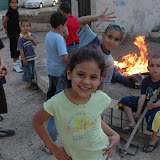
Lag Ba'Omer in Ajami

Some holidays are simply made for all.
On Purim all kids in Jaffa, including young Muslim children, dress up. Little girls in long flower-fairy dresses, little boys running around proudly as as spiderman or ninja turtle.
Some adults criticize this trend, but try kids to convince them NOT to dress up.

Towards Lag Ba'Omer Ajami's many villa building sites put up extra guards, as Jaffa children, ALL of them, walk around with old shopping carts (and some not so old ones) gathering wood for the their "LagBa'Omer fires": the higher the better and nowhere you find as much wood as on building sites. After the place has been selected, the kids start bringing out the wood they have been gathering (and carefully hiding) for a few weeks. While bringing on more wood, they always leave a kid behind to guard the growing pile from other groups of equally ardent youngsters.
Tonight it's "big fire" night in Ajami.


More images:
Lag_BaOmer