Saturday, May 19

The Jaffa Heiress

Intissar is seventeen, bright, funny, streetwise, the youngest of 10 children and until yesterday, full of hopes and dreams. A knock on the door of the small apartment where she lives, ended those dreams. Her sister's little, 3 year old, boy opened the door and several police men entered, with arrest warrants for Intissar, her elderly disabled mother and all of her nine sisters and brothers (2 of them disabled as well). That's 11 arrest warrants in one go.
Why?

Because of debts, not even theirs. Debts they inherited.

The story goes back a long time. Intissar's mum developed a mental disease, when Intissar was very young, a tiny toddler, and became unable to care for her children. Intissar's father was addicted to to drugs and alcohol. The welfare department removed all children from the home and placed them in boarding schools. Intissar was only 2 years old, when they took her from her parents' care and placed her in a home, in order to give her a chance, by juvenile court order.

Intissar's father died about 4 years ago. Junkies with alcohol problems don't live long. After his death, all minor children were returned home by the welfare department. Their mum is still suffering from the same severe psychiatric disorder she's had for many years, and not really able to care for her daughters. But Intissar is strong and in spite of many difficulties, she copes, somehow. But how can a 17 year old girl cope with her "heritage of debts"? Because that's the problem here.

In Israel, when a person dies, and he or she leaves behind money or other possessions, these are shared by the inheritors according the the person's last will or, if there is no will, according to the law on inheritance.
BUT, if the person died owing money, his or her inheritors inherit his or her debts. If the person owned a house, usually the house can be sold, the debts covered and the remainder shared among the family, the cat or dog or whoever else.
Yet, in Intissar's case there is no home to be sold, there are no possessions. Her large family lives in a tiny public housing apartment in one of the worst slums in Jaffa.

All of the children grew up in boarding schools and children's homes. They hardly ever saw their parents. Their father was interested in one thing: getting high before cold turkey sets in.
Over the years he made incredible debts. How exactly is only partially clear. Each time the water. electricity or phone were cut, he renewed the connection not by paying the bills, but by putting the new bill in the name of the next child of his 10 children. Thus, all of the 10 kids, while they never lived at home and were minors, ran huge debts at the various utility companies without knowing anything about it.
I do not exactly understand how the utility companies accept contracts made by minors who are not present at all. Minors who have been made "wards of the state" and are under the responsibility of the welfare department.
But these are not the only debts. There is an "inheritance" of over a million NIS shared by all of the family members, and arrest warrants against all, including minor Intissar (which is illegal, by the way) because of those debts.
Intissar comes form a very weak background, but she is a fighter. Life in the many homes she stayed in, has toughened her. But she has no tools coping with this. In a few months she will be 18 years old. Instead of starting a career, and doing things 18-year olds like doing, she'll be facing impossible debts, her "inheritance".
When she works, most of her salary will go towards paying those debts. She'll become a slave to her father's "inheritance" of debts.
Through legal aid, she may be able to pay off those debts in monthly instalments always facing arrest if she doesn't meet them. Career? Study? Intissar can forget about those for years to come and perhaps for ever.
There is something VERY wrong with a system that allows this kind of injustice.


Intissar is not her real name, for reasons of confidentiality. The story is true, i wish it weren't

Friday, May 18

Something not so weird in Jaffa - Drugs

Last night, a police heli keeping me from concentrating on my book ("Bnot HaDrakon") by hovering with its powerful searchlight over my house, occasionally keeping me in its blinding focus.
Two streets more or less from my home, at Donollo HaRofe street, a huge drug search had been going on, successfully apparently.
Drugs and Ajami go pretty much hand in hand. And it was no secret to anyone from our 'hood that some of the inhabitants of that particular home were deeply involved. No longer so. Sixteen police cars came and the Israeli keystone variety arrested and carried off several people suspected of being involved and that trade.

Thursday, May 17

something weird is going on

Right now a police helicopter has been hovering above my house for several minutes. A strong light beam circles our rooftops, apparently searching for something
What? Who? Why? Hell knows.
Most of my neighbours are out on their balconies, rooftops and the street. Nobody seems to know much.
Perhaps this will turn into a developing story...

So far, not really.
It costs over $1000 per hour to keep a helicopter in the air. That's a lot of money for the short funded Jaffa cops, so it must have been something major. But there isn't a thing about it in the papers or on the news sites.

It feels exposed, to stand on one's rooftop balcony in the focus of a blinding search light.


Friday, May 11

Boycot "Mul Yam"

Today's Ha'aretz carries an amazing article, which just goes to show how much employers care about their employees' safety and health:
Mul Yam, a very fancy and expensive seafood restaurant in Tel Aviv's harbour is owned by Shalom Mahrovksy, who's most proud of keeping the names of his clients, some of them quite famous and others perhaps rather infamous, confidential, even when they try to abuse his employees.

According to the article in Ha'aretz, two female employees who volunteered to stay working late after the restaurant closed (and the rest of the employees had gone home after a long day and night of work), but a party was still going on in one of the private VIP rooms.
Both employees were offered a sip of wine by the client whose name is kept confidential by Mahrovsky.
Soon after that fateful sip, they started to loose consciousness. Another employee, who had not tasted the laced wine, managed to release one of the employees, when the guest tried to push her into a waiting taxi.
The other employee was too much out of it, to even close the restaurant.
Te next days both employees woke up after many hours, dizzy, confused and unable to remember anything from the previous evening. Symptoms consistent with so-called "rape drugs", like ketamine and others. The victims went to the hospital, but as these drugs break down quickly in the body (which is exactly what makes them so "attractive" for pervs and creeps) obviously it was too late to detect any signs.
Both employees were sacked (to be returned to their work later, when Mahrovsky understood all of the 48 man strong staff were very angry with him because of the victims' dismissal).
At the same time, Mahrovsky stated he keeps the name of the client confidential, but told him "not to come to his restaurant any longer". Which basically proves two points: Mahrovsky KNOWS exactly who the guy is, and protects him and his own business rather then his replaceable employees.
I suggest hitting him where it will hurt him most: his pocket. Boycot "Mul Yam".


Tuesday, May 8

So angry

Sometimes, i suppose, it 'd be much healthier not to read the paper early mornings.
Today's Ha'aretz tells me the minister of welfare wants to re-establish food coupons for the poor, to ensure they will receive food safety. What about paying liveable wages (some 40% of Israel's poor are employed full-time, but do not make enough money, the so-called "working poor") and enforcing these? And returning the horrid cuts in social security payments? These will do much more for food security.
The brilliant plan is an answer to the demand of various food charities, who believe they should not be held responsible for something so basic as food security. They are right of course, but a coupons program is NOT the answer.
Simply: PAY more.
Funny enough that has worked in several countries where it was tried. No, people did not loose their jobs and factories were not closed, and no there was not more unemployment as some of the cronies of the very wealthy want us to believe, whenever raising the minimum wage (and bloody well enforcing it) is mentioned.
Another "lovely" one from the Ha'aretz front-page: Netanyahu our next minister of defence? Noooooooooo, tell me i'm still asleep, please.

Which reminds me of the fact pointed out by "New Voices" that 18 families in Israel
"earn one-third of Israel’s commercial revenues, totaling approximately 44 billion dollars. This revenue counts for 32 percent of income within the State of Israel, but does not reflect the families’ inherited wealth, savings or any income from investments outside the country. The families’ earnings increased four percent from the previous year".

The same article also points out 7 of those families are friends of our beloved chairman (aka Olmert) , who, with Netanyahoo, sold them many of the country's assets in the framework of their beloved "privatization".

Where's the emergency exit?

Monday, May 7

Les Miserables, in Jaffa, in a way.

Several years ago i lived in a small street, just behind the "Nouzha" Mosque, in Victor Hugo Street. What i loved most about the small house, was its garden. I planted a vine, rosemary, morning glory "Leylet el kader" (a big green bush with tiny white flowers opening only at night, with a wonderful smell) flowers, herbs; my own small paradise.
I thought i would always live there.
True, the two drug-dealers in the street operating their business like a banking machine (put your money in a slot, collect your wares through the window) wasn't exactly my idea of "nice neighbours, but i loved the street, the house and the garden i planted.
Victor Hugo Street connects between Dante and Michelangelo streets. Somehow referring to both hell and heaven.
And yes, there were some really wonderful people living there too. And some very funny ones. Opposite my house there was a small 2 room apartment. The owner filled it up with 3 layer bunk beds and some 22 (yes twenty two) Chinese workers lived there. Only one of them knew English and none knew Hebrew nor Arabic. The English speaking Chinese guy had become a good friend over time, and spent the Seder night with us and many a regular evening in the small garden, joining us for some tea with nana or luisa.

Then, the shooting started. . Automatic guns, that is. A hell of a sound to wake up to. The greengrocer on the corner had been shot. Everybody out in the street at 4 o'clock in the morning. Shouting, scared, angry, fed up.
And me? When the lease ran out, i moved out of my little paradise.
I kept contact with some of the (other) neighbours.

Yesterday evening, the neighbours in Victor Hugo Street sat outside, as usual. People carry some chairs, a small table outside and enjoy the mellow evening temperatures with a tea, a coffee, a water-pipe, some sweets. The children play in the street. Just another evening, like so many others.
The sudden sound of shooting, automatic fire, rapid. Muhamad Zeynab, falls down, mortally wounded. His wife and a female neighbor are wounded as well.

Les miserables, Victor Hugo Street, Jaffa, 2007

Saturday, May 5

Lag Ba'Omer in Ajami

Some holidays are simply made for all.
On Purim all kids in Jaffa, including young Muslim children, dress up. Little girls in long flower-fairy dresses, little boys running around proudly as as spiderman or ninja turtle.
Some adults criticize this trend, but try kids to convince them NOT to dress up.

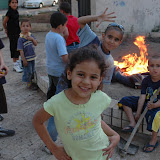
Towards Lag Ba'Omer Ajami's many villa building sites put up extra guards, as Jaffa children, ALL of them, walk around with old shopping carts (and some not so old ones) gathering wood for the their "LagBa'Omer fires": the higher the better and nowhere you find as much wood as on building sites. After the place has been selected, the kids start bringing out the wood they have been gathering (and carefully hiding) for a few weeks. While bringing on more wood, they always leave a kid behind to guard the growing pile from other groups of equally ardent youngsters.
Tonight it's "big fire" night in Ajami.


More images:
Lag_BaOmer


When a brothel goes on fire...

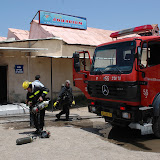
Shivering in spite of the strong midday sun, the clients stand, rather wet, in their underpants. A uniformed policeman takes their details. their ID-cards are still inside. Most of them look very young, in their late teens and early twenties.
The smell of smoke, burnt plastic and soot hangs heavy in the air.
The area is ugly, small industry, second hand car lots, right behind the new regional police headquarters in Salame street.
It was called the "Aquarium Spa", but the business-cards laying around in the mud, around the place leave no doubt, this was no health spa or naive "massage" parlour, but a brothel. The women are no longer there. Perhaps they ran off through a back-door. I hope none are still inside, the firemen enter the place wearing oxigen tanks on their backs and the burn smell, also outside, is overpowering.
The heavily tattooed, Russian looking "manager" (pimp is perhaps a better word, or maybe he was a guard) is being questioned by a policeman. He shouts at me when he notices i shoot his picture. the heavy Russian accent leaves no doubt. He's angry, but realizes he cannot do much, with police and firemen present.

A little further away a white, new Volkswagen with the number 98 613 24. A woman with Slavic features stands next to it. She looks worried, scared, keeps her mouth covered with her hands. It seems she has tears in her eyes, but maybe i am imagining things. She quiet, doesn't say a word.
The clients are worried, their things are still in side. One of them tells his friend he's pissed off, as he paid money, but had not yet received "service". After a while they laugh and ask me to take their picture in front of the fire truck.
A fireman brings a pair of brand new sports shoes outside. A wet flowered underpants wearing teenager picks them up. They are still white and new looking, and wet. The young man is pleased. He looks like any other young guy. Shoulder length hair, a beaded necklace, a kid from "Sheinkin".

No one talks about the true victims, the women.


more images:
Fire


Wednesday, May 2

"Bimkom" Conference in Jaffa

"Bimkom" a non-profit organization of Planners for Planning Rights with the goal of strengthening the connection between human rights and spatial planning in Israel, in cooperation with the Arab Center for Alternative Planning held a two-day conference on civil society's right vis-a-vis the establishment.
The second day of the conference was held in Jaffa at "AlRabita" and dedicated to the fight for affordable housing and against the demolitions and ethnic transfer of the Palestinians from Ajami and Jabaliya neighbourhoods.
As i make it a point never to work on the first of may, happy mayday, by the way, i decided to attend the second day of the conference.
As the demolition problem is urgent, in Jaffa most of us concentrate on the immediate, preveting the close desistaster of ethnic transfer. Yet it truly is important, to pay muoch attention to the larger implications and the long run effects of the activities as well.
What is happening today in Jaffa, is part of a wider tendency, by which extremely wealthy developers and their cronies, all out to make a quick buck, push away very basic human rights, such as affordable housing and sustainable community life. On their way, like a bulldozer, they do away with whathever bothers them even slightly.And they can do so, as they know how to have the law on their side, and if they don't they have enough power to manipulate it to be on their side.
True, Jaffa in general and Ajami and Jabaliyah in specific the problems are more urgent than anywhere else. And it is important to loose every round in the fight to save those neighbourhoods as the Palestinian neighbourhoods they are and have always been.
The fact that the lands and houses were originally Palestinian property taken away from the owners in 1948 by the Israel land administration which then made the owners pay rent for the properties they had been robbed of, makes it al the more horrid.
Yet similar processes take place in Florentin, Kfar Salame and other southern Tel Aviv neighbourhoods: huge office buildings and dwellings for the very rich are being put up at the cost of the inhabitants who are in danger of being kicked out. The developers and investors make tons of money "living of the rent" or making much money by buying and then selling when the price is even better. Thus housing no longer is a need and a right, but a commodity, cynically manipulated for making tons of money by those who already have a lot of it.
The community? The people? Affordable housing? Historic neighbourhoods? Ecology? Who cares. Money, money money...

Architect Busayna Dabit (see image) from Ramle put the discourse in its historical, political, cultural and spatial context, of house demolitions of former Palestinian property in Ramle, Lod and now in Jaffa.
Michael Edwards (UCL, London) provided a description of the very long struggle against developments in the Kings Cross area in London, a struggle which initially was successful in preventing massive developments which would have left the local population homeless as well as destroyed many historical landmarks, yet the war has not yet been won, as a new, only slightly less horrid development plan has been introduced and it has much support from Blair's cronies and much money stands to be made.
Yet, at the same time, the inhabitants of the area have started direct talking with the developers, instead of the discourse being mediated by the establishments' various organizational bodies. An interesting approach, possible, because the their are a few large developers. In Jaffa the situation is different in that respect. Yet to be learned, analysed and adapted in other areas in the country.
Emily Silverman of the Technion described various interesting models of "improving without moving": gentrification without kicking out the original population. Mixed income neighbourhoods as an alternative to gentrifying an slummy but attractive area by kicking out the poor to nowhere. Some of these models might be excellent for Jaffa and i believe suggesting an alternative plan incorporating solutions of this kind, might be a good long term housing and community solution for Ajami and Jabaliyah.
Erez Zafdie emphasized the problematic dynamics happening "below the surface": the colonialist tendencies as well as the ethnic nationalist logic's dynamic interaction with the economic "development" principle. The Israel land authority owns most of the land in Israel since 1948. By using a development logic it serves other needs as well. As these incredibly discriminatory methods are difficult to defend in court, the tactic is carried out through privatization of the development. Thus "community settlements" can defend their racist "admitting committees" etc..

There is no doubt the municipality wants to turn Jaffa's Ajami and Jabaliyah into a Jewish neighbourhoods. In fact, the major refused to use the term "mixed city" and describes Jaffa as a Jewish city with a small other ethnic and religious minority, thereby wiping out Jaffa's proud cultural past and much of its current identity as a Palestinian city.
The question of Jaffa becoming a separate municipality was rightfully raised in this respect.

During the afternoon various practical workshops concerning the fight for a Palestinian Ajami and Jabaliya were held, and the results will be obvious in the field.

images:
"Bimkom" conference in Jaffa


Friday, April 27

No! to demolitions in Ajami and Jabaliyah

Over three thousand people from Jaffa, both Palestinian and Jewish Israelis, peacefully marched together this afternoon in Jaffa's Jabaliya and Ajami neighbourhoods, in order to protest against the demolition of 497 homes of families from Ajami and Jabaliya neighbourhood in Jaffa and the transfer of the people from Jaffa.

Almost 500 families in Jaffa, many of them with several children, are about to become homeless.
Since the onset of the gentrification process in Jaffa's Ajami neighbourhood, more and more Arab families have been served demolition orders or court orders towards the inevitable demolition order of their homes. The very large majority of those families have lived in these homes for all or most of their lives.
In 1948, after the majority of Jaffa's Arab population had been driven out, the small group staying behind were forced into Ajami neighbourhood, behind barbed wire. Their homes were confiscated by the Israel land authority, then rented out by Amidar to the original owners, who had lost their ownership. Amidar didn't bother to care for the houses, in spite of the fact that the inhabitants paid full rent. Nobody really cared very much about Ajami and Jabaliyah, and both neighbourhoods turned into slums, until some years ago, when the wealthy yuppies discovered Ajami and Jabaliyah and the prices started to rise quickly, fantastically....
Jaffa is the new pet project of the developers for the very rich. And if that means the poor and minority will have to be kicked out, that's just fine and dandy with them. The result: over 2000 people are about to become homeless. The municipality will be happy to see them leave to Ramle or Lod, or wherever, they do not really care. Tel Aviv and Jaffa are quickly turning into places for the very wealthy only. Jewish wealthy, that is.

Although the legal fight has led to small successes for some family, the larger principle needs to be dealt with: affordable and decent housing for all is a basic right. People, Jaffa's Palestinian population included, have the RIGHT to live in Jaffa. And to stay there.
This doesn't only imply NOT demolishing their homes, but also ensuring true and good public housing solutions, not in slums, but in all neighbourhoods. No developer should receive a building permit, if not at least 20% of the houses he or she builds will be made available as public housing. No original inhabitants should loose their homes as a result of development.

The demonstration was organised by the public committee, made up out of representatives of several groups in Jaffa: reut sedaka, alrabita, the Jaffa assn for humanitarian assistance and others.
Among the participants and speakers were Esther Saba, whose home in HaLimon street was the first to be demolished (right now the court has cancelled the demolition order), Fadi Shabita of Reut Sedaka, sheikh Anwar Dake (Jaffa Humanitarian Aid), Camal Agbarieh of the Ajami neighbourhood council, Sami AbuShade, Gerardo Leibner (Tel Aviv University's history department) , knesset members Dov Khenin, Ibrahim Zarzur, Yossi Beilin and Ran Cohen, as well as Tel Aviv's deputy mayor Yael Dayan and many others.


Tuesday, April 24

Thamer Nafar Performance Cancelled

Today's planned performance by rapper Thamer Nafar has been cancelled

Monday, April 23

Independence-day/ Remembering the Naqbe:Thamer Nafer in Jaffa Tomorrow

Almost 500 houses are about to be demolished in Jaffa, all of them lived in by Palestinian families.
There is very little to be happy about and definitely nothing that justifies "partying".

So, tomorrow, tuesday April the 24th, instead of partying, Thamer Nafar, the "Dam" rapper from Ramla, will give a performance in "Gan HaShneym" on Yefet street in Jaffa, at 14.00 o'clock.

Sunday, April 22

A Small Victory in the Legal Fight Against the House Demolitions in Jaffa

The Court of Justice cancelled the demolition order against the Saba family today. Lawyer Ibtissam Tanos (who volunteered her services) convinced the court to cancel the demolition order. The court believed it to be unjust to remove the Saba family with their three young children from the home in which the father has lived some 40 years.

Amidar, the housing company, and the the Israel Land Administration were considered to have acted "not in good faith".
Of course this is just a first stage, but the Sabas can sleep quietly tonight.

Demonstration against the transfer from Jaffa

Demonstration against the transfer from Jaffa

Filth on Jaffa's Jabaliya ("Givat Aliya") Beach

The official bathing season opened a few days ago.
A lovely sunny day brought out many to Jaffa's beach yesterday. Families with children, young people around a water pipe, teenage boys with their dogs, scuba divers trying out their material. The atmosphere was relaxed, the sea quiet and the lifeguards enjoying an easy day; no big waves, no dangerous undertow.

The beach, however, is downright filthy. True, the large debris brought in by the storm some weeks ago, has been removed, but the sand is full of...
all kinds on things you do not want to step into or on top of. It's gross. And unhealthy.

Municipality? "Mishlama"? You guys awake? Time to do something! And while talking about the beach, lately there has been a lot of vandalism on the beach and the stairs leading towards the beach. Garbage cans have been broken, bannisters destroyed, graffiti. It looks quite horrid. It would have been nice if all of that had been repaired prior to the onset of the bathing season. But worse, it's also unsafe. A lot of kids go to the beach. Municipality guys, wake up!! Are you waiting until a small child falls through one of the big holes in the fences?


Saturday, April 21

Activities in Jaffa Against the Ethnic Transfer

About 2000 Jaffa inhabitants are about to become homeless. Not 500, as i previously thought in my optimism. 497 home demolition orders have been made, all of them against Arab families form Jaffa's Ajami neighbourhood. All of them against Arab families.
FAMILIES WHO HAVE BEEN LIVING IN THOSE HOUSES FOR GENERATIONS.

There are a number of legal tricks used in the process of the home demolitions.
One of them is making misuse of the "protected inhabitant" law. This law recognizes the second generation (the sons of the previous owner as having a right to continue living in the house, but doesn't say a thing about the third generation, the grand children of the original owner. As a result they are declared "illegal squatters" (although they may have been born in the houses and lived there all their lives).
Another legal trick used, is the negation of the (signed) agreements reached some 12 years ago between the land management authority, the Amidar public housing company and the residents of Ajami.
The result is the same: the poor Palestinian residents are being thrown out in the streets, the wealthy and rich move in. And by being thrown out in the streets, i intend just that: made homeless: 2000 people form Ajami are being made homeless, with no solution in sight.

This coming friday, April the 27th, 2007 at 14.00 o'clock there will be a demonstration against the demolition of 597 houses in Ajami.
The demo will start in Jabaliya ("Givat Aliya), from the "reef" beach, towards the northern wealthy neighbourhoods. From there to the Arab Jewish Community Center where there will be a meeting.

On the May the 1st (labor day) a conference concerning housing issues will beheld, to discuss viable housing solution which will not lead to slummification. Details later

Wednesday, April 18

Jaffa Harbor Destruction

Sometime, between 5000 - 4000 years ago, people settled down in the Jaffa harbour area. A natural harbour, protected by rock formations against high storm waves and any enemy not acquainted with its tricky entrance. It was a logical choice, for people using stone and later bronze tools. There were sweet water sources, the soil was excellent for fruit trees and flowers. The sea, at that time, had plenty of fish.
The small village developed into an affluent city, by then known as Ya-pu, ruled by the Egyptians. The Ya-pu tax records were found in the Tel AlAmarna excavations and indicate the citizens were wealthy enough to pay a lot of tax. Then came the Philistines, the Hebrew kings for a few years, the Greek, the Romans, the Mameluks, the crusaders, the Turks, the French, the Brits and today, the state of Israel.
Jaffa is reported to be the oldest continually inhabited harbour city in the world.
The harbor was its major source of income for many centuries.
However, with the arrival of the tall steamships, the harbour started to loose much of its commercial attraction: the ships were too big to fit in, and the natural rock formations which had always proteced Jaffa, now were an obstacle. Newer, much deeper harbours were constructed elsewhere, and the Jaffa harbor became a fishermen & small boats harbour. In over the years 1947-1948 the majority of Jaffa's Palestinian population were forced to leave and the harbour became a shadow of its former self.
The city, which had been a cultural centre for the country's Palestinian population, started to loose much of its former splendour.
It kept many of its old characteristics, but "The Bride of the Sea" had become tired.

The municipality intends to develop the harbour area into a sort of pleasure & tourist area, with restaurants, clubs, a large parking place, a hotel etc. Some of the buildings will be restored, but the majority are being demolished.
I have used the old warehouses several times as a backdrop for photographs, never ever thinking that i would see their destruction.
Another piece of Palestinian Jaffa is being erased.
The municipality is proud of its developments in Jaffa. To me, the ongoing gentrification process simply means one thing: kicking out Jaffa's people, erasing its proud Palestinian past.

Thursday, April 5

Tel Aviv's Dan Bus-cooperative on a fairly wild strike

Dan bus drivers went on a sort-of-wild-strike today. The cooperative's members are quite well paid, but the employed non-member drivers rather less so. As a result, some of the drivers went on strike today, completely stopping parts of the city's public transport. The drivers blocked the entrance and exit lanes of the "Carmel" Bus Depot, next to Tel Aviv's market.
As a result, public transport to all of the city and neighbouring suburbs was badly damaged. More than that, Egged buses, running from the same station, were blocked from leaving, while packed with commuters who selected to drive "Egged" rather than their regular "Dan" buses in an attempt to get home with heavy bags full of produce bought at the market or from work. The strike had not been pronounced officially and as a result many people waited for hours on over loaded bus stops, speculating why things took so long.
I do have a lot of understanding for the position of the employed drivers, however, going on a wild strike is sort of, well, counter productive, as the people who might be their best allies, were incredibly pissed off. Getting stuck with heavy bags of food and not enough money for a taxi on such a hot "khamsin" day, does do very little for sympathy.
The Egged busdrivers who picked up commuters and rode rather wild escape outes to get out of the blocked bus station, were considered the true heros by many of the public.


Sunday, April 1

Icecream Muggers

Jaffa counts 4 major ice cream parlours: Andre's (142 Yefet Street), Dr. Lek (Goldman street), the original "Glida Mastik" on Jerusalem Boulevard (Nouzha, for old-timers) and "Victory" (at the corner of Yefet and Yehuda Merguza street), presented here in strictly alphabetical order.
Each ice cream parlour has its aficionados convinced of the absolute superiority of "their" parlour above all the others and i will not risk loosing my already doubtful reputation by professing to prefer one over the other. Let it be said that i occasionally consume ice cream from all 4.
All four are known to to great business with rows of people waiting on the side walk to have their orders filled, especially during the weekend and the evening hours.

Last night late however, robbers threatened the Dr. Lek counter guys with a knife and got away with the lot of money, profit of Saturday's business.